

12 Ways To Divide An Open Concept Home For A More Stylish, Peaceful Layout
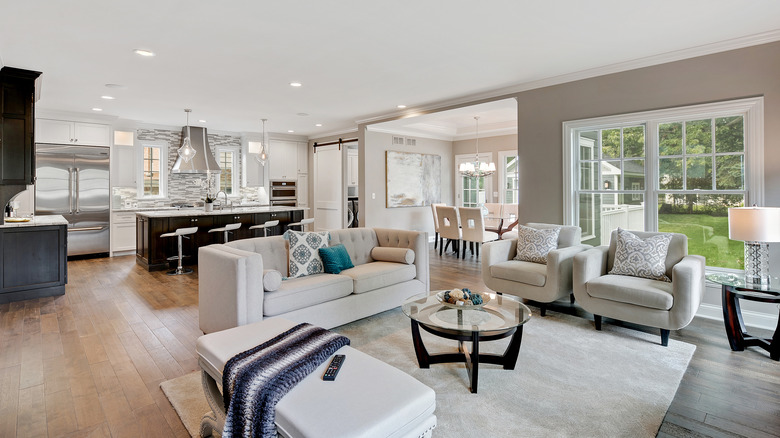
Anyone who's watched even one episode of HGTV's "House Hunters" understands just how desirable an open concept home once was. While the occasional home buyer detailed their wish for cozily defined spaces on the long-running series, a much more common refrain was the inquiry, "Is this wall load-bearing?" But much like other once-ubiquitous home trends (we're looking at you, all-white kitchens), the draw of one large space has begun to wane.
Though "Property Brothers" star Jonathan Scott noted in a YouTube Q&A last year, "I don't think you're going to have fully compartmentalized houses like they did in the past," he also acknowledged just how many homeowners were no longer infatuated with all those wide-open spaces. While people still appreciate a sense of flow from room to room, they're increasingly drawn to the increased privacy and decreased noise of a more closed-off kitchen, living, and dining area. And if you're among those hoping to let the walls close in a bit, you don't necessarily need to hunt down a contractor. There are plenty of ways to create cozy reading nooks or closed-off dining quarters that don't involve building up walls. So, before you Google "how to put up drywall," consider these easier-to-accomplish options. From strategic furniture placement to creative flooring tweaks, there are several ways you can close that loop.
Being thoughtful about furniture placement creates defined spaces
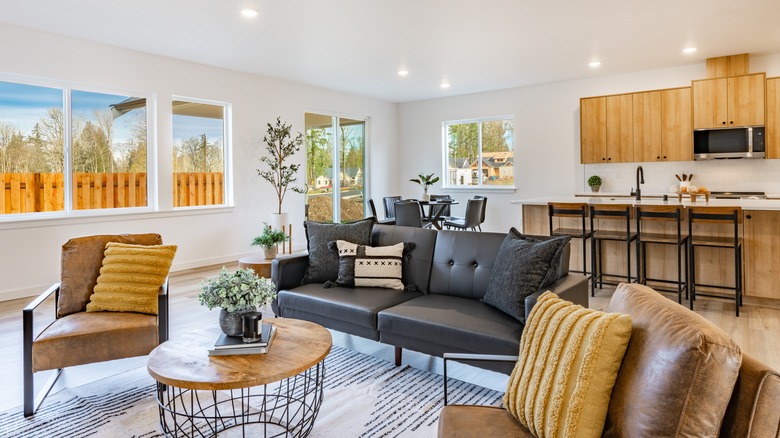
Yes, it's possible to create rooms within your open concept layout without touching a hammer or a single plank of wood. Allow us to make the case for a bit of strategic furniture placement. It may seem as if your sofa or sectional belongs against the biggest wall. But if you shift it into the center of the room, add a console table, sideboard, or buffet behind it, and a chair or two on each side, you suddenly have a seating area that feels quite separate from the kitchen and dining space.
And not only do the options abound when it comes to rearranging your furnishings, but it's something you can change up in an afternoon as long as you have a set of extra hands. Another way to make your dining space stand out in an open floor plan requires even less manual labor. Using peel-and-stick wallpaper — or even a particularly bold shade of paint — can create a literal border around your dining area that visually separates it from the rest of the room.
Utilize built-in furniture to stylishly earmark rooms
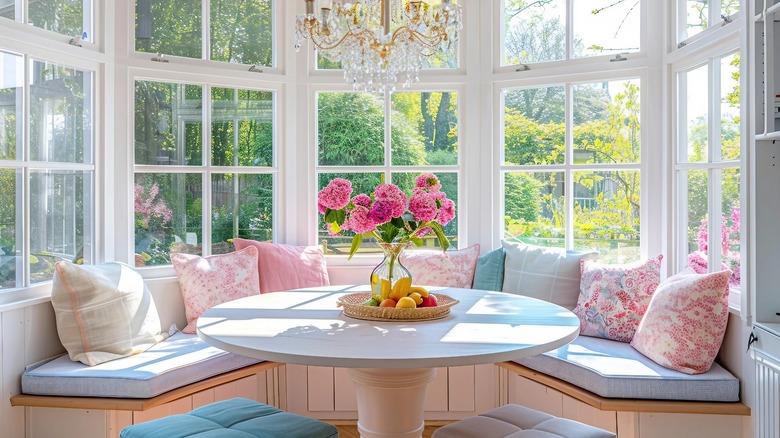
Charming built-in bookshelves — ideal for cosplaying as Belle from "Beauty and the Beast" and clearly delineating the square footage that makes up your living room — can do the trick. That type of shelving, or pieces like a built-in window bench, function similarly to other furniture pieces. But because they're a more permanent part of your home's design, the look feels more intentional, giving your space a cohesive feel. Similarly, a built-in banquette is a smart way to clearly signal a dining space — and it offers a more streamlined vibe than a clunky table and chairs.
And if you're not lucky enough to already have the retro design trend in place, there's a budget-friendly way to easily DIY banquette seating. Clocking in at roughly $8 to $18 per board, tongue-and-groove wall paneling allows you to create inexpensive bench seating that appears as if it were built into the wall. The project involves mounting plywood boards directly to your wall and installing the tongue-and-groove paneling on top. Then, once you've built the seating out of plywood and some 2-by-4s, you have a bench that feels bespoke while still staying on budget.
Privacy screens offer a temporary fix

The OG room divider, folding screens have long provided privacy for roommates in cramped, shared spaces. And they can function similarly in your open concept floor plan. Not only are they an affordable solution for those looking for a little separation, but they can also be easily stowed when you'd prefer more wide-open spaces. You've just got to, uh, know when to hold 'em, know when to fold 'em.
Whether you opt for something simple or get one with decorative panels that operate more as a piece of art, they can be placed anywhere in the room and easily moved. Consider this boho-chic style rattan option from West Elm for an elevated mid-century modern vibe. Or opt for Leesinwing's four-panel pegboard piece that doubles as a spot to hang bags, jewelry, or blankets. No matter which style you select, dress it up with plants, string lights, or artwork for a statement piece that feels both fashionable and functional.
Use tall plants as room dividers

Allow us to plant an idea in your head: greenery is an ideal way to break up an outdated open floor plan. Not only can a tall plant create separation between, say, your entertaining space and your dining area, but studies show that adding all manner of flora to your home can reduce stress levels, boost productivity, and improve the air quality.
Ready to dig in? You'll want to take the size of your space into account. In a smaller room, one or two large houseplants can do the trick. Just opt for something with large leaves like a monstera, elephant ear plant, banana leaf, or fiddle-leaf fig. If you have more space to work with, consider using a planter box that can be filled with tall greenery such as a rubber plant, snake plant, or dragon tree. And if floor space is at a premium, you can still hang with this trend by using hooks, brackets, or tension rods to create a suspended living wall.
Open shelving serves as a divider and extra storage

If you're looking for something a bit more sizable than a console table but privacy screens aren't really your thing, try, uh, shelving the issue. With the ability to provide separation while still allowing light and air to flow through, "bookshelves aren't just for books," designer Michael Helwig of Michael Helwig Interiors shared on his blog. "They can also be a stylish room divider, especially if they are designed to be freestanding and open on both sides."
And while you can absolutely fill up those nooks with your to-be read stack, consider pairing an affordable unit — like IKEA's Kallax line — with a set of baskets or bins. Designed for their shelves, IKEA's Lustigkurre water hyacinth and seagrass baskets are open enough for you to see what's inside while still concealing all manner of miscellany. Used near the kitchen, they can hold your pots, pans, Tupperware, or small appliances. And in your foyer or entryway, they're an ideal landing spot for shoes, bags, gloves, and other accessories.
Use wooden partitions as makeshift walls
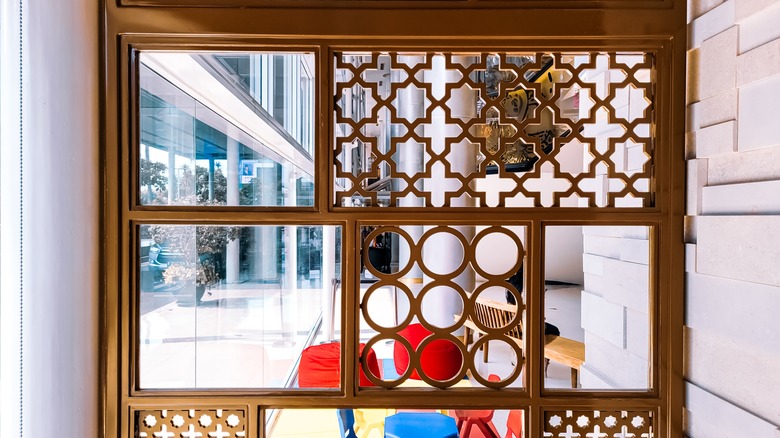
Get the look of a barn door but maintain that flexibility by lifting this stunning design idea from Joanna Gaines. In Episode 5, Season 5, of "Fixer Upper," the queen of farmhouse style used a pair of wood partitions to separate the kitchen and dining space from the living room. While requiring less work to install than a full wall, the hanging panels help enclose the space, with Gaines raving about the "warm wood accents and modern details." She used a similar set of wood screens to add privacy to a loft space she created on "Fixer Upper: The Lakehouse."
Architecturally pleasing, it's a solution that can be entirely custom when you buy something like ERRULAN's wooden-screen partition. At just over 11 inches by 11 inches, the pieces can be put together to create any-size wall you'd prefer. And while you'll need to channel a bit of that DIY spirit, they can be installed using a drill and a few hooks.
A simple set of curtains can help you hide unsightly messes
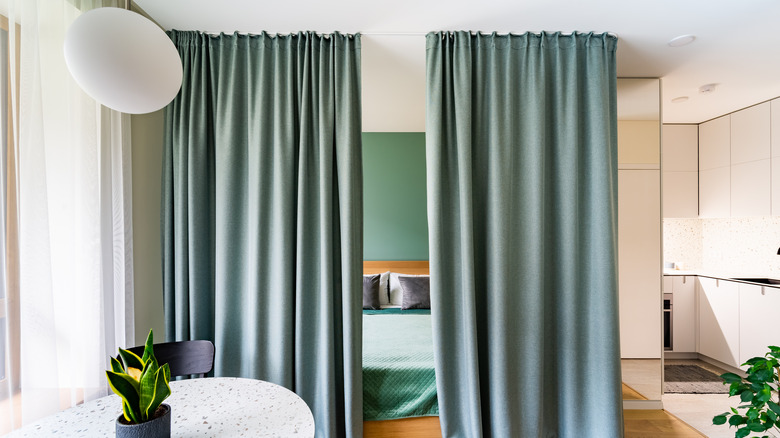
Curtains, they're not just for window treatments anymore. As designer Dane Austin explained to House Beautiful, they're the perfect recipe for covering up any messy situations while allowing that wide-open flow when you want it. "I love the privacy it gives you, especially in the evening after a large party, when people are winding down," he explained. "It's like: We can get to the dishes tomorrow." Interior designer Max Sinsteden employed a similar strategy to hide away the bed in his studio, even suspending a large piece of artwork to hang in front of it. "I hate seeing a bed from the front door, so I added a curtain to partition that space," he noted. "When you close it, you honestly feel like you're in a Parisian hotel."
If you'd like to say "oui" to the savvy solution, you'll want to consider the benefits of using plain or patterned curtains in your space. While a solid hue is certainly a timeless option, a floral, geometric, or other type of pattern can inject some personality. As Jennifer Jones, principal designer at Niche Interiors, told House Digest, "Patterned curtains add interest and depth to a room, creating a more layered and collected feel."
Building a block wall creates a real conversation piece
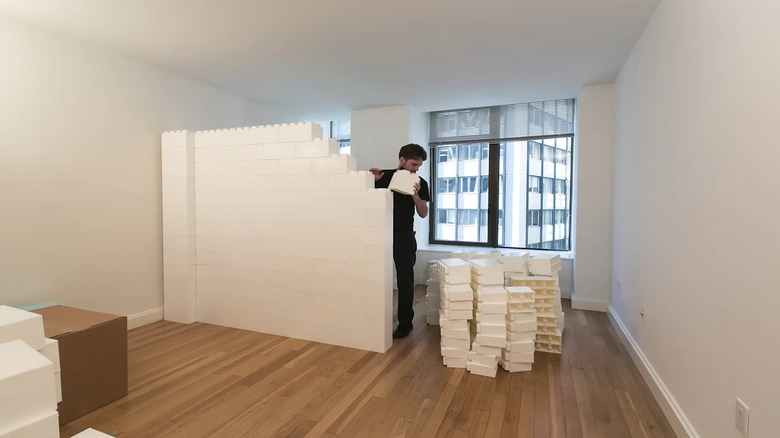
If you spent your childhood pawing through boxes of LEGOS, this may be the ideal design solution for you. Functioning similarly to the building blocks you once used as a kid (or an adult, no judgment!), EverBlocks snap together to create a partition wall. And since they're available in a range of colors, you can even create a unique design by using various shades.
Though you'll want to consider a few aspects before building with the giant LEGO-style blocks of your dreams. While they're a modular option, giving you the flexibility to move things around when necessary, their thicker size means they take up more space than a traditional wall. They can also be on the costlier side, ranging from $3.90 to $7.90 per piece, with kits starting around $1,200.
Rely on different area rugs to create zones
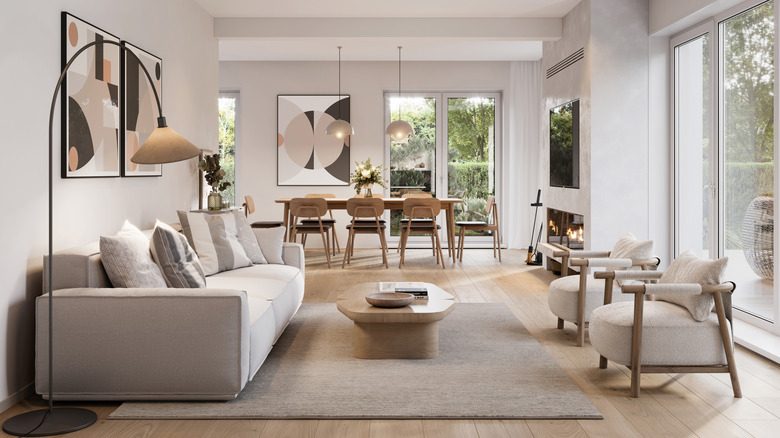
An easy way to ground different areas in one big open space is by using various area rugs. To differentiate each zone, you'll want to choose flooring in different colors, textures, and styles, while ensuring that each piece still complements the others. With a slew of colors, materials, and piles to choose from, picking the right rug for your space can feel intimidating. So try to stick to these dos and don'ts of styling rugs.
In addition to thinking about size and placement — in a living room, for instance, you'll want the front legs of your sofa to comfortably sit atop your rug — you'll also need to consider durability. While delightfully cushy underneath, a high-pile pick is not ideal for a high-traffic area. But when it comes to styling, nearly anything goes. As you play with colors, patterns, and textures, design historian Sarah Bilotta suggested to House Digest, "A great way to determine this is to buy swatches and place them next to each other, then mix and match until you find a combination that feels right."
Ceiling beams can visually separate one area from the next
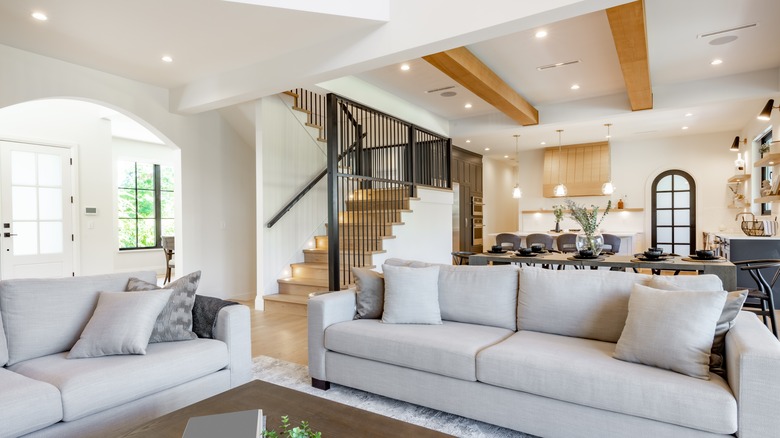
For the next trick of the eye, we're going up, up, up. While hanging pendants, chandeliers, and other types of lighting can help visually separate one area from the next, there's an even more dramatic option. "To create a sense of separation while keeping the spaces open, I'll often drop a beam from the ceiling at the edge of the room," William J. Hirsch Jr., an architect and author of "Designing Your Perfect House," told Realtor.com. "But any kind of ceiling detail will define the edges of the spaces."
And there's no need to dig deep and find your inner carpenter to try out the trendy solution. There's a simple way to DIY faux beams for an upgraded ceiling makeover. With this trick, you get the appearance of exposed reclaimed wood beams without the price tag or having to worry about whether your ceiling can support them. You'll just need three wood beams, glue, nails, and paint or stain to achieve your desired aesthetic.
Glass partitions wall off some space while still letting the light in
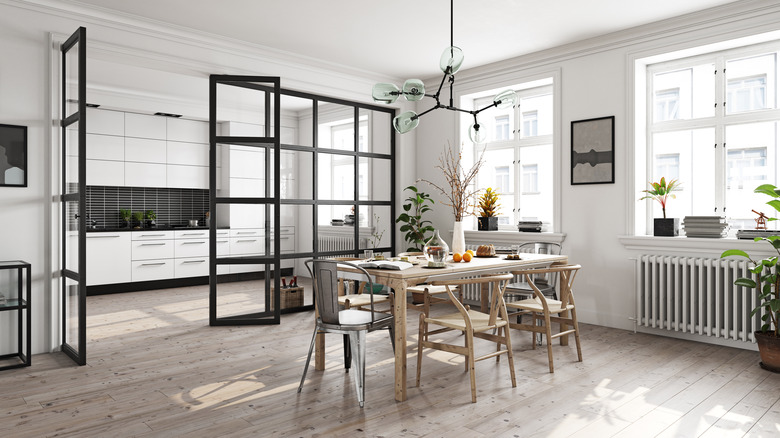
The upside of adding a window wall is fairly transparent: by creating a literal wall, they delineate the space from one area to the next. They can also cut down on the noise from room to room while still allowing light to shine through, leaving the space feeling bright and airy. It's a strategy Gaines employed in Season 1, Episode 4, of "Fixer Upper: Welcome Home," installing a window with bold, black framing. It's a solution that not only looks great, but provides sight lines into various areas while still offering privacy.
Having a window into a playroom or being able to look out from a home office is a great way to keep tabs on everything. It's admittedly a pricier solution, coming in at $5,000 on average. If you can find the option that works for you — like this set of sliding doors from Wayfair — and stay on top of the cleaning, you can strike the right balance between spacious open concept and cozy defined spaces.
A butler's pantry allows you to hide the mess

Love an open floor plan, but hate having your messy kitchen on display? A butler's pantry could provide the right recipe. As the name suggests, these oversized pantries were once a spot where a literal butler could keep tabs on the home's china and supervise dinner party prep. Now, they function as an extension of the kitchen, allowing you to make a mess in one area and sip wine with friends in another. Although it does require a bit of construction know-how (or the name of a solid contractor), putting up walls lets you place a buffer between your guests and the mess you created while preparing for their arrival.
It's a solution that comes with a higher price tag, with the cost of building a butler's pantry starting at roughly $2,000. But it's a renovation that will undoubtedly add value to your home. If you already have an existing pantry, you can transform it into a butler's pantry with a few simple renovations. And handier types can create a DIY version that will provide extra kitchen storage.