

Avoid Getting Plowed Into Your Driveway With A Clever Snow Shoveling Trick
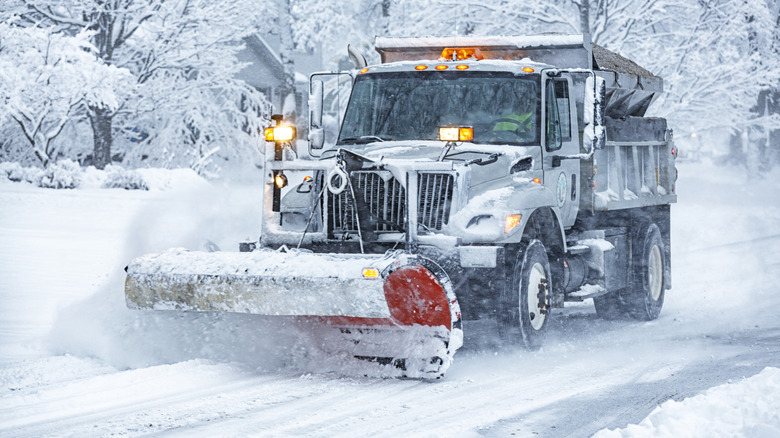
Last night's dumping of snow has you thinking of telling the boss you won't be in today. But wait, the thundering, scraping sound of a plow is coming down the road to liberate you and your car from winter's grip (yay...). Resignedly, you head for your car just as you realize the plow has deposited an impassable wall of snow right at the end of your driveway. Looks like you'll be working from home after all!
This scenario is a lovely excuse to work remotely for the day, but there are many times when getting plowed into your driveway puts a major damper on your schedule. One of the handiest hacks to take care of snow left by plows comes down to a shoveling technique that can prevent the entire situation. The trick involves shoveling an extra 10-foot swath to the left of your driveway, parallel to the road. When the plow passes, the snow on the blade that would normally be pushed into the empty space at the end of your driveway will collect here instead, leaving you a clearer path so your car can enter and exit.
The method is commonly shared by city officials and news outlets in areas with high snowfall, and although many doubt that it would save a homeowner any work, it boils down to timing. Yes, you'll be removing the same amount of snow, but if you shovel both your driveway and this spot ahead of time, you could avoid being plowed in later when you are pressed for time. While it's not a fail-proof practice, it definitely worth a try if conditions are right.
Best ways to use this shoveling hack before the plow arrives
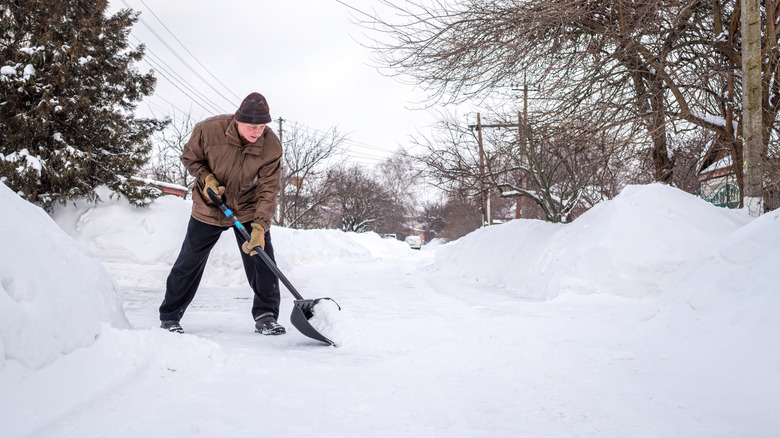
Carving out a "snow pocket" to collect plow-spills is a potential stress-buster for rushed snowy mornings. However, this trick is only possible if you have the space, and that might not be feasible if your home is right next to your neighbor's. There are high-density neighborhoods that don't leave 10 feet between your home's driveway and your neighbor's. If this preventative measure entails shoveling onto your neighbors' property, you should only do this if your neighbor gives you the thumbs up.
It helps to try this strategy when there isn't a thick layer of snow already on the ground. In many cases, the best time to shovel snow for easier removal is in the morning or after 2 to 4 inches has fallen. Shovel a few times as needed in an extended snowstorm, and expect to pick the shovel up again once it has stopped. That's not the most welcome news, but removing smaller amounts in multiple goes will save your body a bit of heavy lifting and prevent snow from compacting to some extent. Keep in mind that giving yourself that extra 10 feet of clearance may not be effective in certain areas that regularly see lots of accumulation without much melting between snowfalls. If you live on narrow streets where plows may come from either direction, this also isn't as practical, as you'd have to remove snow on both side of the drive.