

Must-Know Advice For Keeping Bolts And Nuts Organized
We may receive a commission on purchases made from links.
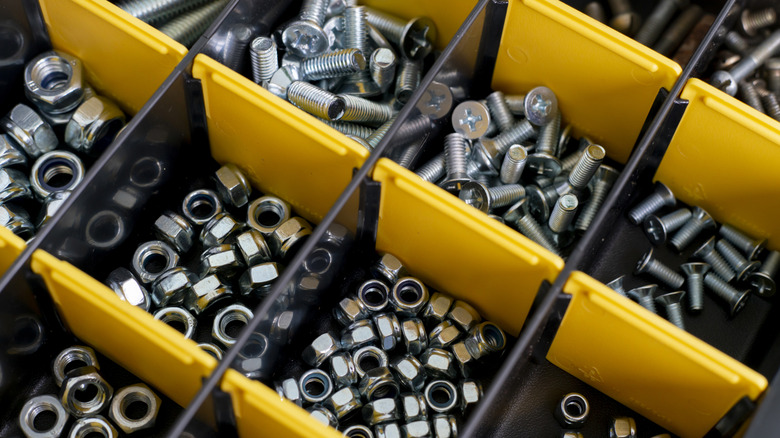
Having a workspace that's unorganized can add a significant amount of time to your projects, cause you to repurchase items you might already own, and interrupt your workflow. Think about it — fumbling around for a specific tool takes time, and after rooting through all of your drawers, cabinets, and piles of materials to no avail, it makes logical sense to just purchase another of the same item and assume the original was lost. If you want to complete your builds and DIYs as efficiently as possible, a little order goes a long way, especially when it comes to small, fiddly items like nuts and bolts. Keeping them separated by size and shape can significantly cut down the amount of effort you have to spend digging around in a messy drawer for the perfect part, especially when everything is the same color and looks similar across the board.
While any amount of organization is a step up from tossing your nuts and bolts into a drawer or jar, there are some simple considerations that you can make that will guarantee that your organizational system is helpful in your particular situation. Shopping around for an organizer specifically designed for nuts and bolts, investing in a drawer system, labeling your sections, and looking for a product with sturdy construction and a lid are all great ways to help you maintain your sanity in your workshop. Who knows, you might even be inspired by this relatively small project and decide to declutter and organize your entire garage tool kit like a pro.
Find an organizer specifically meant for nuts and bolts
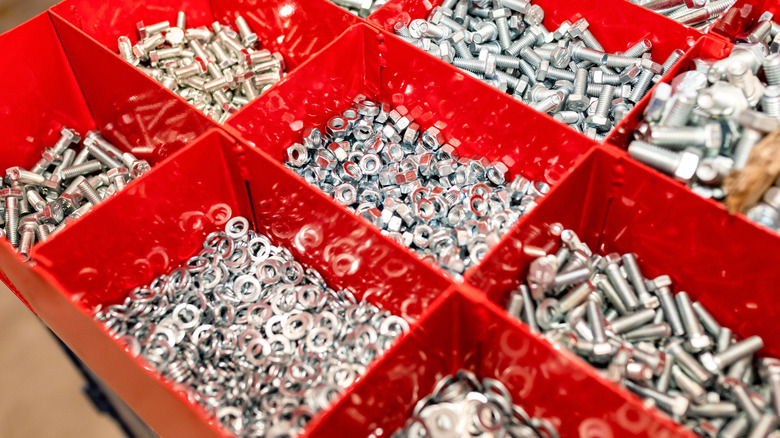
While any organizer is better than nothing, a product specifically designed to hold nuts and bolts is almost always going to be the easiest to use to sort and maintain your small parts. These organizers are already divided into sections that are the correct size and depth for what you need. Too small, and you'll only be able to hold a couple of items; too large, and you'll have to either create your own dividers or let the extra space go to waste. It's a bit of a Goldilocks situation, and products from tool brands like this Craftsman Storage Organizer usually strike the right balance because the home improvement industry generally knows what its customers are looking for.
That said, it is possible to repurpose other organizers in a pinch. Nuts and bolts are fairly small items, so look for organizers that are made for things that are a similar size. Reuse that old tackle box, repurpose a drawer organizer, or give new life to those plastic drawers you used to use for bathroom storage — extra points if they're clear, as transparency helps with quick identification. Just make sure you don't use anything that has sections that are too large for your needs. It can be tempting to want to fill every area of an organizer, but as soon as you start putting multiple sizes of nuts and bolts in one section, you're creating another issue for yourself.
Try out a drawer system
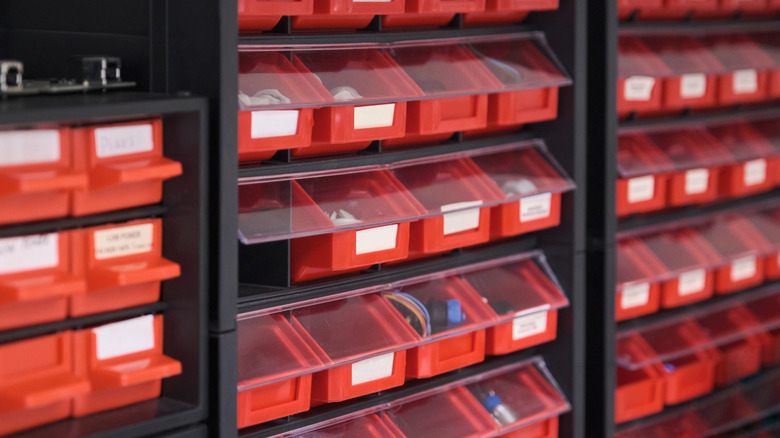
If you almost always work in the same area, consider trying out a drawer system to organize your nuts and bolts. Items like the IRIS USA Screw Tool Organizer Small Parts Cabinet are perfect for clearly separating your hardware and can easily sit on your workbench or be mounted on the wall. They don't have to be used just for your nuts and bolts, either — if there are enough drawers, you can also use these organizers for screws, anchors, drill bits, washers, rubber bands, batteries, extra parts, small tools, and just about anything else that can get easily lost in your workspace.
The only downside to drawer systems is that they're not very easy to transport. If you need to bring your hardware to and from the job site, clients' homes, or even just into your own house, it might be better to stick with a toolbox-style organizer with an attached lid and handle. These organizers are usually smaller because they're designed for portability, so you could also set up a larger drawer system at home and buy a smaller organizer to use when you're out and about, so you have both options.
Label your sections
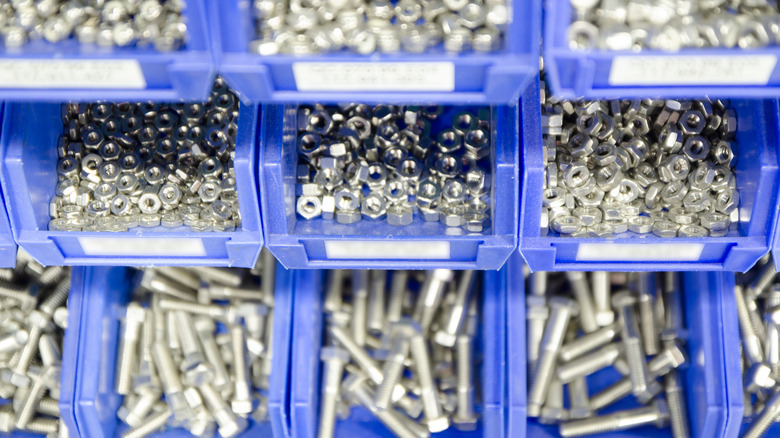
If there's one thing to take away from this, it's that you should label your organizers. Sure, it's nice to have your hardware neatly divided into sections, but if you're not sure exactly what size each nut or bolt is, you'll still have to either measure it or try it by trial and error to determine whether it's the right fit. This can be even more frustrating if your organizer isn't clear — do you really want to have to open every drawer or bin to find what you're looking for? Some simple labeling (whether it's a nut or bolt, what size, and what length) will go a long way in making your system actually functional for you, especially when you're dealing with a large collection of similar-looking items.
If you don't want to spend any extra money and you're okay with your organizer looking slightly imperfect, all you need is some masking tape and a permanent marker to create your labels. If you're going for consistency, however, you can purchase a label maker like the Nelko Label Maker Machine with Tape for less than $20. The uses don't stop there, either — there are plenty of genius ways to use a label maker around your house that will ensure you get your money's worth out of this product.
Keep your most-used items accessible
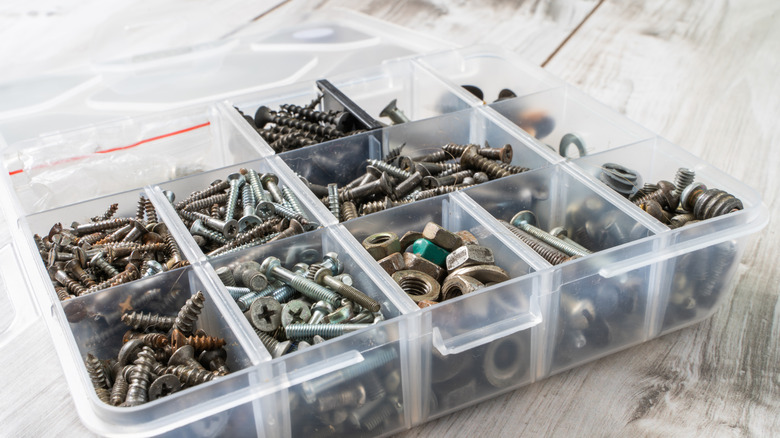
Not every fastener you have on hand will be used for every project. Naturally, you'll reach for some more than others. To ensure your organizational system is functional and useful, keep your most-used nuts and bolts front and center. This way, they'll be easy to grab without interrupting your workflow. Lesser-used hardware, like hyper-specific fasteners for particular branded items or that come as part of a kit, can be stowed away in less accessible sections.
To streamline your workflow even more, consider also sorting your nuts and bolts by project or project type. If you frequently work on cars and build furniture, there's no reason to keep your fasteners for both of these kinds of projects in the same organizer. Split them up if it's more convenient for you. If you're working on a particularly involved project, consider keeping all your nuts and bolts for that in a separate container rather than mixing them with your supplies from past projects. How you organize will, of course, depend on your specific situation, but these tips can help ensure that your workspace looks less cluttered, your workflow is streamlined, and you can find exactly what you need as soon as you need it.