

How To Choose The Best Base For Pavers For Your Home

You probably heard it right, but just didn't believe it. That is, when you were calling around about getting a paver patio installed and the installer said something like, "You can get by with three-quarter minus and concrete sand, plus the geotextile, but I'll steer you away from quarter-ten." What they're talking about is the layers of rock that are used beneath pavers. The other thing they're revealing is that hardscaping professionals can be almost impossible to understand. All you asked was what you should put under your pavers to improve drainage, stability, and the ability to bear loads. It's enough to drive a DIYer to ignore the risks of laying patio pavers directly on dirt and just toss them on the ground without ever finding out the actual ideal base for your layout.
Here's the simplest answer: If your budget is small or inflexible, a traditional base might be the best choice. If you live in an area with very cold winters or require extra drainage (including permeable pavers), you might need an open-graded base. Smaller on-grade installations that don't require extra drainage might benefit from a synthetic base.
Of course, it can be a little more complicated than that, so let's take a step back. A paver base usually includes a base layer of either ¾- or 1-inch crushed stone (with or without finer particles) to provide support and stability and a bedding layer of concrete sand or small stone (high-performance bedding, aka HPB) to level and hold your pavers in place. Synthetic paver bases are large interlocking panels that require less excavation and are best for small areas with only foot traffic.
How to choose the right paver base
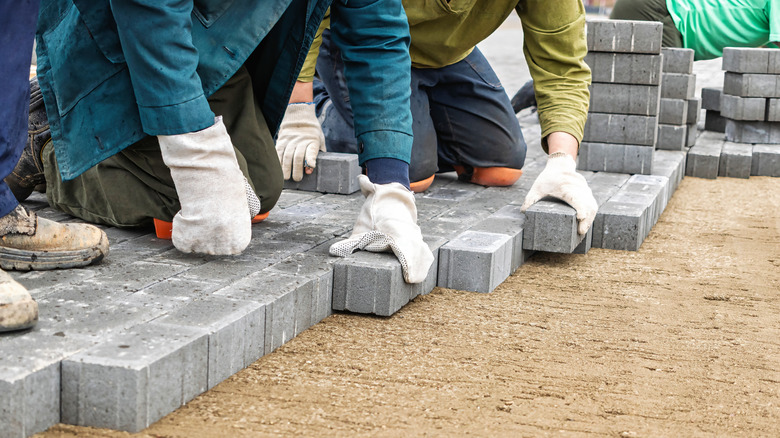
These three basic ways to prepare a paver base (synthetic, traditional, and open-graded) cover most situations. These methods describe base and bedding layers, and all assume a compacted subsoil at the bottom. Synthetic bases like Brock panels can simplify your paver installation and are far more efficient, requiring less than half of the usual excavation and only needing a layer of concrete sand. But they're also more limited in that they can only be used on existing grades, for pedestrian traffic, and for surfaces that don't tie into other paved areas.
The traditional paver base includes a layer of ¾-inch angular crushed stone (less for walkways, more for driveways) down to fine — also known as "¾ minus," meaning it also contains smaller rock particles — and a 1-inch layer of concrete sand. In this method, the base layer's larger rocks supply structure while the finer particles bind the whole thing together. Traditional base materials tend to be readily available and less expensive. It's also stable, durable, capable of bearing heavy loads, and able to provide good drainage.
Open-graded bases are made with ¾- or 1-inch angular crushed stone without fines (smaller particles) and use an HPB bedding layer that's also without fines. Open-graded bases can handle freeze-thaw cycles, won't suffer from fines washout, and are prone to harboring fewer insects and weeds. They're easy to install, work for non-permeable pavers, and are required for permeable pavers. They drain well and prevent water accumulation, so are ideal for areas with heavy rainfall. The bedding layer material might be expensive or difficult to find, though.
Considering the other big factors
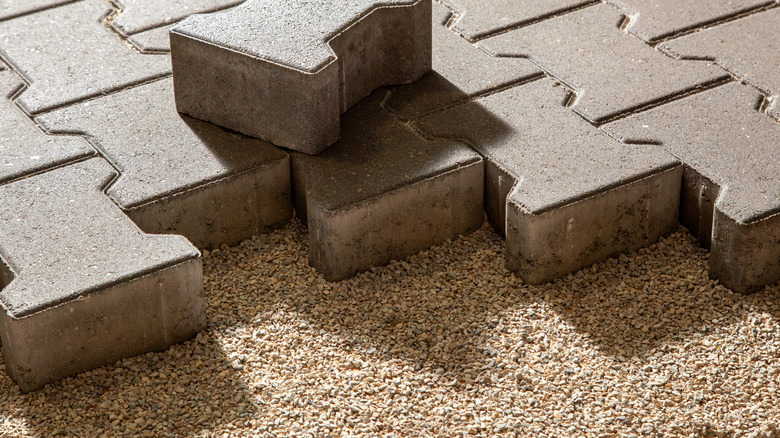
So far, you basically have a choice among synthetics, bases with fines, and clean stone (that is, without fines). There are a whole host of other considerations that can affect your choice, like maintenance requirements, your climate, your soil type, the type of traffic your pavers will experience, the depth of the base you need (assuming it's not synthetic), the thickness that's required below grade, and the costs of the materials in various quantities. Many of these factors are figured into cost; especially the depth of your base. A 4-inch-thick, 100-square-foot base requires about 2 tons of gravel, so it adds up quickly, especially when your pavers need to handle vehicle traffic. Soil type also informs your base depth, with clay soil requiring substantially more excavation.
And then comes weather and climate, which has a huge impact on base material choice. Cold areas need deeper excavation — as much as 12 inches — to cope with frost heaves. Since the traditional base of ¾ minus and concrete sand is sensitive to weather conditions like freeze-thaw cycles, you tend to find that combination in warmer areas whereas clean-stone combinations like open-graded bases are more popular in colder climates. Hybrid bases with ¾ minus under HPB is sometimes used, but it's not tolerant of frost-heaving either. And since it might entail additional expense due to the HPB, hybrids might not be worth considering. This might all lead you to conclude that synthetic paver base panels are a better choice than gravel for your project.