

Moisture Vs. Poor Airflow: How To Tell Which One Is Making Your Basement Smell Musty

If you have a basement with that distinct musty smell and hope to fix it with a fan or by opening a window, there's bad news. Moving air around might temporarily eliminate the odor, but it will return shortly after you turn that fan off or close the window. The reason is that musty odors are usually associated with mold, and always associated with moisture.
It's not uncommon for basements to be damp, of course, but if you believe your basement is perfectly dry, yet you still smell mustiness, you probably haven't looked closely enough. Water ingress can involve a flood, but it can also be an insidious affair that keeps to hidden or out-of-the-way areas and only reveals itself indirectly: a musty smell, for example. One common symptom of an overly wet basement is fogged windows, and therein lies a hint at one of moisture's favorite hiding places — the air. If the air in your basement is humid beyond around 60%, you have an environment primed for mold growth and musty smells.
While it's possible that high humidity is the only source of moisture in your basement, it's extremely unlikely in a modern, climate-controlled home. Be on the lookout for the signs that your basement is full of mold or hidden water incursion: damp patches, condensation, and efflorescence, a white, powdery residue left on porous materials (often masonry) by moisture that leaves salt deposits on their surfaces. Once you've identified the symptoms of moisture ingress, you're well on your way to identifying the causes — these might include foundation cracks, poor landscape drainage, problems with gutters, and many others.
What causes musty basement odors

Smells we describe as musty almost always circle back around to mold, in one form or another. It might be dismissively described as "mildew" or alarmingly as "decay," but these are distinctions without a difference. Mold and mildew are the same thing at different levels of severity. "Mildew" is often used to refer to the ambient, low-level moldiness of any damp area in regions like the American South. And structural decay or rot is mold — or, more precisely, the activity of mold fungi breaking down materials like wood and paper — so the smells obviously overlap a lot.
There are lots of potential sources of unpleasant smells in basements ... usually bioaerosols from bacteria, mites, pollen, and the like, and volatile compounds from a number of sources ranging from sewage to radon. Some mVOCs cause sulfurous, sour, or even fruity smells. Musty smells are typically caused by microbial volatile organic compounds (mVOCs) produced by mold or, occasionally, by Streptomyces, a genus of bacteria that contributes to the "earthy" smell of a rain shower or a damp storage space. (Interestingly, Streptomyces is a filamentous, spore-producing microorganism that can indicate water intrusion in a building, but it's not a mold, but rather a genus of bacteria that mimic many characteristics of mold.)
Of course, what you're usually dealing with is mold and is, in any event, moisture-related. You'll find mold in dark, damp areas where you store organic materials like textiles and wood- or paper-based materials (think cardboard). And another thing mold-friendly areas tend to have in common is poor airflow.
The problem to fix is always both ... and then some
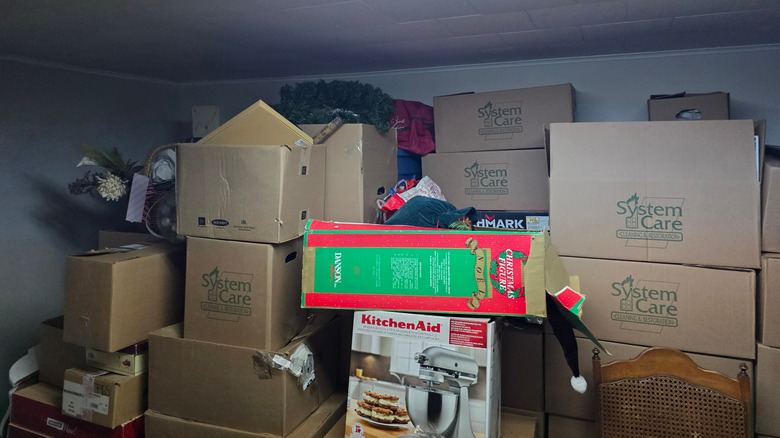
Dealing with musty odors, then, is primarily a matter of dealing with moisture ... and usually with airflow as well. The solution to a musty basement is a regimen that includes removing sources of moisture and humidity; improving ventilation; cleaning surfaces that might harbor mold; and removing or protecting organic materials within the affected area.
The steps required to prevent moisture, of course, depend on the cause of the moisture. You might need to seal foundation cracks, insulate pipes, or add a vpor barrier to walls,, but you could also need to improve the direction of downspouts away from your foundation or clean and repair your gutters, which can overflow and direct water into your walls or against your foundation. Measures might even include improving landscape drainage, adding a perimeter drain or drain tile system, or even installing a sump pump. And don't forget to safely dehumidify your basement to combat moisture and mold, which might require the installation of a dehumidifier. Sometimes it's sufficient to improve air movement by the use of circulation fans, open windows and doors, exhaust fans, or the air-exchange function of your HVAC system.
Once you've dealt with the moisture, it's time to clean all surfaces that might harbor mold with a mold-killing solution like bleach water or a mold-killing and -preventing product like Concrobium. This means attaking walls, floors, carpets, and upholstery, and removing materials that can't be cleaned or are likely to foster future mold growth (again, think cardboard). And don't forget to clean structural elements like floor joists that also require mold removal.