

How To Prune Your Poinsettia Plant To Encourage More Beautiful Blooms
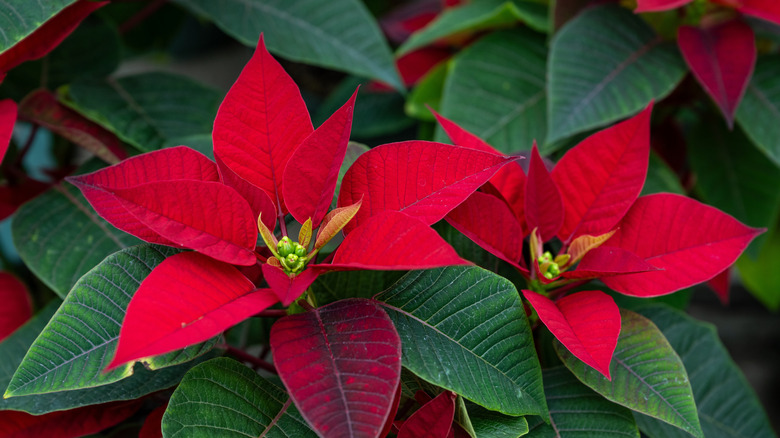
When you're preparing for the winter season with some traditional decorating, you might be looking for simple ways to incorporate the poinsettia into your holiday decor. Once the season is over, though, many people might discard their poinsettia (Euphorbia pulcherrima) plants by February or March.
The truth is that you don't have to discard these plants and buy new ones when wintertime rolls around again. The potted varieties can last for years if you treat them well. You can transplant your potted poinsettia outdoors for long-lasting growth in a garden bed, too, as long as you live in USDA hardiness zones 9 through 11, which encompasses the extreme southeastern and southwestern United States, as well as coastal parts of southern California.
To keep your poinsettia plants thriving and ready for maximum blooming during holiday seasons to come, you can take a few key pruning steps in the months between. Instead of discarding the poinsettia when March arrives, you should prune it back in late March or early April after it finishes flowering. It should show strong growth later in spring, and you should prune it again in summer. Following this pruning schedule while watering and fertilizing the poinsettia — along with keeping it in darkness for several weeks starting in late September — should give it the best chance to make the brightest blooms during its natural blooming season in November and December.
How to properly prune poinsettias in spring
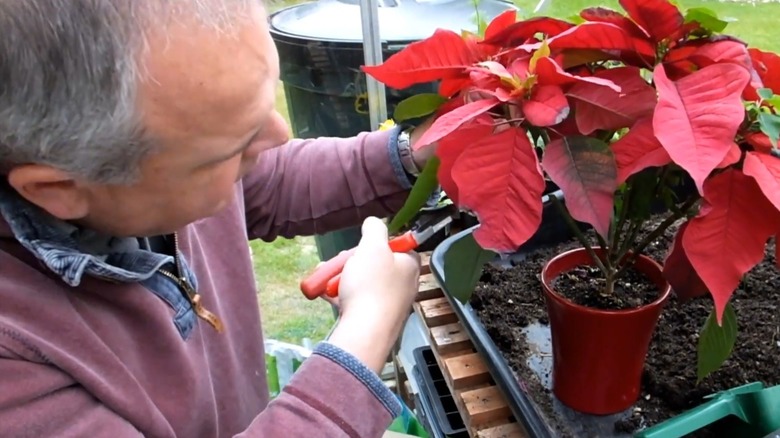
Poinsettias remain in bloom for up to four months. Once the plant starts to lose its color — usually in late March or early April — you can prune it, helping to strengthen it and prepare it for blooming in the following holiday season. As the leaves and bracts (which is the name for the brightly colored leaves that look like flower petals on the poinsettia) naturally begin to drop in spring, you can prune the branches. Cut all the faded and dried parts of the poinsettia, and prune the branches back to leave only between 4 and 8 inches in height. Try to make the cuts just above any leaf nodes. The plant will resemble a stump. Use sharp, clean scissors or pruning shears, as poor cuts with dull tools may bruise the plant. Wear gloves, as the milky sap can irritate the skin of some people.
After pruning, you can prepare to move the plant outdoors in late spring or early summer. One of the things you should know before planting your poinsettia outside or moving the pot outdoors is that you need to wait until all possibilities of frost are gone. Nighttime temperatures of 55 degrees Fahrenheit or higher are ideal. When moving it outdoors, you should transplant it to a container that's 2 to 4 inches larger in diameter than the original pot or place it in a garden bed that receives partial sun.
Prune the poinsettia again in late summer for holiday blooms
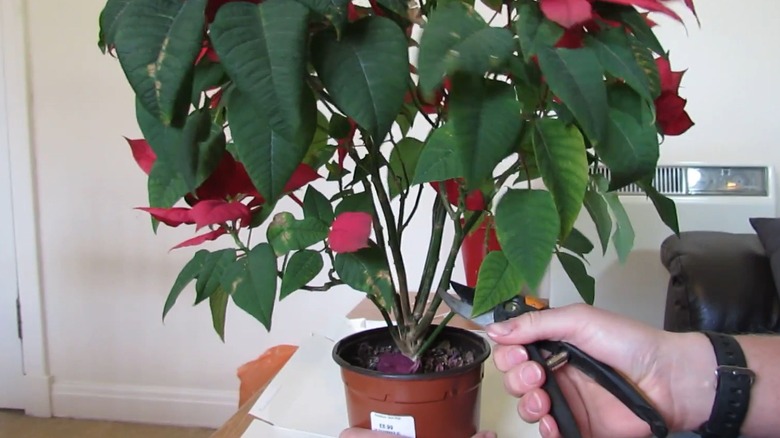
After moving it outdoors, it should regenerate and begin to show vigorous new growth. You can then perform an additional pruning in summer, usually around August, to prepare it for its natural holiday blooming time. Cut back all the shoots on the poinsettia plant so each one only has three to four leaves remaining. Pruning in August should help the plant maintain a compact shape that's desirable for holiday display. Just as you did in the earlier pruning, wear gloves to protect against potential skin irritation from the sap and use sharp cutting tools to give the plant the best chance at healing.
Once you complete this pruning in August, you should not prune the plant again until well after the holidays. Cutting any shoots between August and the winter likely will negatively affect the poinsettia's ability to create its red blooms for the holidays.
To ensure the most desirable blooms after the last pruning, you should place the plant in darkness beginning in late September. It needs between 14 and 16 hours of total darkness during nighttime hours to ensure the red color is as bright as possible. Once the red color is strong again, usually by early December, you can begin displaying it as normal without keeping it in total darkness at night.