

The Household Tool You Can Use In A Pinch To Prep Concrete Cracks Before Filling
We may receive a commission on purchases made from links.
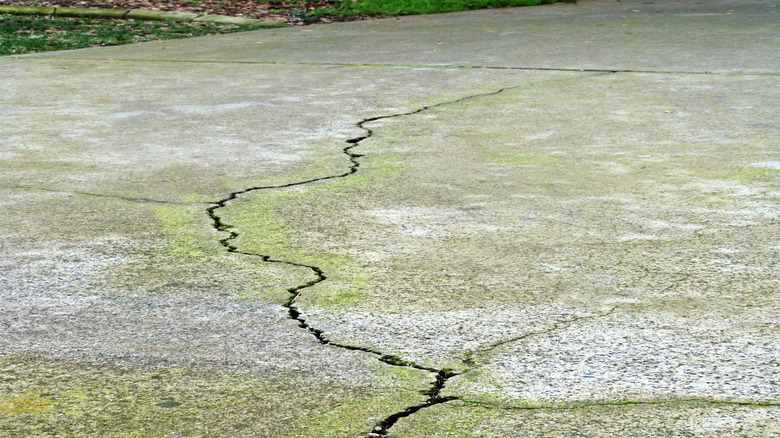
If you have a concrete driveway, eventually the smooth, durable surface will start to crack. Unfortunately, it isn't just the surface that cracks — the damage goes deep into the driveway. What begins as a chip can open into a cavern. What started as a toothpick-sized crease can become a crevasse. Just like a car windshield whose chipped window needs repair fast, the same is true of your driveway. Little flaws can grow into big problems, potentially causing irreparable damage. If all that sounds daunting, take courage. There is a common household tool you can use to prepare concrete cracks before filling them: an angle grinder with a few interchangeable heads. It makes short work of the job and ensures a long-lasting, high-quality repair.
You can't really fix a cracked concrete driveway, but you can disguise unsightly gaps using concrete filler. Taking the time to prepare the surface for repair is essential in preventing further damage. If your concrete driveway is crumbling, you need to remove all debris. Fillers bond better to surfaces that are free of loose concrete, dirt, and weeds. Angle grinders are popular household tools — in fact, they're one of the Harbor Freight tools every DIYer should know about — because they are so versatile. The interchangeable heads allow you to tackle all kinds of tasks, from cutting through concrete to grinding rough edges smooth. Driveway cracks are repaired using backer rod underneath the concrete filler. Another big reason an angle grinder is the best tool for driveway crack repair is that it creates a channel of uniform depth and width. The backer rod will fit neatly and tightly into the crack, ensuring a longer-lasting fix.
How to use an angle grinder on concrete driveway cracks
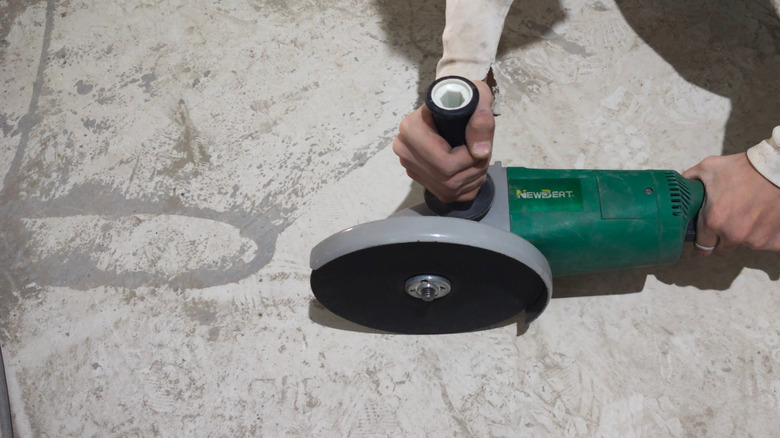
If you don't already have an angle grinder, you'll need to borrow or buy one. There's rarely an electrical outlet near a driveway, so consider the cordless freedom of a battery-operated tool like the DCA 4½ Inch Cordless Angle Grinder. It features a 20-volt brushless motor that spins at 8500 RPM and a battery that charges in just two hours. Blades and discs with a diameter of 4½ inches are common and best for home DIY use or small jobs. Angle grinders generate a lot of dust — and in the case of a concrete driveway, it's dangerous silica dust. Wear protective gear, including long sleeves and pant legs, goggles, and a disposable N95 face mask. Or, better yet, a respirator with a high particulate filter (P100 or N100), like the 3M Half Facepiece Reusable Respirator with 6200 cartridges.
It seems counterintuitive to make a crack bigger before filling it, but that's exactly what you need to do. You need to make the crack wide enough to clean out all the grit, dirt, and broken concrete pieces. You also need to smooth the edges of the crack; concrete filler won't stick to a crumbling surface. To easily fill cracks in your concrete driveway, begin the repair process by fitting your angle grinder with a wire brush attachment. Use that to clean up any rough edges and deepen the crack to a uniform ¼ inch deep. Then switch out the attachment for a diamond grinding wheel, which will create the smooth surface the concrete filler needs. Finish the job by removing all the pieces and grinding dust with a leaf blower or shop vac.