

Goodbye To The Eyesore Of Outdoor Trash Cans: This DIY Hides Them In A Dreamy Way
We may receive a commission on purchases made from links.
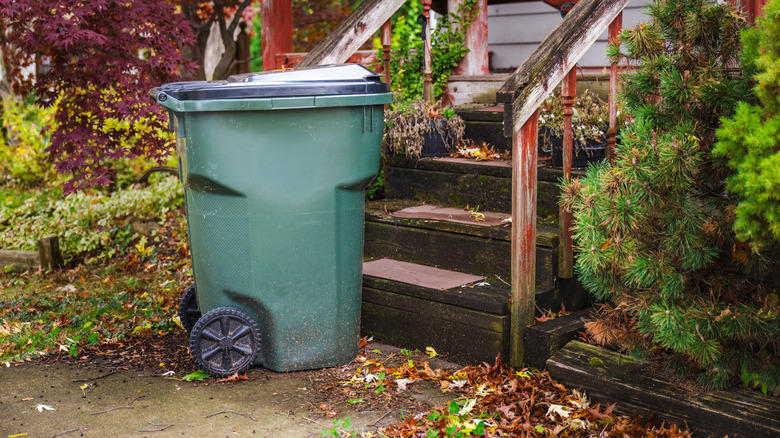
Let's face it, even if they're clean and in good condition, trash cans are something you'd rather not see. There are a number of straightforward ways to say goodbye to the eyesore of indoor trash cans, but outdoor trash cans are another matter. Not only is there a considerable difference in size, but many homes have at least two. Some people put up screens to help hide them, but that doesn't do much to stop raccoons from throwing the contents all across your yard.
Over on YouTube, a Cityline broadcast features Dave Kennedy and Joey Fletcher and their attractive DIY solution — an enclosed planter cabinet — to hide the eyesore of outdoor trash cans. It looks very professional, but with no more than some lumber, hardware, and a couple of the must-have power tools for first-time homeowners, you could put together something similar in a weekend (Dave and Joey's claim that it took around 3 hours is a bit optimistic).
The construction method isn't clear but could be simple rectangular frames for the ends, with horizontal rails to connect them. Vertical rails would be added for the dividers. Boards are fitted all around for both appearance and rigidity. Any simple joinery, like butt joints, will work for making the framework. There are videos online if you've not done that before. Common 2x2 and 1x4 lumber should be strong enough. Screws should be used throughout. Although nails seem simpler, screws are stronger, and galvanized ones are resistant to rust. Let's look at sizing and other details.
What you need to know to make the DIY planter cabinet for your outdoor trash cans
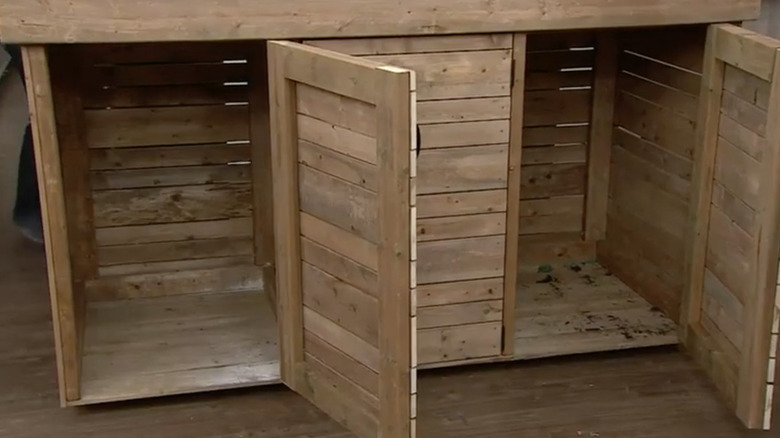
The example shown holds three trash cans but could easily be modified for two. You'll obviously need to take into account the size of your trash cans, allowing a few inches all around to make it easy to get them in and out. Don't forget to include the thickness of the materials you're using when drawing up your plan, or you might find the cabinet ends up too small on the inside. In the video, Dave and Joey use different widths of fence boards for the outer cladding. Any boards will do, but you'll want to bear in mind the widths when working out the final dimensions of your cabinet. Alternatively, you could cut some down to fit.
As Dave points out, it's important to use outdoor-grade lumber that has been pressure treated to resist rot and insect attack. It is widely available from places like Home Depot and Lowe's. When building the frames, it's a good idea to add a couple of additional cross-members for extra support, particularly for the base and top. Think of it like adding rungs to a ladder.
Dave and Joey add a planter to the top of their cabinet, which they say has been waterproofed, although they don't say how. Finding one or more plastic trays that fit would perhaps be the easiest solution. You could glue plastic sheeting to the inside using spray adhesive or use a rubberizing product like Flex Seal. Casters have also been added, but just to make it easier to get the cabinet in and out of the TV studio. If you do want to move it around, you'll need six or eight, and they'll need to be heavy-duty.
Finishing touches and extra options for your outdoor trash can cabinet
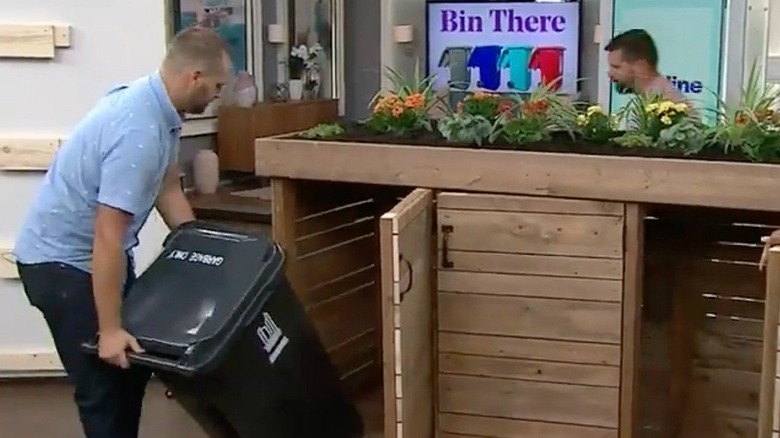
Pressure-treated lumber is durable but sometimes has a greenish hue from the chemicals used. The cabinet in the video has been woodstained, which allows the grain to show, but you could paint it any color you like, perhaps to match your house. You'll also need to choose hinges and handles for the doors. The hinges are mostly hidden on the design show, but there are other styles that fit to the front which you might prefer. If you want to prevent local wildlife from getting in, you could fit a handle with a latch. Alternatively, you could add a matching hasp and staple and fit a padlock.
One issue with the planter is the risk of overwatering. There isn't any drainage in the tray, and making holes would lead to water running down the sides. It would be possible to create a slight slope in the tray and have a drainage hose in one corner, but that seems overcomplicated. Rather than the planter, you might simply have hinged lids on each bin section instead. The ability to lift these might also make it easier to put trash in the can rather than trying to do it from the door on the front.
There are lots of creative ways to increase your home's curb appeal. Hiding the eyesore of your outdoor trash cans will certainly help. This smart and versatile DIY allows you to do that and is easy to adapt to your needs and taste.