

The Best Kinds Of Wood To Use When Building An Outdoor Tree House
We may receive a commission on purchases made from links.
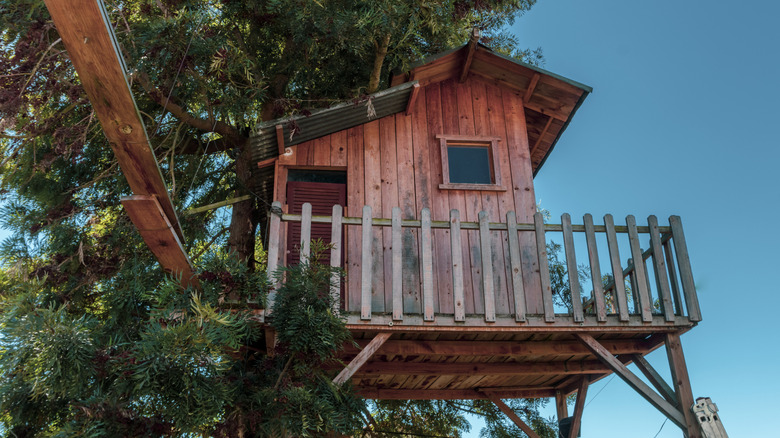
We sometimes take the construction of treehouses less seriously than other structures, but we shouldn't. It is, after all, a playhouse that doesn't seem to warrant all the strict attention to building codes and best practices. But it is a playhouse in the sky, containing our children, and so it demands attention to sturdiness and safety. Part of the strength conversation inevitably has to do with lumber choice. By and large, the most popular choices for framing treehouses have long been cedar and pine, owing to the strength and price of pine, the decay resistance of cedar, and the availability of both.
Cedar is a good all-purpose choice, but if you're framing, sheathing, wrapping, and cladding a treehouse like a normal house, there's no reason for the added expense of cedar when good ol' spruce-pine-fir framing lumber is fine. But, of course, most treehouses aren't built like modern homes, so cedar's strength and weather resistance cause some builders to prefer cedar for outdoor structures and gardeners to use cedar to build raised garden beds and other yard projects.
But how do cedar and pine really stack up against other woods for outdoor uses like treehouses? Douglas fir (which is not in the spruce-pine-fir lumber group we normally describe simply as "pine") is among the most durable kinds of wood for home improvement projects and framing. And hardwood framing lumber in general is plenty strong but quite expensive, if you can locate any at all, because it grows slowly and is often imported. It's also more challenging to work with, owing to its hardness. But hardwoods like Ipe are comparably priced to cedar and might be worth considering for certain timber-framed treehouse structures.
Pine is affordable and widely available
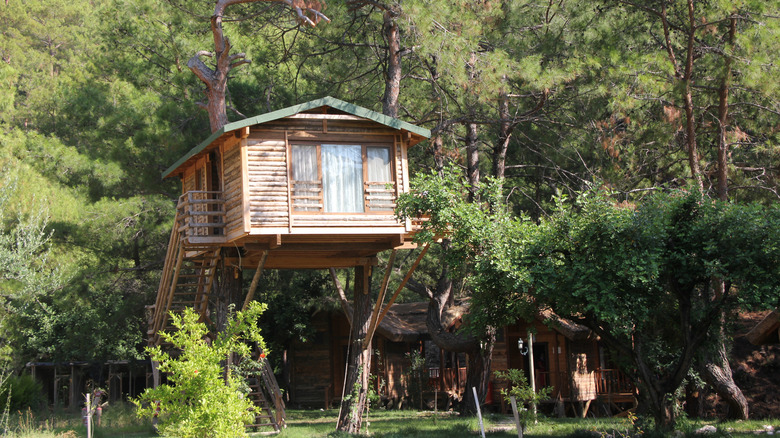
Pine and cedar are both good choices, each with different advantages over the other. Pine is plenty strong for treehouse framing and structural support. While cedar two-by-fours are suitable for light framing of the sort you find in treehouses, larger cedar posts are required for use in bearing substantial loads (like the structure that keeps the treehouse aloft). And note that western red cedar heartwood is sometimes only available in the smaller dimensions — 1 inch thick or less — used for fence pickets, turning cedar fencing into stylish vent hoods, and many other things.
And some of cedar's advantages aren't bulletproof. For example, cedar isn't completely impervious to the machinations of time and weather. Its color naturally changes over time and with weather exposure. And while cedar has lower maintenance requirements than pine, pressure-treated pine is a better choice for any lumber that's going to have direct ground contact (although this is obviously a fairly small percentage of a treehouse build).
Of course, pine's big advantages are price and availability. You rarely have to worry about a lumberyard or big box home improvement retailer being out of pine two-by-fours. And at the time of writing, you can pick up a whitewood wall stud from Home Depot (usually pine, just under 8 feet) for $3.44, while a full 8-foot pine two-by-four is in stock at $3.45. A cedar board two-by-four, on the other hand, will run you $21.98.
Cedar is resistant to moisture and insects
While cedar is appreciably more expensive than pine, its other qualities make it workable for something like a treehouse that requires relatively little lumber. Cedar's straight grain and fine texture resist warping, swelling, and shrinkage from moisture exposure. It has a natural resistance to decay and to insect infestation, and can last 25 years or more, depending on the circumstances. It has excellent thermal and sound insulation properties, and its low weight makes it easier to work with in general ... especially for building a treehouse. And red cedar actually bests pine on the Janka wood hardness scale.
It's also an aesthetically pleasing wood. More than a dozen species of both hardwoods and softwoods are called "cedar," and technically, they are not cedars at all but members of the cypress family. In general, though, the appearance of what we call cedar makes it ideal for exposed timber framing, elements of which are common in treehouse builds. And it smells great.
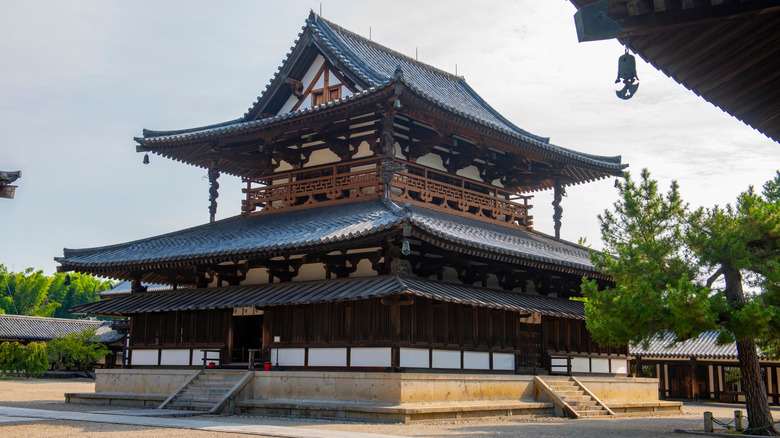
Some experts believe that the recent harvesting of smaller trees has changed the grain of readily available cedar lumber, resulting in wood that's less resistant to rot, especially in areas with extreme heat/freeze cycles. But even in those areas, cedar is still a good choice for vertical construction. And consider this: Japan's Horyu Temple — the oldest wooden structure in the world — is built of 2,000-year-old cypress (remember, that's what we tend to call "cedar") trees cut down 1,300 years ago.