

A Few Storage Shelves Turns A Simple Closet Into A Luxe Built-In

We may receive a commission on purchases made from links.
Closets come in all shapes and sizes. Some are true walk-ins, while others are more peek-in, where it feels like you can barely fit your head inside. Some stretch tall, while others are short enough to make you feel slightly crushed when reaching for your clothes. No matter the setup, most closets come with one common feature — the traditional white wire shelf and hanger rail running from side to side. And that's all. While this built-in wire shelf is helpful, it often turns into a place for stacking items haphazardly, leaving the closet looking cluttered. With just store-bought storage furniture, you can transform those ugly wire shelves to create a lovely closet aesthetic. You line the top of the wire rack with cube shelves and stack shoe racks neatly in the space underneath.
To pull off this closet trick that designers use to create a luxe look, you'll first need to take some measurements. Closet sizes vary widely, and you need to see how many shelves will actually fit in yours. Then start shopping for your storage organizers. These Comhoma 4 Wood Cube Storage Organizers sell for around $40 each and measure 11 inches deep, 23 inches wide, and 23 inches high. IKEA's two-cube KALLAX shelf units could work, too — they're shorter and great for closets with low ceilings. You'll also want a few Whitmor Wood Stackable Two-Shelf Shoe Racks, which measure 11 inches deep, 24 inches wide, and 11 inches high and cost about $75 each. Based on these measurements, you could fit two of the cube shelves across the top of a standard 4-by-4-foot walk-in closet (depending on overhead clearance) and two shoe racks side by side on the bottom.
Give your closet a custom upgrade with cube shelves and shoe racks
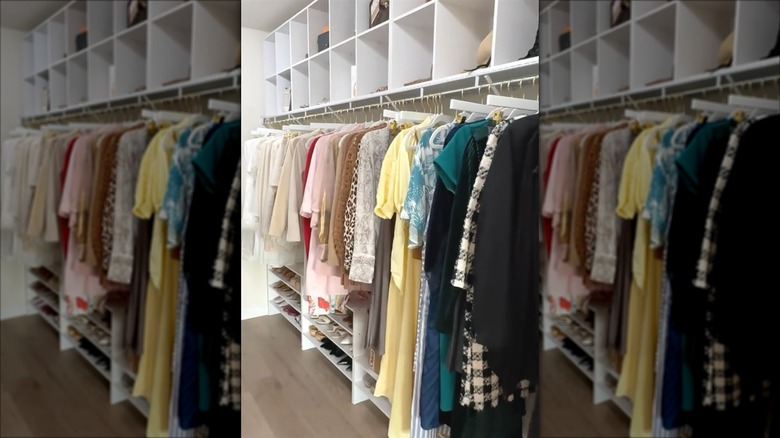
Ready to turn a basic closet into something that feels practical and even plush without the custom price tag? There's one important thing to remember when designing your closet this way: weight capacity. Wire closet shelves have weight limits, which are tested and specified by the manufacturer. For example, the popular ClosetMaid MaxLoad wire shelves can support up to 100 pounds per linear foot (every 12 inches). Weight limits vary widely across brands and installation methods. Plus, you might not even know or be able to determine the capacity of inherited closet shelving. Err on the side of caution by reinforcing the wire rack with metal brackets or securing the storage shelves to the wall with screws. It's an extra step or two, sure, but avoiding a collapse is well worth it.
If needed, assemble your purchases according to the manufacturer's instructions. Start up high by simply placing the cube-style storage shelves atop the wire shelving. Depending on the shelf height, you could be working with four-cubby or two-cubby shelves. Then, arrange the shoe racks on the floor, flush with the wall and directly under the wire shelving. How you arrange these is customizable, depending on how big your closet is, how many shoe racks you bought, and your number of shoes. You can stack a few two-high, for example, or arrange them in a stair-step layout. The latter gives room to hang longer clothing, like dresses. Once all the shelving units and shoe racks are in place, use the cubbies up high to organize accessories — think hats, scarves, and purses. You could even put a few of your favorite pairs of shoes on display up there. Fill the shoe racks on the floor with your everyday footwear.