

The Must-Know Sorting Tip That'll Elevate Your Shoe Storage
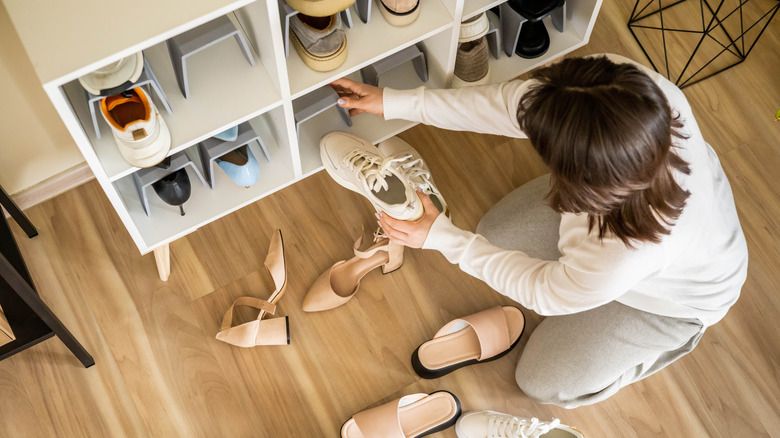
While you may live by the creed "you can never have too many shoes," your home may say otherwise. Unorganized shoes take up extra space, whether they're in a pile in the corner of your room or stashed at the bottom of the closet. And if your shoes are in an unruly pile, you already know how frustrating it is to dig through and find the pair you need. Additionally, when you keep your shoes in a pile, some are likely to be damaged. Luckily, you can keep your shoes neatly organized to protect them and make them easier to find. If you've been cramming your shoes into your clothing closet, it's time to stop storing them in this cluttered space. This will not only leave room to organize more clothing, but also help you improve the flow of your boots, whether they have their own closet or simply their own rack.
To keep your shoes safe and make it easier to find what you need, organize them by category. Select a tall shoe rack or shelf that fits your shoes, organize your shoes into categories that make sense, and place them on the shelves, with the toes facing forward so you can easily determine which pair you are looking at. Start with the shoes with the least coverage at the top of your rack, ending with boots on the bottom shelf. Organizing shoes by category will also help deal with shoe overflow, by keeping daily shoes front-and-center, and keeping seasonal or hardly worn shoes out of the way.
Determining your shoe organization categories

Break your shoes up into casuals, formals, and boots. Seasonal shoes can go in their own category if you pack them up when they're out of season, but if you don't, they'll remain grouped with the basic categories. Your casual shoes are not just sneakers — this is the ideal category for slip-ons and flats, and for sandals and flip-flops if you're not categorizing them as seasonal. Your formal shoes should be those you'd wear to a business meeting, a big event, or the office — think loafers or dress shoes with heels. Finally, your boots include both tall and ankle boots. And, of course, if you're not sorting them out by season, your snow and rain boots go here, too. While you don't have to keep your boots on the bottom shelf, it's often the tallest and best suited for tall shoes. If you run out of room, prioritize the shoes you wear the most, and keep those special occasion shoes stored in the harder-to-reach top of the closet. As you're going through your shoes, decide which to get rid of — no sense in organizing them if they no longer have a place in your collection.
Since your shoes are now sorted by type, this is a good time to also break them down by color — it will enhance the visual appeal of your shoe closet. This also makes it easier to find exactly what you need when you're looking for the perfect pair of shoes to complete your outfit — your eyes will first go to the category you need, then to the colors that best complement your outfit. With just a few strategic plans, you can completely organize your shoe closet.