

The Once-Popular Tool No One Uses Anymore
We may receive a commission on purchases made from links.
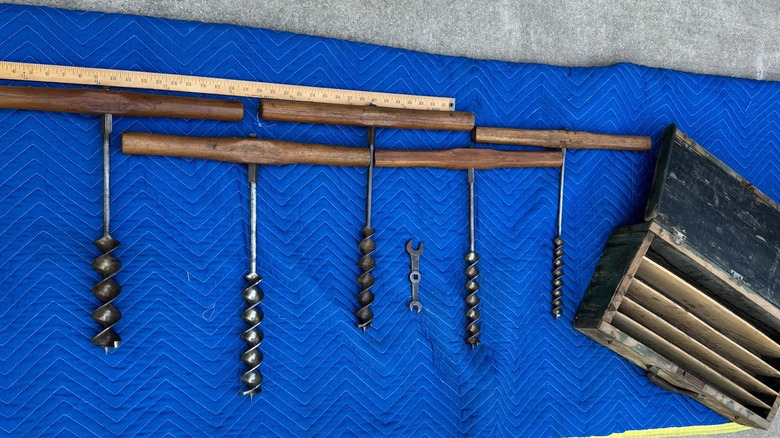
You can often look at an antique tool and tell that it's something you want no part of. The hand auger is such a tool, and is a good example of why and how some tools are replaced by better — or at least preferable — options. Made up of a handle forming the top of a T with the auger bit itself, the hand auger looks like the very distillation of manual effort. They were once common because the need to bore holes is unavoidable, irrespective of the effort required. But through the years the wood-boring hand auger has been replaced by a number of faster, easier options.
In the long, slowly rolling wake of my father's passing I eventually ended up with a bunch of his tools, as is the way with fathers and sons and tools. I integrated these tools into my already-overstuffed workshop, which was actually a lot of fun, and ended up with a drawer of tools I couldn't identify and a box of old-school tools that are mostly obsolete. But there were precious few tools among the obsolete that might be used by a builder or DIY home renovator; Building methods have mostly improved incrementally over the decades, and a few revolutions have been incomplete, leaving the old practices and tools firmly in the heads and hands of the average carpenter. Homes 3D-printed with robotics are still a thing of the future.
Whatever happened to the hand auger?
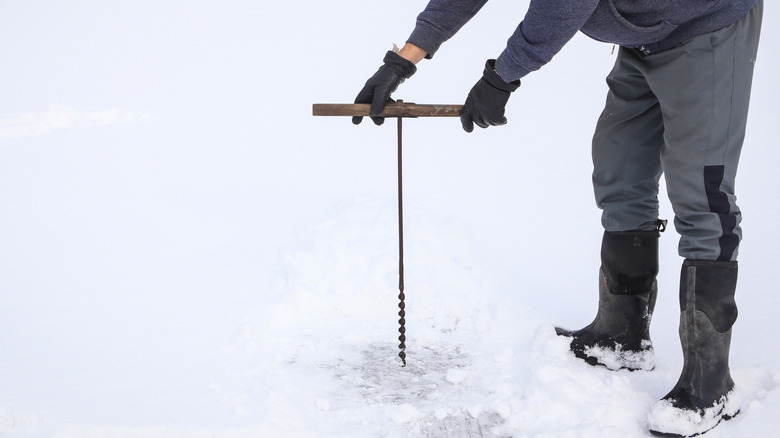
A good metric for determining if a tool is still used is whether or not it's still manufactured. The trouble is that almost everything is still manufactured, either out of sheer obstinance but sometimes because there's a surprising amount of demand. Garrett Wade, for example, describes the Yankee screwdriver — a device that ratchets its shaft as you press down on it, and something you'd think of as outdated — as one of its "bestselling, most popular items." The hand auger is still manufactured by the thousands, but almost exclusively for boring holes in things other than wood, such as dirt, and ice, or unclogging sink and other drains. You can still buy hand augers for wood, but they're for bushcraft purposes ... that is, in a sense they're desirable specifically because they're obsolete.
The electric drill made it far easier to use auger bits and their various competitors — tri-flute bits, spade bits, Forstner bits, and hole saws. I've only ever used auger bits for running Romex through wall studs, but they're good at making deep, clean holes and, unlike spade bits, won't get turned into a kitschy plant marker stake by the first embedded nail they encounter. The auger concept isn't outmoded, but the effort required to drive one by hand just isn't worth it. You might be surprised how close you can come to a drill's force; a typical man can produce 60 foot-pounds of torque with a T-shaped tool like a hand auger, while a professional-quality cordless drill might produce 100 foot-pounds. You can get the work done under your own power, but it's a lot of power.
How tools become obsolete ... or don't
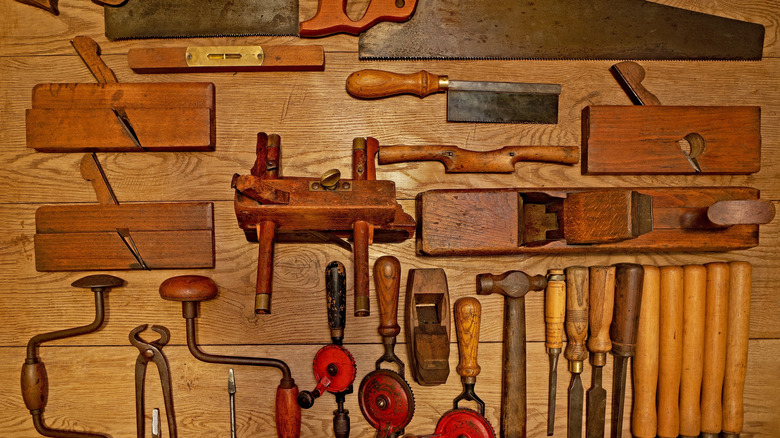
So, what's obsolete about the T-handle hand auger — if anything at all — is the handle. Indeed, they're not exactly common, but there are sources for new auger brace bits, along with impassioned craftsmen who will argue that a brace and bit is the way to go for ... what, authenticity? So it's really just the T-shaped handle that no one is willing to deal with anymore. But there are reasons other than effort that tools become obsolete ... speed and efficiency might eventually make handsaws a thing of the past, convenience could eventually kill off corded tools, and technology eventually bypasses tools in certain industries (automotive tools, for example ... consider the dwell meter or, for that matter, the buggy wheel hub auger.
I said earlier that I inherited a box of mostly obsolete tools, and it's fair to wonder what "mostly obsolete" means. It is, after all, a binary state: things are obsolete, or aren't. But in a sense, no tool ever becomes completely obsolete without a drawn-out fight between progress and the nostalgia, parsimony, and stubbornness of the tools' owners. The owner of an antique car might occasionally use a timing light. Artisans and madmen will still drill holes with an old bit brace or egg-beater drill. I've even had occasion to use a water level when a laser level's line-of-sight requirement didn't suit, which sounds quaint until you've goggled at the price of plastic tubing. No tool goes away until there's no work it can do ... which is rare ... or until it's replaced by something that's better, faster, easier, and reasonably affordable.