

The Simple Rule That Helps You Pick The Perfect Place For Your Bird Feeder

According to the U.S Fish and Wildlife Service, more than one billion bird-window collisions happen each year, just in the United States. While you may be able to easily spot a window while outside, for your feathered friends, windows can easily be mistaken for a safe flying zone, leading to harmful, or even fatal, collisions. As a result, when you're choosing the perfect place to hang a bird feeder to keep your feathered friends safe, you want to take windows into account — and this simple 3/30 rule can help you find a safe sweet spot that both you and your local backyard birds can enjoy.
Placing your bird feeder near a window can give you an ideal vantage spot for watching your feathered friends fly by for a bite. However, if your bird feeder is placed in the wrong location, it could do your local birds more harm than good. As a result, when picking the perfect place for your bird feeder, you want to consider a location that is either far enough away from a window that your birds can safely dine without any worries of any nearby windows or close enough to the window that even a startled bird won't be able to get enough momentum for a lethal collision. This is known as the 3/30 rule — a simple trick that can make setting up a feeder to attract more birds to your garden a breeze.
How to safely place bird feeders around windows
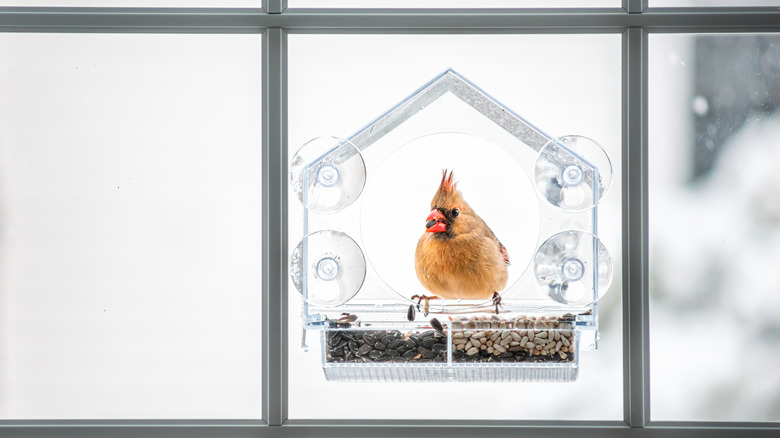
When it comes to safely placing bird feeders in your yard while keeping them in view of windows, it can feel a bit like a balancing act. Fortunately, you have two options: place your bird feeder close to your window (within 3 feet) or far away (more than 30 feet away).
If you want to ensure you have the best views possible when birds visit your feeder, then you may be more interested in the three portion of the 3/30 rule. This means that bird feeders of any kind should be placed closer than 3 feet to your home. While this may seem counterproductive if your goal is to keep birds from colliding with surfaces or windows, it actually works quite well. A bird is most vulnerable to predators while eating, and if a bird is startled at a feeder, their instinct is to fly away. However, they don't reach top speeds instantaneously. As a result, by placing your bird feeder closer to your home, most birds won't be able to build up enough momentum for a collision to have lasting or severe effects.
On the other hand, you may want to consider placing your bird feeder further away from your house, which is the latter part of the 3/30 rule. Whereas a bird closer than 3 feet may not get enough momentum for harmful crashes, a bird that's more than 30 feet away often won't come close to your house at all. This can reduce the likelihood of collisions, creating a safer environment to reap the benefits of a bird feeder.