

The Common Countertop Installation Mistake That May Be The Cause Of Cracking

Getting a new countertop is one of the most exciting ways to upgrade your kitchen's aesthetic, but that excitement can quickly turn to heartbreak when a hairline fracture appears on it. While it's understandable to think a crack is caused by a defective stone slab, the true reason might lie hidden beneath the surface. In fact, the most common installation mistake is poor surface preparation, specifically an uneven or weak base. Why? These issues create pressure points where the stone is forced to span a gap without good enough support. Many common natural stone countertop materials have very little flex. Over time, the weight of the stone (and repeatedly placing heavy items on it, like grocery bags) can cause the material to snap at its weakest point.
No matter what ideas you have for your kitchen renovation or new house construction, you deserve peace of mind that your investment is secure. The key is making sure your cabinetry is perfectly level and structurally sound before the stone ever arrives. Gaps shouldn't be larger than ⅛ inch. Over time, cabinetry ages and floorboards shift (from regular use or foundation shifts); these issues can affect the base's angle and lead to larger gaps. That puts stress on your countertops, causing them to bridge any low spots and creating stress points.
By prioritizing a flat, sturdy foundation, you'll ensure your stone countertop sits flush against its base. This helps it distribute its weight evenly and reduce any tension that could lead to a crack. Neglecting this could mean even the highest-quality stone could fail eventually.
How to build a good foundation for long-term stability
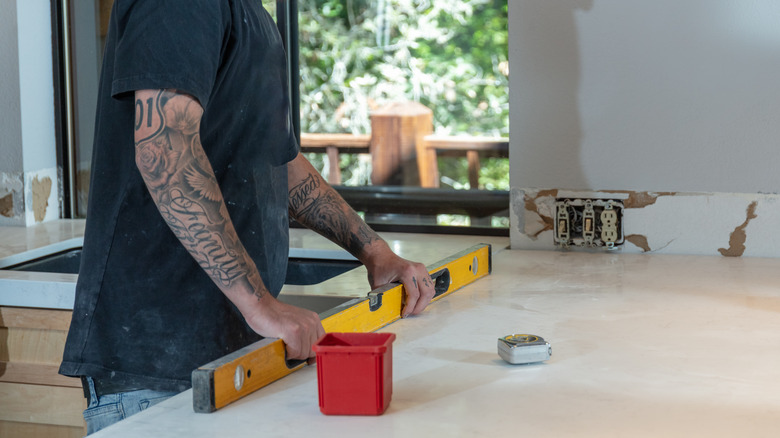
Once you've made sure your countertop base is level, the next big step is to reinforce any high-risk areas to prevent the countertop from cracking. Certain areas are naturally weaker and more vulnerable, like wide spans over a dishwasher or the thin strips of material that go around a sink or cooktop cutout, and need extra bracing. This added support usually happens in the form of plywood sub-tops or specialized steel brackets to keep the stone from cracking. Without this added support, issues like appliance vibration or the weight of a filled sink could stress the material enough to crack it. And then you'll need a countertop repair kit or a costly professional repair team.
Give those stabilizers a leg up by also using a professional-grade adhesive, like silicone sealant; this is a stable, waterproof, and dependable adhesive. Why? You don't want to bolt down a stone countertop. Rather, a silicon adhesive will keep it in place and easily absorb expansion and even vibrations (say, from your dishwasher running or plopping your toddler on the countertop to feed them, for example). By taking these expert steps before installing your kitchen countertop, you can enjoy your beautiful countertop for decades without worrying about cracks (hairline or otherwise). Reinforcing things proactively turns a potentially fragile installation into a durable centerpiece of your home. Ultimately, a little extra attention to the foundation today ensures your dream kitchen remains sturdy and up to whatever you throw at it, or rather, set on it.