

The Breakfast Staple You Should Be Adding To Your Compost Bin

We may receive a commission on purchases made from links.
Nature has its way of recycling nutrients back to the earth through decomposition. We humans have found a way to accelerate this process through composting, which is simply a controlled version of this process. There are many compost ingredients you likely already have at home, such as fruit and vegetable scraps, paper waste, and yard trimmings. You're probably composting these things already. However, there's one common yet overlooked breakfast item you should also start adding to your pile if you haven't already: oatmeal.
Composting is an unexpected use for oats around the garden. It works because the cereal grain contains nutrients and minerals that are beneficial to crops. In particular, oats contain carbon and nitrogen, both of which are essential for the growth and reproduction of the microorganisms responsible for decomposition. Plus, it contains beneficial micronutrients, including potassium, phosphorus, iron, copper, zinc, and manganese.
When selecting oats for your compost, your best bet is to go with plain, uncooked oats. A pack that has expired or that no one wants to eat anymore is perfect. Never add cooked oats — or cooked anything, for that matter — to a backyard compost pile unless in very small amounts. They won't fully decompose in the temperatures home composting reaches. Moreover, cooked food can attract nuisance animals to your yard.
Proper way to add oats to your compost bin
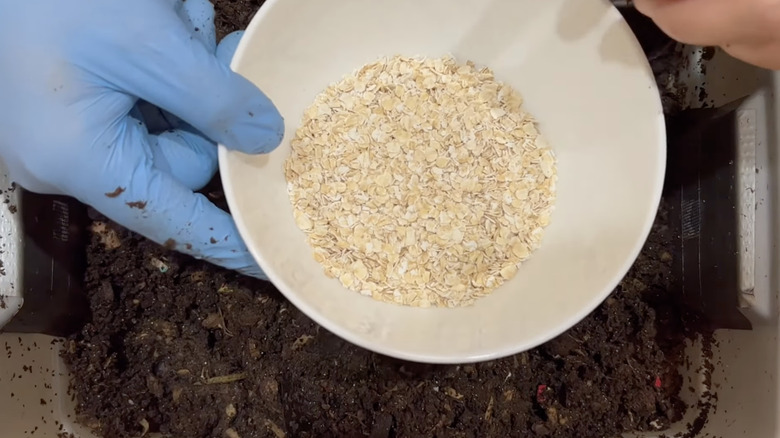
One of the most important things to keep in mind when making your own DIY compost using oats is balance. You need to meet a specific carbon–to–nitrogen ratio to achieve decomposition. For each part of nitrogen-rich matter, you should add two to three parts of carbon-rich matter. Oats are one of the green materials that give your compost pile a serious nitrogen boost. That means you need to add two to three times the amount of carbon-rich substances, such as dried leaves, wood chips, plant trimmings, or shredded paper and cardboard, to create the right balance.
It also helps to bury the oats in the center of the compost pile, especially if you're adding cooked oats, to avoid attracting pests or rodents. Uncooked oats tend to absorb lots of moisture; they clump together, or worse, grow mold. Always spread out the grains and avoid dumping a large amount in one spot. Or add the oats in layers, alternating them with other compostables, for a more even distribution. Finally, turn and mix your compost pile regularly to introduce oxygen and prevent uneven decomposition. Monitor the moisture and temperature levels of the pile as it decomposes — an Irtov 4-in-1 Digital Soil Meter helps here. Once it's cured, you can spread your finished compost on your garden beds.