

Increase Your Living Room Space With An Outdoor Improvement Project This Year

We may receive a commission on purchases made from links.
Is your living room feeling cramped? Whether because of more frequent visitors, extra furniture, or a growing family, interior living spaces can begin to feel small and impractical, even if the rest of the home is just the right fit. But if this is true for you, don't start looking for a new house just yet. Instead, you may first want to take into account a part of your property that you could have overlooked as a potential living area: outdoor space. Believe it or not, a home's outdoor area can often be utilized to increase available living room space. This is particularly true for those who live in climates with mild temperatures year-round, but it can also be a viable option for more extreme environments with a few key changes. And one great way to make your outdoor space into a usable living area is by building a screened-in porch.
But can you DIY a screened-in porch, or is this a job best left to the pros? Well, if your house already has a porch with a roof and side supports, it may be as easy as using mesh — such as this DOCAZOO Window Screen Mesh — along with screws and power tools to add the screened-in element and make your outdoor space better for temperature control, insect repulsion, and weather protection. If your home doesn't have those existing supports, the process could be more complicated. Either way, you will need to look into your home's zoning and regulations to check what kind of screened-in porch, if any, you are allowed to build. But if a screened-in porch is an option for your property, how can you determine exactly how large it should be and how to make it usable for more of the year?
Determining the size and adjustments of a screened-in porch
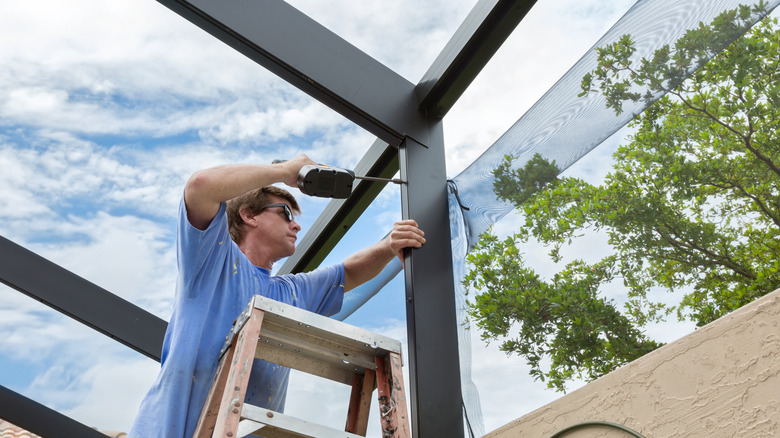
Some key things to consider when thinking about how large to make your screened-in porch are the size of the furniture you plan to put inside it and the estimated cost. If, as mentioned above, you already have a porch with a roof and side structures, the easiest option is to simply build your screened-in version around that existing footprint. However, if you are planning to build the porch from scratch or would like it to be bigger, how large should it be? One popular size for a screened-in porch is 14 by 16 feet, which is enough room to accommodate a lounge area or a few armchairs and a small table. This is likely a good size if your goal for the screened-in porch is to extend your living space as it accommodates multiple comfortable seating options.
When it comes to cost, it is estimated that a 16 by 16 foot screened-in wood porch generally costs around $45,000, though this number can be higher depending on the materials used and any add-ons. For example, one addition you may want to consider if you live in a colder climate, and would like to use your porch as a year-round living space, is an infrared heater. These heaters warm objects instead of the air, making them an efficient choice for screened-in porches which are connected to the outside. If you would like to add heaters, make sure to read the product specifications about safe placement and allow proper ventilation as needed. So, once you've determined the size of your screened-in porch and selected helpful accessories like heaters, what other furnishings can you add to your new porch to make it a usable and enjoyable extension of your current living room?
How to decorate your screened-in porch as a living space

Once you've worked out how best to construct your new screened-in patio build, it is important to think about how to utilize the space to make it feel like a part of your home rather than an occasional seating option. First, consider which elements of your living room make it feel cozy and desirable. Is it the large sofa, the television, or the decor elements such as photos, candles, or paintings? Try using similar items in your screened-in porch. If you want to mount a television, make sure to hang it in the shade or on a south-facing surface to avoid glare and protect the screen from sun. This will help make the television usable, like it would be in an interior living space.
Plush seating is also a great way to fast-track your screened-in porch into feeling like an extension of your living room because being able to relax on a sofa or armchair is often associated with the most restful rooms in the house. Try looking for weather-resistant furniture pieces (though there are different types of mesh available that are good for blocking wind, rain, or harsh sunlight) to ensure they last as long as possible. If the ones you have your eye on still feel more like patio furniture than living room units, try adding soft furnishings such as cozy throw blankets, pillows, or even a rug to give them a comfortable, indoor feel. Finally, to make the porch a viable option for movie nights, evening drinks, after-school playtime, or simply just relaxing and socializing, try adding lights that give off a warm glow and match the tone of your indoor lighting, making it feel snug and like a natural addition to your living room space.