

HGTV's Todd Talbot Saves Kitchen Countertop Space With A Smart Design

On HGTV's "Love It or List It, Too," Todd Talbot helps hopefuls find their dream home, but when it comes to making decisions for his own, it can get complicated. The Canadian TV personality and his wife Rabecca spent 16 months intensively renovating a quaint 1940s bungalow in Vancouver, of which the kitchen is one of the definitive highlights. As a relatively small space, the Talbots wanted to make sure they got the most out of its square footage, and they know that one of the most effective ways to maximize your kitchen space is by placing appliances in the right spot.
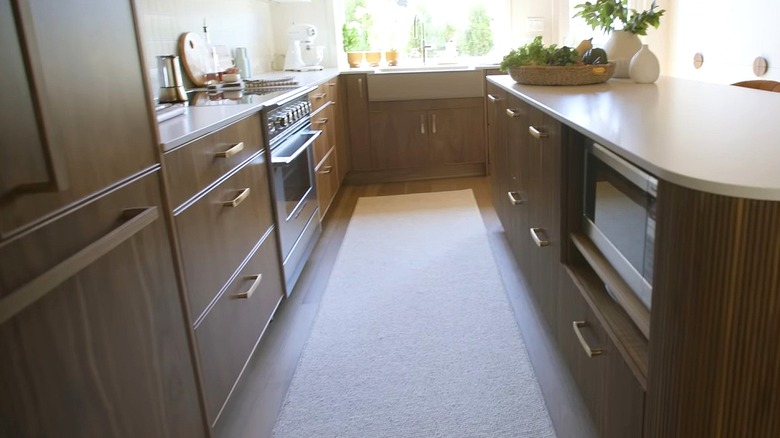
Among their cleverest space-saving hacks was an integrated microwave in the kitchen island, in an open cabinet box tailor-made to hold the appliance. Kitchen island microwaves have been gaining popularity as a simple way to create extra counter space in your kitchen and shield this functional object from view. They're also convenient, since islands are often the hub of food prep, and safer, putting an end to the days of awkwardly retrieving scalding plates and bowls from wall or over-the-range microwaves installed a little too high.
Talbot, in collaboration with Canadian cabinet makers Merit Kitchens, opted for simply placing the microwave in the dedicated space, without a flush trim. You can, however, get a trim kit from the microwave manufacturer or customize the face frame of the island cabinet box to hide the gap between the appliance and the structure for a more seamless look. As for microwave type, microwave drawers that you can pull out work especially well for kitchen island applications, facilitating access.
Aesthetic considerations of island microwaves
A microwave is the perfect appliance you can add to a kitchen island for out-of-sight convenience, but there are a few aspects to consider when it comes to installation. Even if it is possible to retrofit a microwave in an island, this idea is more easily implemented when designing a new kitchen, particularly one with custom-made cabinetry. Ideally, start by picking your microwave model, then design your island with a slot to fit it. You'll find more information on safe measurements for proper ventilation below.
Microwaves specifically designed for built-in installations are preferable, because they come with matching trim kits that include all the components needed for a seamless and safe installation, like ducts for ventilation, and a frame in the material of the appliance. However, while the ventilation ducts are always a good idea, for an even more seamless look, you can swap the sheet metal or plastic trim from these kits for a wood trim matching the rest of your cabinetry. It's best to plan this with your cabinet manufacturer, but, typically, you'll want the inner edge of the trim to match the measurements of your microwave, essentially hiding the gap between it and the cabinet box. If choosing a pull-out microwave drawer, make sure there's enough clearance for it to open adequately, which is typically about 41 inches.
Alternatively, and following HGTV's Todd Talbot's lead, you can opt for a regular open cabinet, with regular framing, tall and deep enough to safely accommodate your microwave, which will just sit inside. This entails less tailoring, thus less carpentry work, and likely lower costs. Make sure the wood or paint finish on the interior panels of the cabinet box matches that of the outside cabinet parts for a more elegant appearance.
Safety considerations of island microwaves
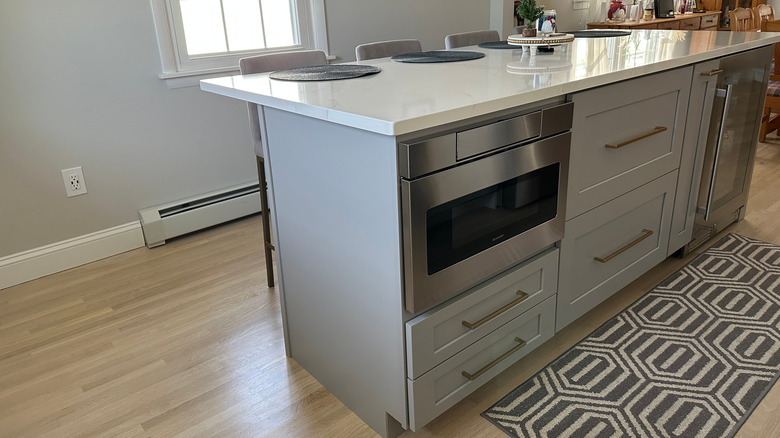
You want your island microwave to look great, but you also it to be safe. If designing an island from scratch, confirm the electrical wiring and respective outlets are fit for an appliance like a microwave. A standard model needs a dedicated circuit, meaning it should not be shared with other appliances, and a 20-amp, 120/125-volt grounded outlet, installed inside the cabinet behind the microwave. Proper power connection significantly reduces the chances of circuit overload, which can trip the circuit breaker or, worse, cause a fire.
If you're retrofitting a microwave into an island that doesn't have any outlets, you likely already have electric wiring running to it, since the National Electrical Code requires all islands to be prepared for future outlet additions. Contact an electrician to connect the existing wiring to the microwave outlet. If your island isn't wired at all, then a more complex intervention to run conduits through your floors or cabinets will be needed.
You'll also want to ensure the microwave is well ventilated. This appliance has fans that remove warm air and cool down the electrical components, so there has to be enough space around it to ensure proper warm air expulsion and avoid overheating. While microwaves have thermal fuses that turn them off before the situation escalates into a fire, it's best to avoid it altogether. As mentioned above, trim kits from the manufacturer come with ducts that move warm air forward and out through the trim. If using custom wood trim, make sure to recreate that system. Talbot's open cabinet alternative eliminates the need for dedicated ductwork, but the space should still be large enough to guarantee 3 inches of clearance on the sides and at the top, and 1 inch at the back.