

How To Use One Piece Of Furniture To Inspire Your Living Room's Entire Decor

When you've outgrown your ragtag collection of comfy chairs, mix-and-match end tables, and dorm room curtains, or if you just need a redo, selecting one piece of furniture and designing around it can be just what you need for inspiration. Even if your design skills are top-notch, and friends come to you for unconventional ways to find design inspiration, figuring out a fresh, new look for your living room can be a drag. The most important piece of furniture in the room, and usually the first one your eyes rest on when you enter, is the sofa. The other parts of the room decor puzzle might just fall into place if you design your room around it.
You don't need to buy a new couch to use as a basis for a room makeover, but if you want or need to, keep comfort in mind. A sofa whose only purpose is to look good is useless as a piece of furniture. Once you've chosen a ready-made or custom sofa, or found a valuable antique sofa at a thrift store, remember that it's not color alone that will direct your decor choices. Fabric, texture, and pattern also provide cues for interesting design. A solid-colored sofa may seem the easiest to design around, with wall paint and upholstery colors that coordinate. Bursts of color with throw pillows or large art pieces and changes in texture with oversized house plants and trendy boucle fabric create a calm, sophisticated look. Keeping it minimalist — not overdressing the room with multiple side tables, lamps, and decor pieces — maintains the refined atmosphere. Or, if you're looking for more of a maximalist burst, coordinating within a color palette or mood can offer the inspiration you need for cohesion.
Using your sofa for design ideas
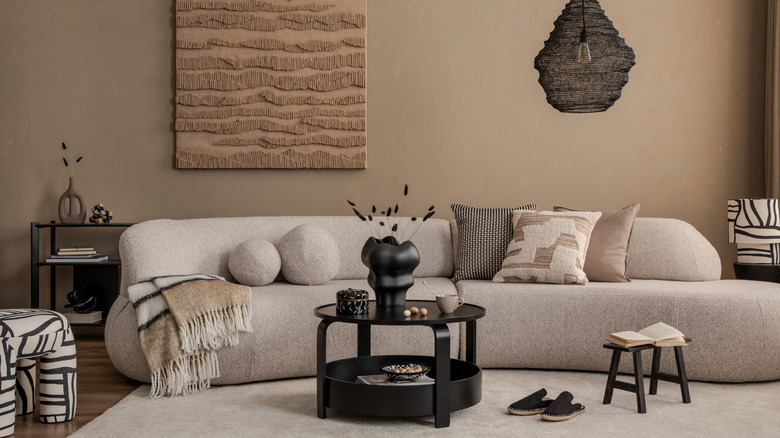
Perhaps because the trend toward biophilic design remains strong, the appreciation of natural colors continues. Neutral sofa colors still dominate, but earthy greens like sage and olive are moving up in popularity, both in solid colors and patterns. To complete a design that embraces the biophilic principle of bringing nature into the room, choose a sofa in a calming, natural green, introduce houseplants or a living wall into the decor, and choose sheer drapes that allow a lot of natural light into the room. Designer Marianna Popejoy (via Livingetc) recommends having "timber touch points" like real wood furniture or solid wood floors.
Designer Sara Swab (via Real Simple) encourages people who love patterns to lean in. "[I]t can make a sofa feel like a true statement piece," she says. Swab suggests using a timeless pattern, rather than something like a floral chintz that looks dated. Use solids for the rest of the room that won't clash or look busy. If the colors on the sofa get along well together, they'll work great in other design elements. Add drama to the room with wainscoting by using one of the darker colors on the lower half and a lighter one on the top section, or create a solid-colored DIY accent wall that will look perfect behind the sofa.
If you've tired of boxy sofas, a curved couch can make a small room seem bigger, provide "more cozy seating arrangements, and offer an intentional asymmetry to a room," says designer Allison Garcy (via Homes and Gardens). The curved sofa is often associated with mid-century modern design, a style that features bright colors, clean lines, and light wood tones. Window dressings are minimal, glass tabletops on coffee tables are common, and chrome is used as an accent.