

15 Hacks For Getting Grout To Look New Again (And 8 That Are Worth Trying)
We may receive a commission on purchases made from links.
It doesn't matter where in your house you have tiles, nor does the condition of the tiles make a difference. If the grout running between them has started to fade or been allowed to gather too much grime, then as far as your home decor is concerned, those tiles are likely to be doing more harm than good. Don't worry, though. It's not yet time to learn how to remove and replace your old grout. Instead, with this guide as your companion, it's time to learn how to clean it.
How, you ask? Well, as you'll see below, there are several methods you can try — some of which are decidedly more effective than others. Whitening toothpaste, for example, while admittedly only effective against lightly-soiled grout, could nevertheless be worth a go if you already have some lying around in your cupboard. Others, like using a steam cleaner or scrubbing your grout baking soda and hydrogen peroxide, are almost guaranteed to restore your dingy grout. The point of this guide is to help you cut through the noise and whittle down the endless list of commonly-touted tricks to a few that are actually likely to work. From steam-cleaning your grout lines and breaking out the power tools, to lifting minor stains with a magic sponge or toothpaste, below you'll find seven surefire hacks for restoring grimy grout, plus eight that, depending on the severity of your stains, could at the very least be worth giving a go.
Scrubbing attachments on a cordless drill will make light work of super stubborn grime
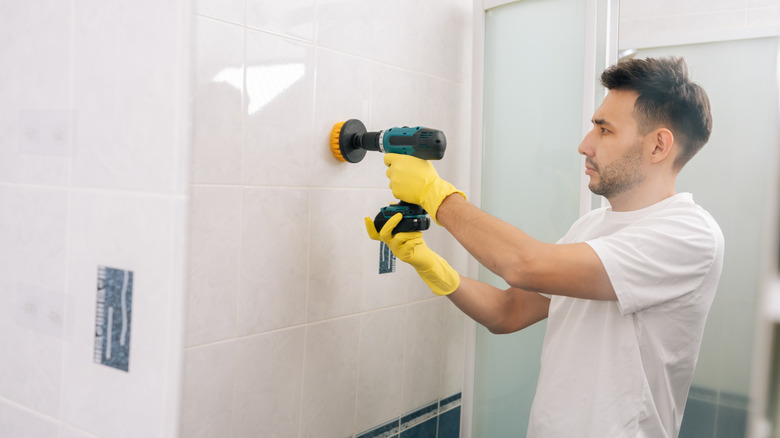
If you have a problem with dirty grout that needs mechanical assistance and you'd prefer to leave your electric toothbrush out of it, then consider busting out the big guns by reaching for your cordless drill. That's right. By using a slide-on scrubbing brush attachment, you'll be amazed at how effective this trick can be at lifting even the most stubborn grout grime. This method blasts away ground-in dirt fast, refreshing grout so it looks clean, bright, and nearly new.
The reason this trick works so well is the speed at which the drill enables the brush to oscillate. Some drills can revolve more than 1,500 times per minute — that's a minimum of 25 revolutions per second. Compare that to the amount of times your hand can go back and forth in a second — and the rate at which your hand, arms, wrist, and fingers are likely to tire — and it's easy to see why this method is so effective. Just note that, if you're using it on sealed grout, you'll need to use a soft brush, or ensure that you reseal the grout once you've finished cleaning.
Sealing your grout after cleaning will help to keep it fresh for longer
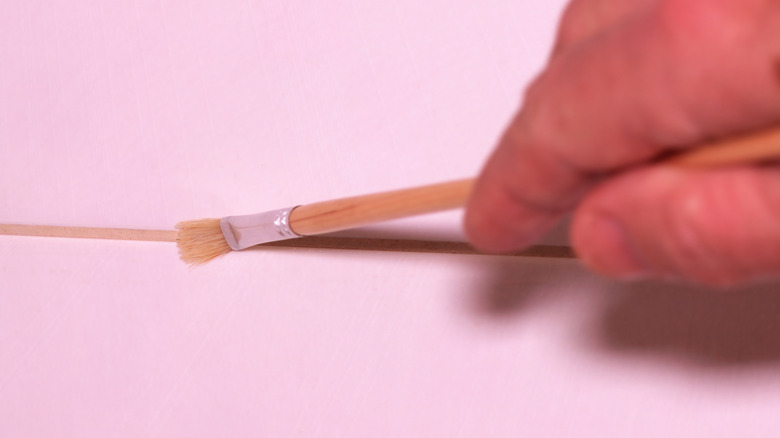
Let us ask you: do you know how often you should be resealing your tile grout? In actual fact, it depends on how high-traffic your tiled area is. Shower enclosures used daily should have their tile grout resealed at least once a year, as should grout between tiles in areas with lots of daily foot traffic. Why, you ask? Well, by treating your grout with a dedicated sealer, you prevent moisture and bacteria from getting inside the microscopic pores of your grout.
As for the type of grout sealant you should use, that's up to you. Penetrating sealants work to block the microscopic pores of your grout, thus preventing moisture and microbes from gaining access. Non-penetrating sealants serve the same purpose, although they provide more of a surface coating, meaning that they require reapplication more frequently than penetrating types. This is especially true if you use more abrasive cleaning solutions, like baking soda, which is likely to compromise the surface-level seal that non-penetrating products provide.
Specially-formulated grout cleaner is a sure way to renew your grout
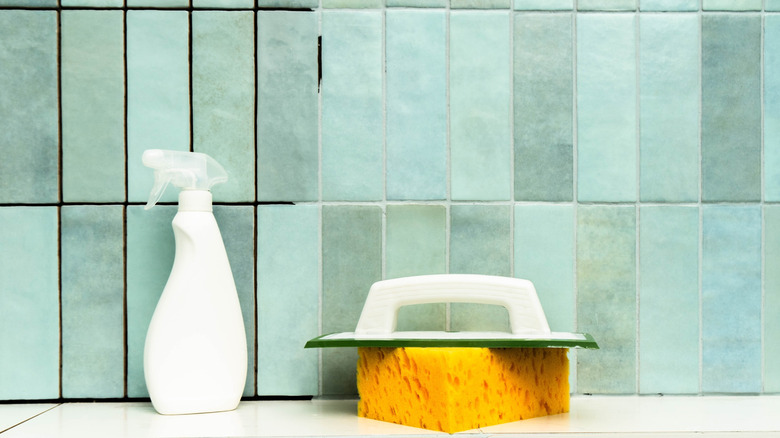
While the chemical make-up of purpose-made grout cleaners can vary, they are almost always the most effective means of cleaning your grout. After all, it's the job they're designed to do. This means if you're struggling to clean your grout with home-remedy hacks like whitening toothpaste or shaving cream — and you'd rather not splurge on a steam cleaner or sully a toothbrush — then this is perhaps the most obvious way to tackle your problem.
These cleaning solutions penetrate the grout and break down dirt and grease. They're often sprayed on and left to soak, and they usually require just a gentle scrub with a soft brush followed by a warm-water rinse. You may need to use your cleaner several times to restore your grout; however, by choosing a tile and grout cleaner that's strongly recommended by consumers, it's almost guaranteed to be more effective on badly stained grout than a tube of toothpaste.
An old electric toothbrush will help to loosen and scrub away grime
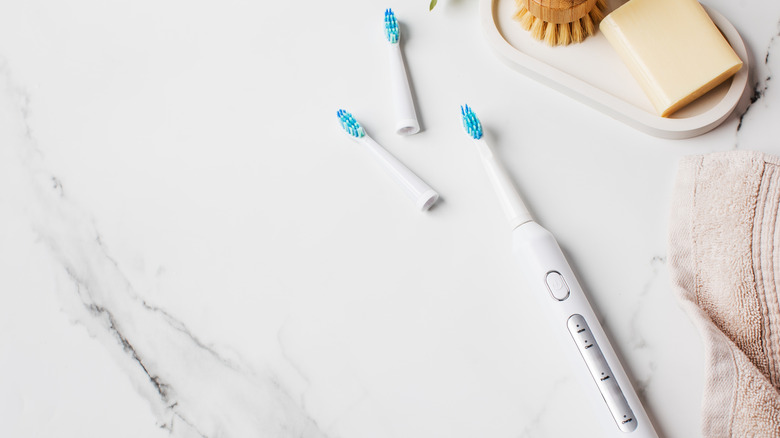
If you think about it, electric toothbrushes are just like any other power tool. Like a drill makes fixing screws in place much easier than a screwdriver, an electric toothbrush, with its oscillating function, does a far better job of cleaning our teeth than a manual brush could ever hope to do. And it's precisely that motion that could make your toothbrush your most powerful ally yet when it comes to cleaning your grout.
Of course, it should go without saying that you shouldn't use your day-to-day brush to do this. Instead, use an old brush attachment, or buy some spares to take care of your tile cleaning. You should also ensure that you clean the entire brush unit between cleaning your tiles and your teeth. Provided you protect yourself from cross-contamination, you'll find the mechanical agitation provided by your toothbrush is excellent at loosening and removing dirt from your grout lines. More than that, it does the job without putting undue strain on your arms, hands, and fingers. Try your toothbrush with just warm water first, and if that doesn't work, consider upping the ante with another of the solutions mentioned in this guide, like baking soda.
Oxygen bleach is gentler and more efficient on grout than its chlorinated cousin
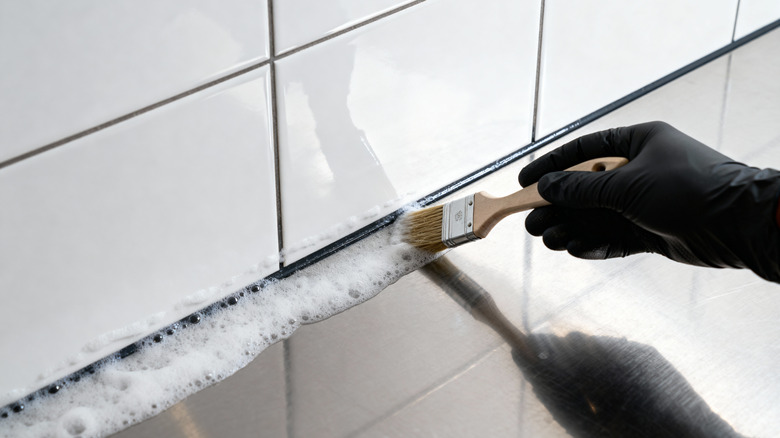
Where there are several genius ways to use chlorinated bleach to clean your bathroom, cleaning your grout lines isn't one of them. Over time, chlorinated bleach can lead to irreversible damage to your grout, eventually compromising its structural integrity and leaving you needing to scrape it all out and replace it. What's more, if your goal is to make your grout look like new, then you should also know that chlorine bleach can eventually lead to discoloration. The answer? Use oxygen bleach instead.
Certain types of oxygen bleach, like sodium percarbonate, are much gentler than chlorinated bleach products. And yet, when dissolved in water, applied to your tile grout, and allowed to work its magic for a few hours (ideally overnight), it can be surprisingly effective at breaking down organic grime. In fact, it can help to restore even the dirtiest white grout, lending your tile work a new lease of life without the risk of damage that comes with harsher chemicals.
Baking soda and hydrogen peroxide combine to fight grime with no nonsense
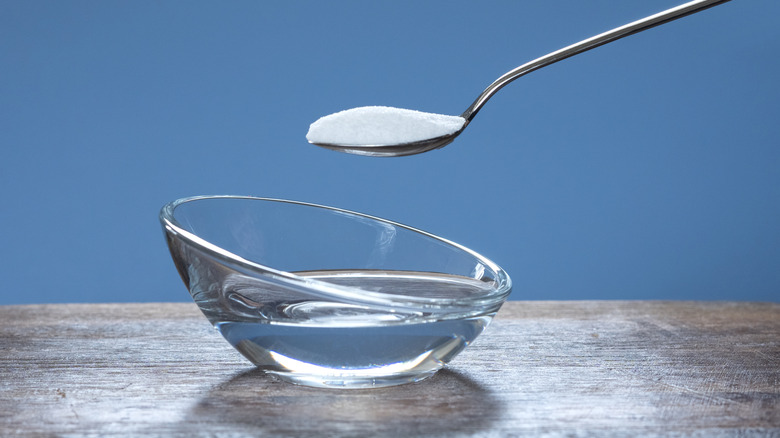
If you've tried baking soda and vinegar to restore your grout and it wasn't enough, consider mixing some of that soda with a dash of hydrogen peroxide. This solution works best on cement-based grout and is decidedly more robust. Just like oxygen bleach, the hydrogen peroxide, in combination with the abrasive baking soda, attacks and lifts the stains on your grout lines without causing unnecessary damage.
To use hydrogen peroxide in your bathroom this way, simply mix together two parts peroxide with one part baking soda to form a paste. Spread it along your grout lines, and then let it sit. This last part is important, as it's when the magic happens. As the solution sits, the peroxide helps to bleach the tile grout. It works in tandem with the baking soda, whose abrasive nature also helps to loosen dirt and grime. Once it's had time to sit, scrub it with a soft-bristled toothbrush, and then rinse with warm water.
A steam cleaner will lift grime without the use of harsh chemicals
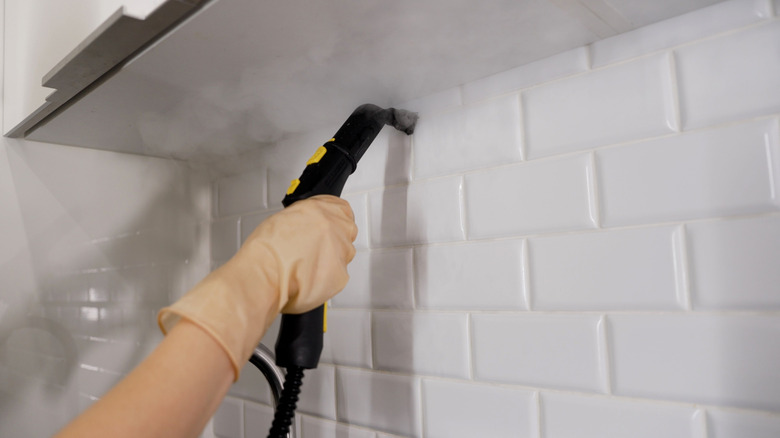
Using a steam cleaner is one of the most popular DIY grout-cleaning methods. The hot steam works its way into the pores of your grout, sanitizing it and killing off any microbes that it may have started to harbor. What's more, when you use a steam cleaner with a grout-cleaning attachment, that steam also helps to loosen any dirt embedded within the grout lines.
Now, you can't just use any old steam cleaner. You'll need one with a hand attachment and narrow nozzle, so that you can focus the steam on the fine lines of your grout. You'll also need one of the aforementioned grout-cleaning brush attachments. Try to use a nylon-bristled brush, as this is unlikely to damage your grout. Alternatively, you could use your steamer in conjunction with an old toothbrush, which will help you to apply extra pressure in any areas that need it.
A mildly abrasive baking soda paste is worth trying for general grout cleaning
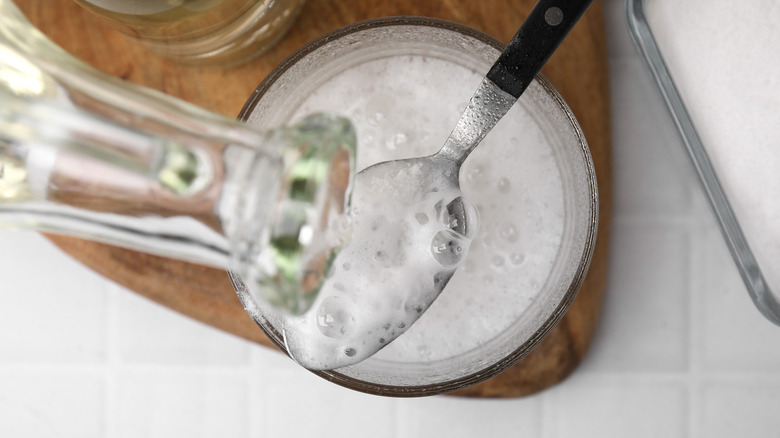
One of several clever uses for baking soda in the bathroom, the theory behind this hack is that the soda's mildly abrasive nature helps to lift surface-level stains without causing damage to the grout. To use it, start by forming a paste with baking soda and water. Next, apply it to the grout and then spray it with vinegar. Let it sit for around 15 minutes, allowing the mixture to "fizz" away at your grout, before scrubbing it gently with a soft brush and rinsing with warm water.
This method is ideal for both porcelain and ceramic tiles, however, you should know that if your grout is seriously soiled, you may need to look for a more robust solution. Yes, baking soda's abrasive properties and the acetic acid in the vinegar can help to lift and dissolve surface grime. But unlike, for example, hot steam, this mixture is unlikely to be strong enough to root out any dirt or grime that's become deeply embedded below the surface.
Whitening toothpaste is worth trying on mild, surface-level stains
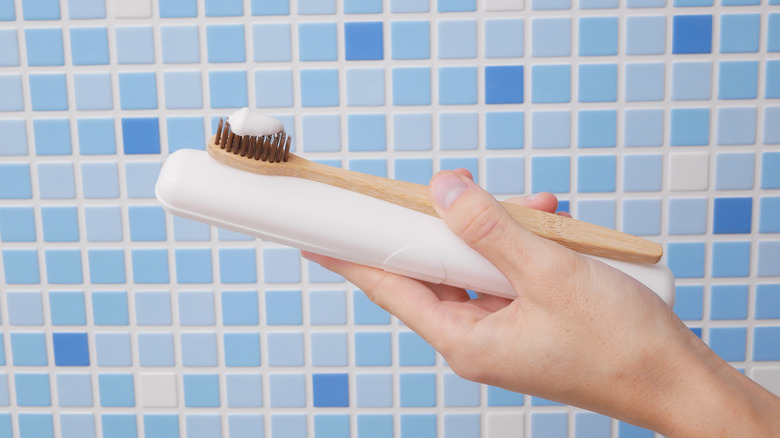
We touched on this earlier, and we'll say it again. If you have a tube of whitening toothpaste in your bathroom cupboard, then it's absolutely worth trying it as a means of cleaning your grout. Like baking soda, it contains mildly abrasive particles, which can make lifting and brightening dingy tile grout easier. Just know that it's unlikely to completely restore severely-soiled grout lines, and that it won't penetrate enough to resolve deeply-embedded stains.
Instead, you may find that this is a better way to clean grout that's already in reasonable shape and which just needs a surface scrub. To try it, apply a thin layer of the toothpaste to your grout lines using an old toothbrush, allow it to sit for a few minutes, then gently scrub it. Once that's done, rinse the paste away with warm water. If nothing else, at least your shower will smell nice and minty fresh!
A magic eraser may restore your dingy grout lines
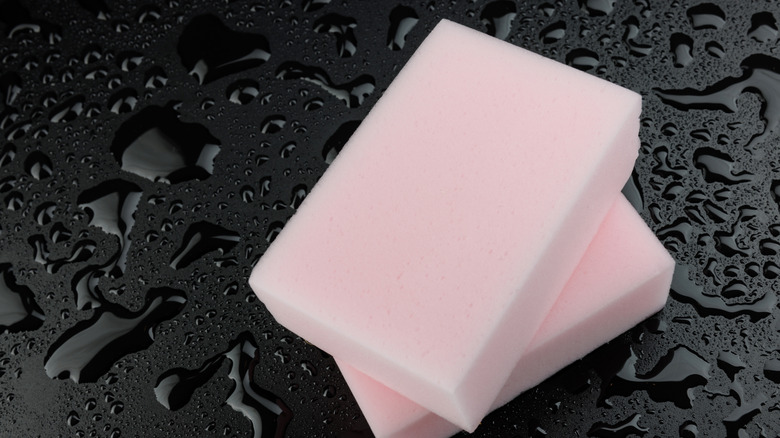
If you've ever experienced the wonder of a magic eraser, then you'll know just how useful they can be for an array of cleaning applications. Made of melamine foam, they act like mildly-abrasive sandpaper. They're great for lifting surface grime off of a multitude of surfaces around the house, and you guessed it — that includes the grout between your tiles.
We should stress that these sponges are unlikely to work on grout lines that are severely and deeply stained. But if you think the grime is surface-level only, then a magic eraser could well do the trick. It's certainly worth ruling out before switching to harsher, more chemical-based solutions. Just bear in mind that tile grout can be fairly hard on these types of sponges, and that they can quickly start to disintegrate. If your sponge begins to fall apart and your grout doesn't look any cleaner for it, then that's a sure sign that you need to try something more heavy duty.
Shaving cream could help to lift surface grime from your grout
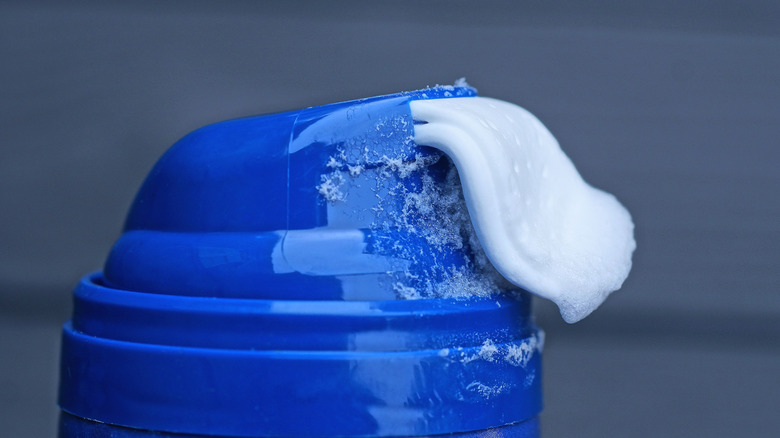
Like whitening toothpaste, if you happen to have a can of shaving foam hiding away under your bathroom sink, then there's no harm in at least trying it on your tile grout. According to what is mostly anecdotal evidence, the foaming agents contained in shaving cream work to loosen and lift light dirt and soap scum from your grout. In other words, it should at least make cleaning your bathroom or kitchen tiles easier.
To use it, spread some of the foam over your grout and allow it a few minutes to work away at the grime. When it's had a chance to work its magic, use a soft-bristled brush to gently scrub the grout, and then rinse the foam away with warm water. Again, this method may not be the best if your grout is seriously stained. But if it's already reasonably clean — and those birthday bottles of shaving cream from your aunt are starting to build up — then it could well be a cheap and easy way to level up your regular cleaning schedule.
Grout pens can temporarily make your tiles look fresh in the medium term
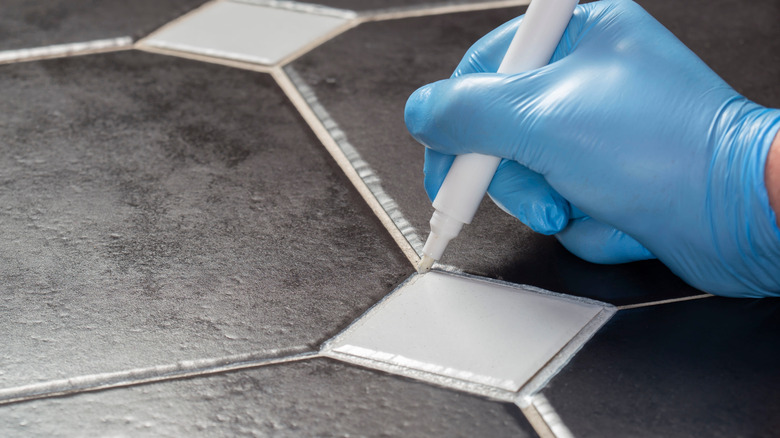
Grout pens, as you may have guessed, offer an affordable way to restore the grout around your tiles versus regrouting the entire surface. They work much like regular pens in that you simply "draw" over your grout lines, and if used correctly, they can really help to make your tiles pop. However, while they may help to spruce up your guest bathroom ahead of the holidays, they should only ever be used as a medium-term solution.
If you decide to buy and use a grout pen, then it's important that you still clean your tile grout before using it. By themselves, these pens don't fix any underlying issues with grime or dirt, and if you simply use them to cover such issues up, you'll only end up locking them in. Grout pens usually double as sealers, which is useful in cases where the grout underneath is clean and free of dirt, mold, and other pathogens. But if it's not, then all the pen is likely to do is lock all that nastiness in. And while there's much to be said for the old adage "out of sight, out of mind," it could spell disaster for your bathroom or kitchen wall if you merely cover up a problem instead of addressing it in time.
A salt scrub may make cleaning easier by dehydrating mold and bacteria
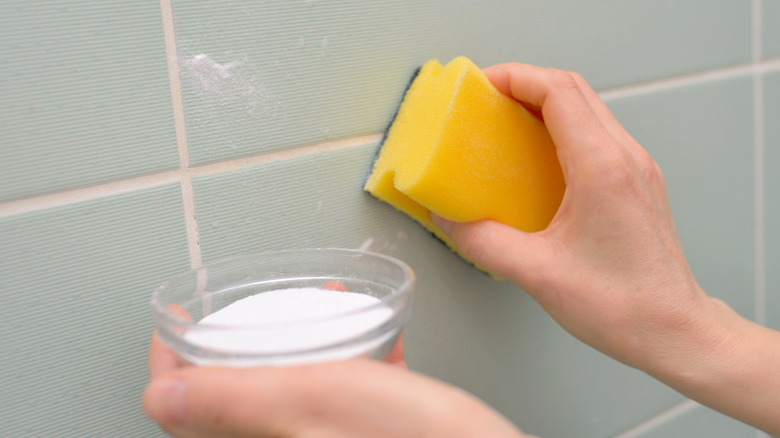
If your bathroom recently recovered from a mold problem and your grout is still showing signs, then a salt scrub may help. The salt works to dehydrate the organic debris that leads to old and dingy tiles, like mold. So, try sprinkling some salt over your tiles (ensuring that they're wet so that the salt sticks). Allow the salt to soak in, then use a brush to work the salt into the grout lines. Let it soak overnight, and then rinse the area with warm water.
We should say, at this stage, that salt alone is unlikely to help seriously dirty grout look like new. As a cleaner, it could be handy, especially if you have mold that you need to kill. However, if you need dramatic results, or are working with grout that is severely soiled with deeply-rooted stains, then you may be better off trying other recommended cleaning solutions, like hydrogen peroxide or oxygen bleach.
Chalk could help make your grout look new, albeit temporarily

If you have guests coming over, and you don't have time to scrub your tile grout within an inch of its life, then consider using chalk. This won't remedy any of the underlying issues behind your dingy grout. As we've already mentioned, any dirt, grime, or mold should always be cleaned and eradicated before applying anything more permanent.
What's more, if you use chalk on bath or shower tiles, then bear in mind that it'll wash away very easily should somebody decide to turn on the tap. However, if the shower is unlikely to be used and you just want to enjoy a little home pride during your guests' next visit, then using chalk is an easy way to make your grout look clean and new. It's also cheap, and shouldn't more more than a few minutes.
Dye or colorant could help to refresh, and reseal, your tile grout
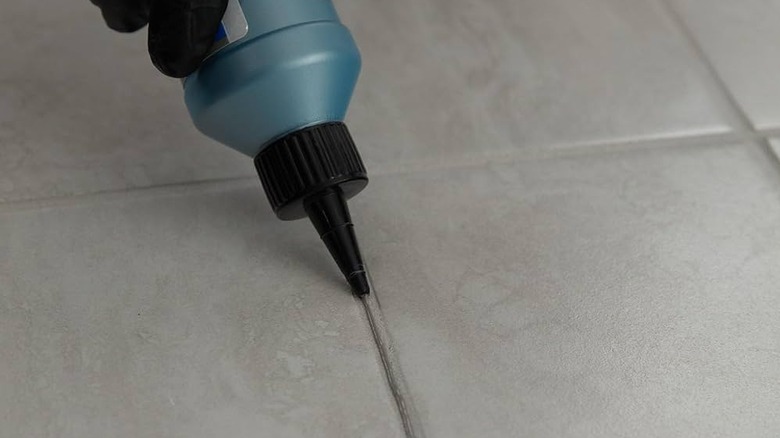
Just like grout pens, using dyes or colorants can help to restore the look of your grout. They also allow you to change the color of your tile grout in a snap without the hassle or expense of actually regrouting. However, they don't inherently "clean" the grout.
Sure, if the grout beneath is clean, then these products can help to seal your grout lines against invasions from dirt, grime, and mold. But if those things already exist, and you don't do something to eradicate them before applying your dye or colorant, then all you'll end up doing is sealing in the problem. Conversely, if the grout is stained but otherwise clean — and the tiles around it are in perfectly good condition — then using dye or colorant could be the perfect, cost-effective way to make your grout look brand new again. Plus, products that also act as a sealant (like Mapei UltraCare Grout Refresh) can help prevent further discoloration.