

Make Your Steep Driveway More Functional With A Low-Cost Solution

If you own a home with a steep driveway, you're probably pretty familiar with carefully angling your car as it reaches the apron. That agonizing crunch or scrape sound as your car's undercarriage brushes against your driveway is enough to make anyone shudder. But it isn't just your car that's taking a beating; your driveway could get damaged, and might even begin crumbling. Some cars, like sedans and even some sports cars, can have a low clearance and regularly struggle with sharp angles like those where the street gutter meets the driveway. Over time, this repeated scraping can cause huge damage to your front bumper, exhaust system, oil pan, and other undercarriage components. Repairs can cost thousands of dollars, making a steep driveway a serious financial liability. Thankfully there's a simple solution: a rubber kerb ramp.
Beyond the mechanical risk for your car, a harsh driveway entry can literally impact your home's curb appeal. You may find yourself swerving at odd angles just to minimize the impact, which can be tough in busy neighborhoods with narrow roads or cramped street parking. Many homeowners assume that the only way to fix this is a total driveway regrade. However, tearing up your concrete is an invasive, costly process that'll require city permits and professional contractors. Plus in many municipalities, pouring your own concrete into the gutter is actually illegal, since it blocks the public drainage systems. But with that clever accessory, you can quickly, easily, and affordably make your driveway's entry point a smoother experience that'll protect your car.
Why is a rubber kerb ramp good for steep driveways?
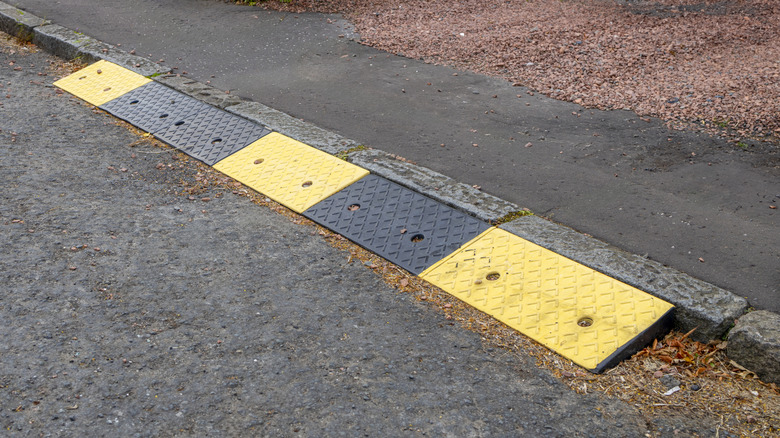
An effective and budget-friendly way to solve this problem is by installing a heavy-duty rubber kerb ramp. Unlike plastic versions that may eventually crack from the pressure, or metal ramps that may rust or slip, rubber is the gold standard for residential use. These ramps are designed to handle heavy SUVs while still providing plenty of cushion for tires. One of the smartest features to look for in a rubber kerb ramp is one with a built-in drainage channel underneath it. This tunnel lets rainwater flow freely through the gutter like it would if the ramps weren't there, ensuring you don't cause localized flooding or violate your city's (or HOA's) codes. What's more, they're modular and come in a variety of shapes and sizes, so you can easily buy the exact number of sections needed for your car's specific wheelbase needs.
Installation is super easy; in most cases, all you need to do is set them down where you want them to go. Most rubber ramps are heavy enough to stay in place via gravity alone. However, some come with pre-drilled holes if you prefer to bolt them down for extra security. These generally cost about $20-$50 a pop for small ones, and up to roughly $75 for a heavy-duty one; that's a fraction of the cost of repaving your driveway. This simple accessory can save your car from expensive trips to the mechanic, prevent your driveway from getting unsightly scuffs and marks, and make the trek in and out smoother. It's a weekend upgrade that pays for itself the very first time you pull into your driveway without hearing that dreaded scraping sound.