

The Affordable Kitchen Cabinet Material Martha Stewart Swears By

Choosing the best material for your kitchen cabinets can be tricky. You want the best of both worlds –- aesthetics as well as functionality. Material type also determines the durability of your cabinetry and how expensive the entire project will be. If you ask Martha Stewart — and why wouldn't you? — she would tell you that poplar wood is one of the best contenders for the job. Not only is it affordable, but it's also easily customizable.
In an interview with Frederic magazine, Martha explained how she came across this discovery. When asked about her Turkey Hill kitchen design, she said of the cupboards, "They were made from a sycamore tree that had fallen down on the property. And while it's a very beautiful wood, it's also very unstable, so the doors eventually warped and cracked. I learned to use poplar going forward for that very reason."
Poplar wood belongs to the hardwood category, though it is quite soft and low in density. This makes it similar to softwoods. It has straight, uniform grains, with a fine texture and light color. It is a popular choice for making furniture and kitchen cabinets because of how easy it is to work with. In fact, some woodworkers find it's one of the best types of wood for a DIY dining table. One of the biggest upsides of using poplar wood for your cabinets is its affordability. Alongside birch and alder, poplar is probably the most cost-effective option for renovating kitchens under a tight budget. An 8 x 4-inch plank of poplar is about $3 to $4 per foot. This is less expensive than red oak or alder and way more cost-effective than other hardwoods like maple.
Advantages of using poplar wood for kitchen cabinets
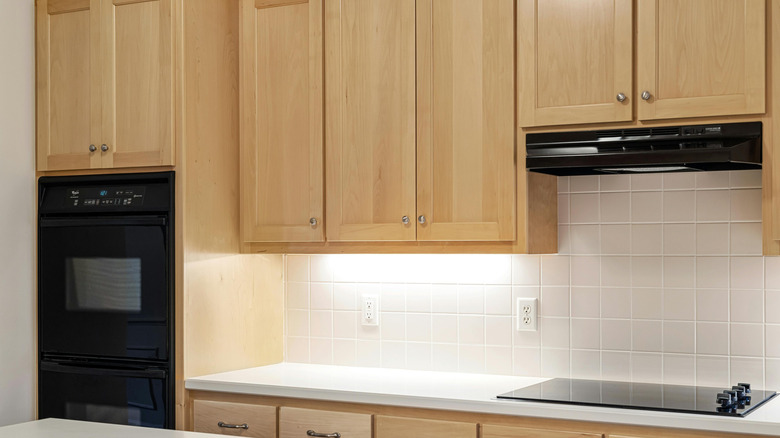
Since poplar is easy to work with, designers may be better equipped to customize the wood to their liking. Compared to other more dense wood types, it does not necessarily take a whole lot of experience or sophisticated machinery to shape poplar into cabinetry or other furniture. If you're the type of person who wants to update kitchen cabinets without replacing them, poplar wood also takes paint and stains quite easily thanks to its tight grains. Poplar is also a great choice for those looking to use sustainable materials in their kitchen. Poplar trees can grow on otherwise useless land, and they grow incredibly fast, which makes the wood a renewable resource.
However, there are some potential downsides to using poplar for cabinetry. Because it is a softer hardwood, it can show dents far more quickly than other more robust wood types. And some experts also note that poplar doesn't always stain evenly because of how porous it is. So for busier kitchens, poplar may not be the best wood option for your kitchen cabinets. That being said, you can improve the durability by properly finishing and sealing your cabinets. So if your kitchen does not see a lot of traffic, poplar can be a great low-cost option for cabinets.