

12 Backyard Birds That Love Birdhouses (& Which Ones Are Best)
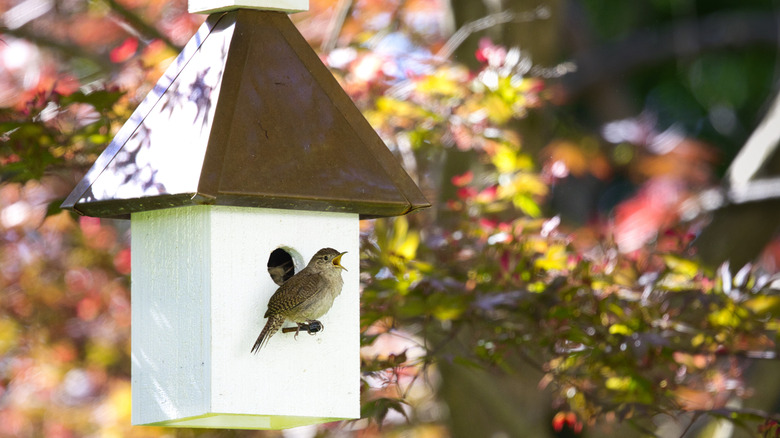
Adding a birdhouse to your backyard can be entertaining for you and offer a welcome resting spot for backyard bird species. But there are some types of birds that rarely use birdhouses or nesting boxes, as they're sometimes called. Some birds prefer other living arrangements, like open platforms on which to build a nest. However, there are plenty of bird species that appreciate the shelter that comes from an enclosed nesting space. Known as cavity nesters, these types of birds like the shelter that a birdhouse provides when building a nest and raising their young.
Even if you choose the best type of birdhouse for your yard, keep in mind that it may not attract a nesting bird right away. If you don't have birds use your nesting box the first year, don't give up. Instead, move the birdhouse to another location on your property. It can also help to put up more than one birdhouse. This gives birds an opportunity to select the nest box that is most appealing. Keep in mind that you should also choose a color for your birdhouse that is appealing to the bird species you're hoping to attract. Wit all of that in mind, here are the most common backyard birds that love birdhouses and what makes the best type of birdhouse for each one.
Bluebirds like small houses that face east
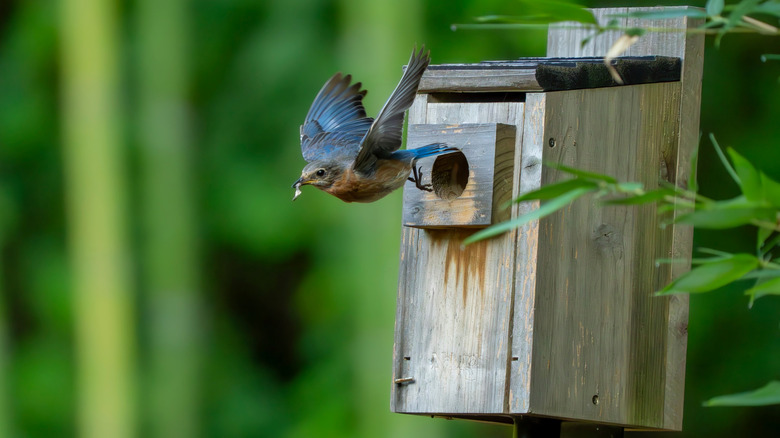
There are three types of bluebirds: eastern, western, and mountain bluebirds. All three of these species will take advantage of the shelter provided by a nesting box to help keep their young chicks safe. At the same time, bluebirds will eat pests, so these beautiful songbirds are a great option for natural pest control.
If you want to provide bluebirds with a suitable birdhouse, it should be medium-sized. It's generally recommended that the interior of a bluebird birdhouse should measure 4 by 4 by 12 inches, with room to expand the footprint up to 5 by 5 by 12 inches. To allow bluebirds easy entry and exit, the entrance hole only needs to be 1 ½ inches in diameter. This small size is plenty for the bluebird but will thwart larger birds that would otherwise take over the nesting box. You'll also want to put the birdhouse in the best place to attract birds. For bluebirds, the birdhouse should be mounted on a pole at a height of 4 to 6 feet from the ground.
Bluebirds start nesting as early as February and as late as September, depending on the region. However, the peak of nesting activity is from March to August. To make your birdhouse as attractive as possible to nesting bluebirds, have the entrance facing eastward. Ideally, it should be pointing toward an open area such as a field or a wetland. That's where bluebirds will find a bounty of insects to feed their growing brood.
Wrens find compact birdhouses near people to be the most suitable
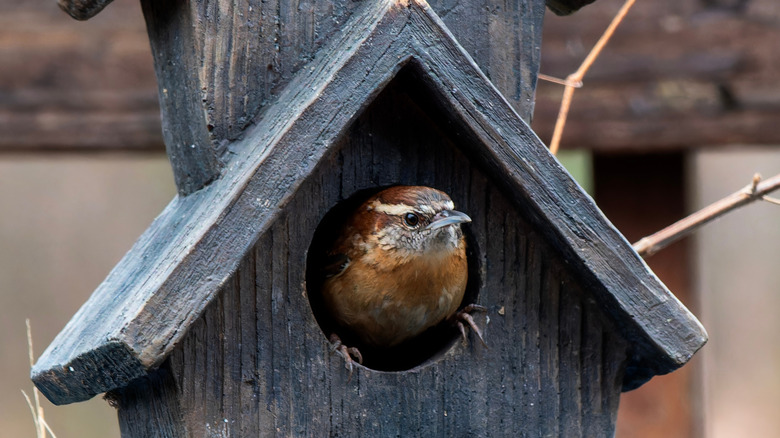
If you want to attract more songbirds to your yard, you might be delighted to have wrens show up. These small songbirds prefer to nest in close proximity to human activity. In exchange for cozy accommodations in a birdhouse, wrens will reward you with singing. This is especially true during breeding season when male wrens will sing out very often, around 10 times in the span of a minute. The right birdhouse for a wren is compact — about 4 by 4 by 8 inches is usually sufficient. Because wrens are petite birds, a small opening of 1 ⅛ inches in diameter will do. That opening is too small for most other bird species, and that's by design, since it keeps out larger birds like starlings.
Wrens like to utilize hanging birdhouses. Some species of wrens, like the Carolina wrens, will use a birdhouse that is concealed in the limbs and vegetation of a tree. Alternatively, you can mount the birdhouse on a pole. To keep a wren's birdhouse safe from ground predators, mount it at a height of 5 to 10 feet.
Tree swallows and violet-green swallows also like small houses
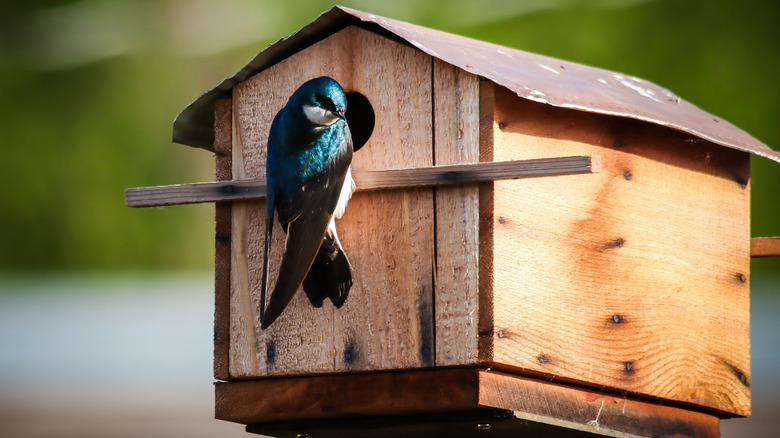
Smaller swallow species such as tree swallows and violet-green swallows will readily take up residence in a birdhouse. If you want to attract these backyard birds to your home, you should make sure that the birdhouse is about 4 by 5 ½ by 9 inches in size — that's about the same dimensions for a bluebird birdhouse. In many cases, these types of swallows will use a bluebird box and easily fit through the small 1 ½-inch entrance hole. The birdhouse should be mounted at least 5 feet from the ground.
There's no need to put a perch on the outside of a birdhouse for a swallow. These birds won't use it, and it may attract other species like European starlings or house sparrows that tend to take over. Tree swallows and violet-green swallows like a steady diet of insects alongside other food sources, such as berries. So having these birds around can help to keep down populations of pesky pests like flies and wasps.
House sparrows like to nest in groups so mount several small birdhouses together
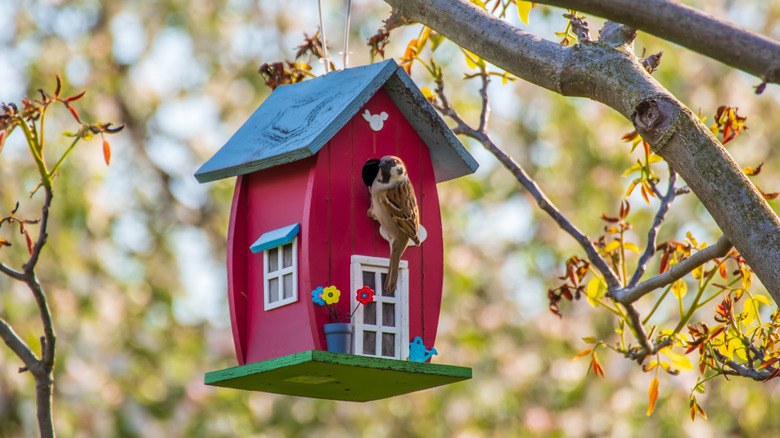
Although house sparrows sometimes get a bad rap for taking over nesting boxes meant for other backyard bird species, their population is in decline. A leading cause is the loss of natural nesting habitats. If you want to give these small birds a spot to nest, a small birdhouse is all that's usually needed. For a house sparrow's birdbox, the dimensions should be 4 by 4 by 8 inches at a minimum. Since these birds are petite, a 1 ½-inch entrance hole is sufficient.
For house sparrows, face the nesting box entrance to the northeast if possible but avoid exposures with intense, direct sun. The birdhouse should be mounted at a height of 6 to 7 feet from the ground. Because house sparrows prefer to nest in groups, it can be more attractive to these birds if you erect several birdhouses in close proximity to each other. This creates the feeling of a nesting colony.
Purple martins need a medium-sized birdhouse near human activity
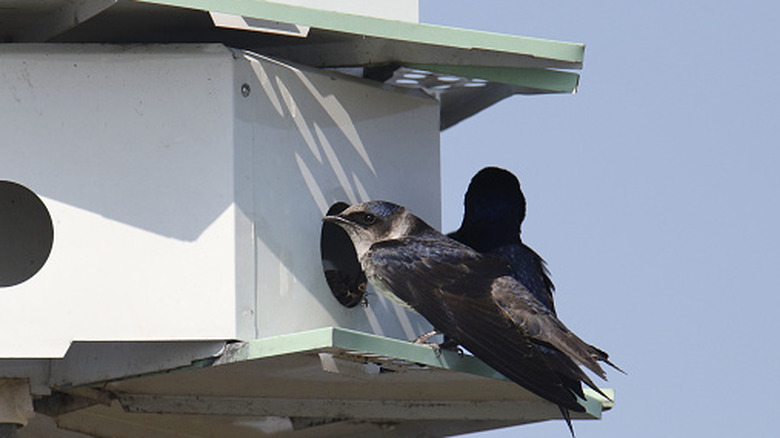
Purple martins are another type of swallow. While they will take up residence in a variety of natural nesting sites, purple martins almost always rely on human-provided nesting boxes in the eastern United States. Since these birds are colony nesters, you might use a birdhouse with multiple nesting boxes. Or, you can mount several birdhouses with single nesting boxes in close proximity to each other, even on the same pole.
These larger swallows need a bigger nesting box than other species. The compartment should be at a minimum 6 by 6 by 10 inches, but if you can expand the birdhouse's footprint to be 7 by 12 inches, that's even better for the purple martin. The entrance hole should be at least 2 ¼ inches in diameter to accommodate this type of swallow. Because that larger opening will also allow European starlings to enter, consider using a birdhouse with a crescent-shaped entrance hole instead. If you go that route, the hole should be 3 inches wide and 1 3/6-inches high.
To protect purple martins from predators, the birdhouse should be mounted 12 to 20 feet from the ground. These birds like open spaces but will benefit from being in close proximity to human activity, so aim for a spot within 100 feet of your house, barn, or workshop.
Eastern screech owls will use a birdhouse if you make it big enough
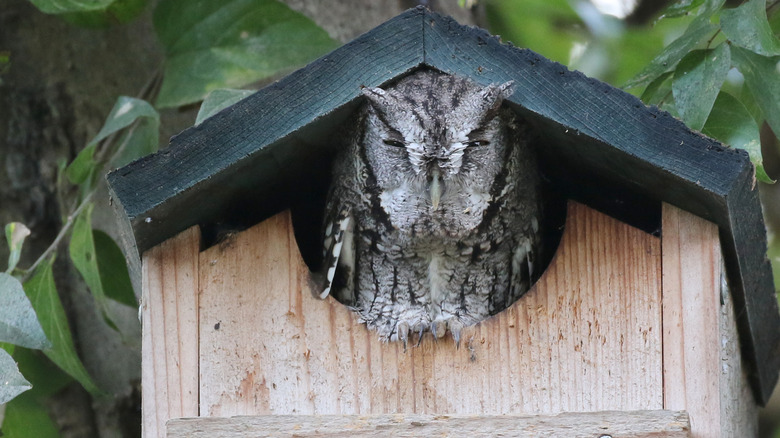
You might not regularly see an Eastern screech owl in your backyard because these birds are well camouflaged during the day and frequently more active at night. But that doesn't mean that you don't have owls nearby that are in search of a nesting site. Eastern screech owls are known to adapt to manmade birdhouses, but you'll need to provide a box with the right dimensions. The box should be about 9 ⅝ by 11 ¼ by 17 ⅜ inches in size. For the owl to come and go, the entrance hole should be 3 inches in diameter. Sometimes a pair of nesting owls abandon the first nest they make and choose an alternate site. For that reason, you might consider mounting two boxes in close proximity to each other.
For an Eastern screech owl, it's usually best to mount the nesting box to a tree at a height of 10 to 30 feet. Another factor to consider is the availability of a nearby branch for fledglings as they prepare to leave the nest. The box should ideally be facing east or south since the owls often will sit at the entrance in the sunlight.
Woodpeckers will enjoy a birdhouse packed with sawdust
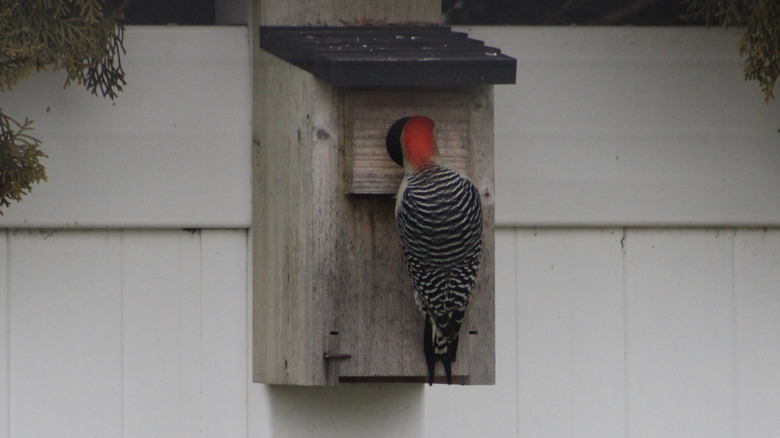
Woodpeckers are a primary cavity-nesting species, which means they can create their own nesting spot by hollowing out a tree. However, a loss of habitat might mean that woodpeckers have to rely on a manmade nesting box instead. If you want to add a birdbox for a woodpecker, make sure that it's big enough for the species that is common to your area. For instance, small downy woodpeckers require a compact nesting box that measures 4 by 4 by 8 inches with a 1 ¼-inch entrance hole. At the other end of the spectrum, the larger redheaded woodpecker will need a birdhouse that is 6 by 6 by 14 inches in size with a 4-inch entrance hole. The birdhouses should be mounted 10 to 20 feet from the ground.
To make a birdhouse more enticing to a woodpecker, pack it with sawdust or woodchips. This makes the structure seem more similar to a decaying tree that a woodpecker would naturally use as a nesting site. The woodpecker can then engage in the natural behavior of "excavating" the interior of the birdhouse before building a nest.
The titmouse likes a birdhouse near trees or bushes
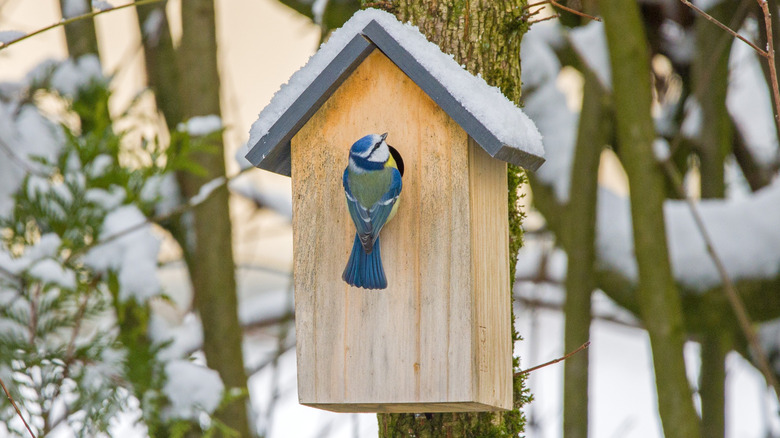
If you want to attract small songbirds like the titmouse to your yard, you will need a small birdhouse. These birds prefer a nesting box that is 5 ½ by 5 ½ by 8 inches in size. The entrance hole should also be small — between 1 ⅛ and 1 ⅜ inches in diameter is sufficient for a titmouse.
Mount a birdhouse for a titmouse on a post at a height of 5 to 10 feet from the ground. It's worth noting that titmouse birds are more likely to use a birdhouse on a post than one that is attached to a tree because of the risk of predators entering the nesting site. The best spot for a titmouse birdhouse is near woods or shrubs. The nearby foliage gives the parent birds something to perch on. In addition, trees or bushes in close proximity to the nest box will also come in handy when fledglings test out their wings for the first time.
Chickadees like a small house with nearby food supplies
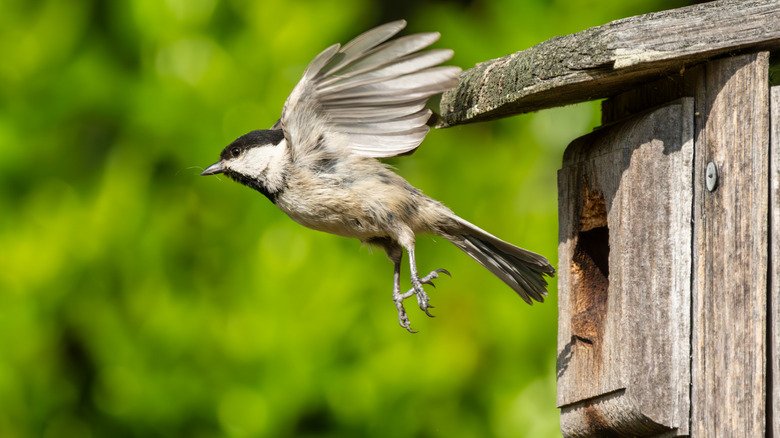
The small chickadee is a common sight in many neighborhoods. If you want to give these little birds a safe and suitable space to raise their young, you'll need a small birdhouse. When building a birdhouse for chickadees, it's recommended that the box have dimensions of at least 4 by 4 by 9 inches. A small entrance hole with a diameter of 1 ⅛ inches is just right for the chickadee but will block bigger birds from entering the nest box.
Chickadees usually start their nesting activity in April or May. The best spot for a chickadee birdhouse is in a yard with mature trees to provide some shade. Mount the birdhouse at a height of 5 to 15 feet. Nearby bird feeders stocked with small seeds are especially attractive to this bird species. In addition, chickadees feed their young invertebrate insects, with caterpillars forming a major part of the baby birds' diet. If you have plants nearby that attract these types of bugs, that makes your yard even more ideal for chickadees.
American kestrels need a medium-sized birdhouse with wood chips inside
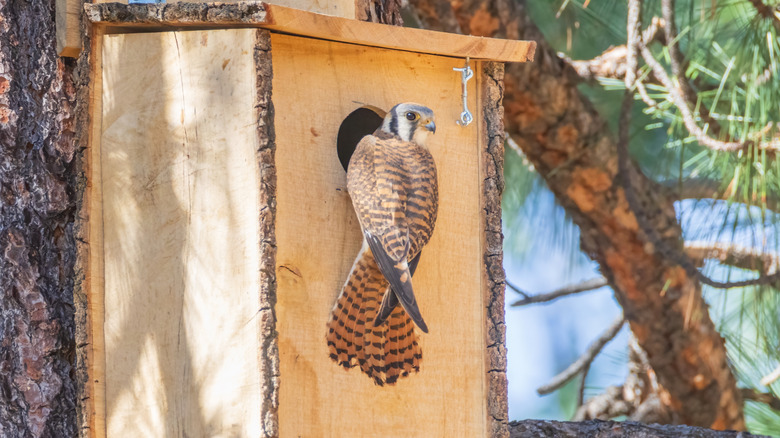
The American kestrel is the smallest species of North American falcon. Its habitat stretches across most of the United States, with breeding activity centered in the northern Midwest states. In some areas, the species is declining in population. By installing a suitable birdhouse, you can attract these colorfully plumed birds to your backyard and help support their nesting activity.
These small falcons need a birdhouse that is at least 8 by 8 by 14 inches in size. The entrance hole should be 3 inches in diameter. These birds appreciate a 2- to 3-inch deep layer of wood chips on the floor of the birdhouse. An ideal spot for an American kestrel nesting box is near a grassy area, like an open field. It should be facing south or west and mounted 10 to 30 feet from the ground.
Warblers prefer small birdhouses near a water source
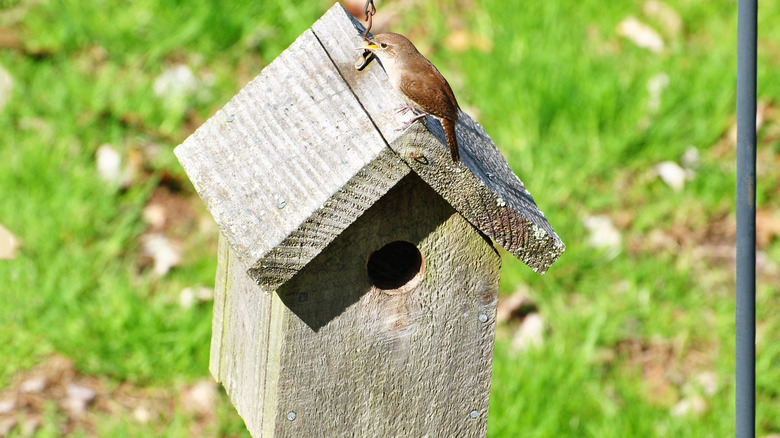
Warblers are small songbirds that are well-known for their quick, agile movements. If you want to get up close and personal with a warbler, you might think that a birdhouse is a good way to attract the birds to your yard, but most warbler species don't use birdhouses. However, there are two species that do — Lucy's warbler and the prothonotary warbler.
For a warbler birdhouse, you'll need a small structure. The recommended dimensions are 4 by 4 by 8 inches. These birds are petite so only a 1 ¼-inch entrance hole is needed. The birdhouse should be mounted at a height of 4 to 7 feet from the ground. Warblers are particularly attracted to still or slow-moving water. With that in mind, the most ideal spot for a warbler birdhouse is within 16 feet of water. You can even mount the birdhouse directly above the water, but if doing so, it should be at least 3 to 5 feet above the highest water level line. If you don't have a natural water source nearby, adding a birdbath to your yard might also help to attract warblers.
Nuthatch birds are attracted to a small birdhouse that contains sawdust
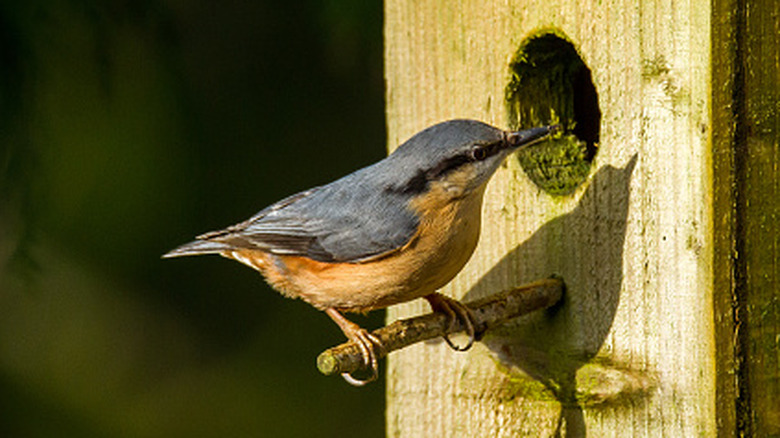
Nuthatch birds are most notable for being able to expertly descend from a tree. These small birds have a sharp rear claw that gives them traction to climb down the bark of the tree. If you want to build a birdhouse for a nuthatch, the ideal dimensions are 4 by 4 by 8 inches with a small entrance only of 1 ¼ inches. The birdhouse should be mounted 5 to 18 feet above the ground. Even after the nesting season, a nuthatch may use a birdhouse as a place to roost when the temperature drops during the winter.
Nuthatch birds are primary cavity nesters, but they are considered weak excavators. This means that they can't hollow out dense wood like a woodpecker, so they look for decaying wood to create a hole. To make a birdhouse more attractive to a nuthatch, fill it with about an inch of wood shavings. The shavings mimic decaying wood and give the bird the opportunity to fulfill its excavating instinct.