

The Affordable Wood Countertop Material That Adds So Much Texture & Character
We may receive a commission on purchases made from links.
It's generally assumed that if you want pretty wood countertops, you'd better be willing to pay a pretty penny. Walnut countertops can cost between $75 and $300 per square foot, while cherry and maple can run around $40 to $275 per square foot. Of course, there are cheaper wood options like acacia and red oak, but choosing one of these might mean sacrificing on looks or durability. However, there's one more affordable wood type that deserves more recognition for its strength and long-lasting beauty. If you're dreaming of gorgeous butcher block countertops but you're not ready to spend a fortune, consider outfitting your kitchen in red birch.
Red birch wood actually comes from the yellow birch, one of the common species of birch tree found in the United States. Like many other species, the heartwood of yellow birch contains more tannins, giving it a naturally darker color that the rest of the tree. Birch countertops can be considerably less expensive than other types of wood, roughly $25 to $75 per square foot, though red birch may be on the higher end due to its narrow board width and intensive drying process. Once rather popular for cabinetry and other pieces, red birch wood shares many of the same properties as yellow birch, including relatively easy workability and easy staining. It also features a subtle grain pattern that can bring effortless warmth and texture to any space.
Red birch offers rich color and decent durability
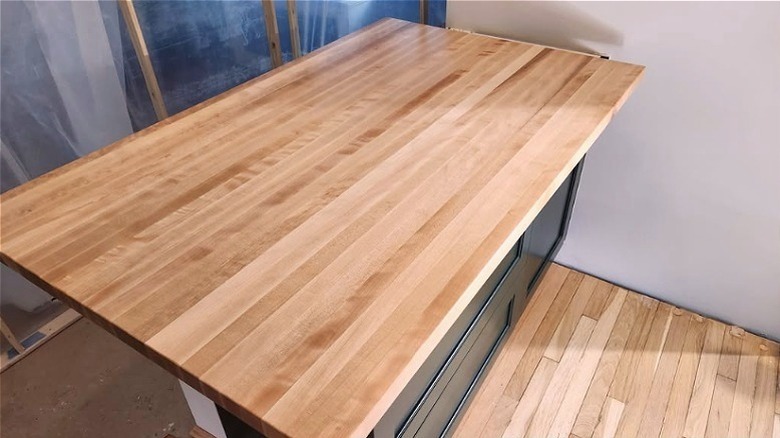
Red birch countertops aren't especially common, so you may need to spend some time scouting around local retailers or consider constructing the countertops from lumber yourself. Some stores like Home Depot sell pre-made birch countertop slabs. These are typically lightly pre-stained to have a uniform color. Although it has been more frequently used for cabinets in the past, red birch has many qualities that make it one of the best types of wood for a DIY butcher block countertop.
Red birch's natural color is a soft reddish-brown, though it may display streaks of lighter yellow wood. "A lot of folks with an untrained eye might think that it's just cherry that hasn't darkened yet," explains Brian Long, founder of CabinetJoint (via YouTube). "It does have that kind of pinkish-red color and very similar graining, but it really is colorfast, meaning it will not change with UV light the way cherry does." For those who aren't especially drawn to this wood tone, red birch takes stain easily, so it can be darkened to look more like walnut, aged cherry, or other popular countertop materials. The grain pattern also isn't very intense, so it's great for those who prefer a more even, uniform look in their butcher block.
Red birch has a hardness rating of 1260 on the Janka scale, making it just slightly softer than red oak but harder than black walnut, two very popular butcher block materials. Maintenance is one major downside of butcher block countertops you should always consider, and red birch makes no exception. Red birch is susceptible to warping and won't withstand too much moisture, so it may be best for islands and countertops without a sink.