

The Crafty DIY That Gives Your Boring Lamp A Stunning Upgrade

We may receive a commission on purchases made from links.
Damaged, stained, ripped, or just plain boring: an old lampshade need not dim your lamplight. Imagine a cozy glow passing through colorful beads instead of dusty fabric. If you find yourself looking for creative ways to give your old lampshade a fresh new look, remove the offensive material completely in favor of something more whimsical. Instead, fill the frame with strings of translucent beads that allow tinted light to brighten your home. Even if your first thought is, "I could never make that," the steps for this project are reassuringly simple and forgiving.
To make your own beaded lamp cover, start with a shade that has vertical supports connecting the top and bottom openings. For the beading, set aside jewelry wire and a large amount of translucent glass or plastic beads, like this pack of 1,000 ZXOPM Glass Beads that come in a variety of colors. (With a bit of luck, you might find vintage glass beads that you can score at the thrift store.) From the tool box, grab a utility knife and wire cutters. If you have a wide, shallow plastic storage bin, grab that, too; this can be a handy work surface to catch inevitable stray beads. Lastly, make sure you have a low-temperature LED bulb for the lamp you'll be covering.
Before launching into building your beaded lampshade, source the best kind of shade. Many lampshades have walls made of rigid material that hold together two separate wire rings at the top and bottom. With a few tweaks, a shade like this could take a beaded makeover, but the best shades have a cage-type frame with vertical pieces connecting the top and bottom rings. Some lampshade styles that fit the bill are cut corner, empire, scalloped, and bell.
Build a beaded lampshade
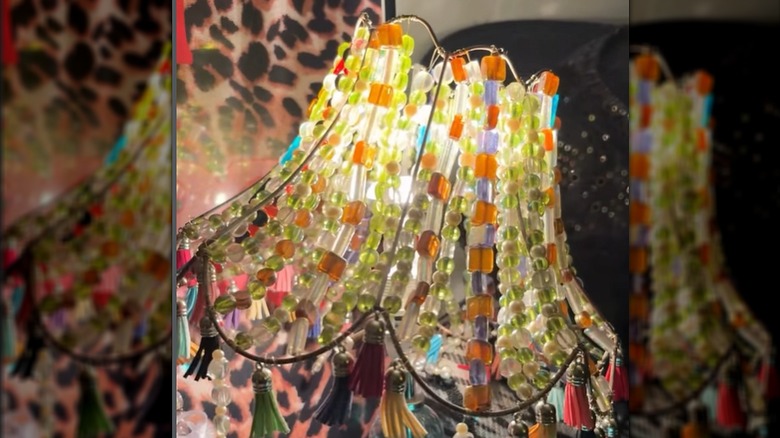
Take care removing the old material on the frame, since the wire form may bend or break under too much pressure. Gently cut away cloth along the wire structure with a utility knife and/or scissors. If your shade is made up of cloth-covered plastic, make sure your utility blade is very sharp before starting, and don't rush the process.
Set the bare shade frame inside the plastic bin, and cut a piece of wire that's several inches longer than the space between the top and bottom rings of the shade. Twist one end of the wire securely around the bottom ring, and slide beads onto the wire until there are enough to fill the vertical space. Twist the remaining wire a few times around the top ring, but don't trim away the excess; a bit of slack might come in handy if you have to make adjustments later.
Continue stringing the beads to the frame, from bottom to top, until all sides are covered. Slide the beaded wires closer to each other as you work. If your bead collection consists of different sizes, and your shade has a bottom ring that's wider than the top, concentrate larger beads near the bottom of the strings to fill in some difference in width. Before twisting the top wires on more securely and trimming the excess, take a moment to see if the strings have consistent tension and that the separate sections of the frame have the same amount of beaded covering. If you're content with the look, place your upgraded lamp in a room that needs some stylish statement lighting.