

Add More Lucky Bamboo Plants To Your Garden With These Easy Propagation Methods
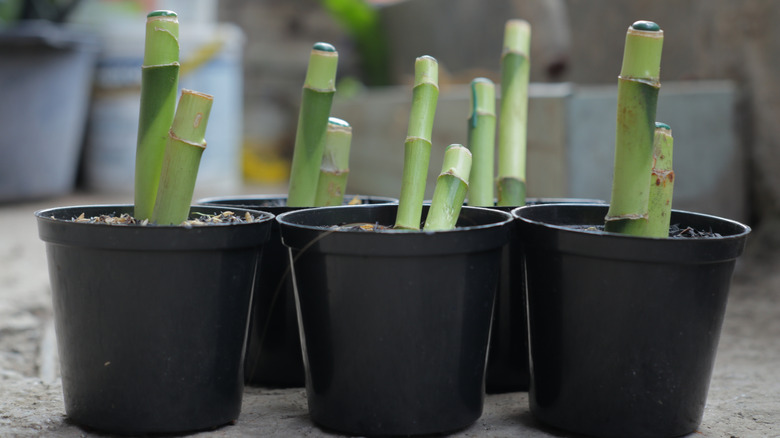
Despite its name, lucky bamboo (Dracaena sanderiana) is not a bamboo (jury's out on the lucky claim), but a type of dracaena plant, just like corn plants and dragon trees. For those fortunate enough to live in the warm climates of USDA Hardiness Zones 10 to 12, you may have a thriving lucky bamboo plant in your yard. If so, you can propagate it and add more plants to your garden in a few different ways, either with soil or with water.
To take cuttings from a lucky bamboo for propagation, first examine your plant for healthy, strong stems. You want to propagate cuttings that have the best chance of success! Once you have found a healthy stem, you can take cuttings directly from this stem, cutting 4 to 6 inches off the tip. Or, you can remove an offshoot from the main stem to use as a cutting. Make sure you are using scissors or shears that are clean and sharp. Make the cut just above the eye or node. You will need to remove the bottom leaves of the cutting for both soil and water propagation.
How to propagate lucky bamboo in soil and water
Once you have your lucky bamboo cutting, you can propagate it with your chosen method. To propagate it in soil, make sure the potting mix you are using is well-draining but able to retain moisture. Perlite or peat moss mixed with sand are both good options for propagation. Dracaena plants tend to root best at around 70 to 75 degrees Fahrenheit, so place your plant propagation station somewhere warm enough for your cuttings. Keep the soil moist and check the cuttings weekly to see if they have rooted. You can give them a little tug, and if there is resistance, it suggests the cuttings are settling in. When they are healthy and strong, you can move them out to your garden and plant them.
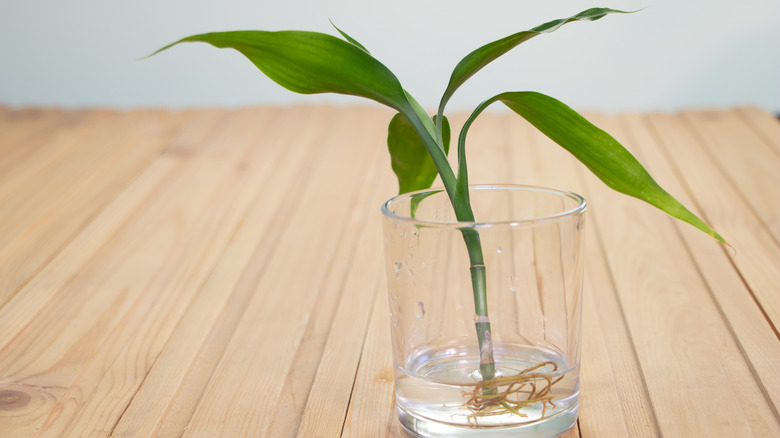
This plant is infamous for its ability to be propagated and grown in water, with lucky bamboo houseplants often found sitting in beautiful bowls and vases. This means that propagating your garden lucky bamboo in water is pretty straightforward. All you need to do is place your cutting in a glass of distilled water. Adding gravel or rocks to the bottom of the vase can help you keep the cutting steady. Keep an eye on your cutting and make sure you are changing the water every three to five days. Soon, it will start to put out roots. Once its roots are established, you can plant it in your garden. Make sure to keep it watered as it settles into its new home, as it will be used to a wet environment.