

Add A Retro Touch To Your Kitchen With A Popular '80s Lighting Trend
When you think of a retro kitchen, you might think of colorful bubble-shaped appliances or whimsical woodland décor, but nostalgic home design doesn't have to go the mid-century route. Instead, you can explore aesthetics of the past in ways that feel decidedly modern. One trick is to look at kitchens of the 1980s for inspiration. One décor trend that screams '80s but is easy to incorporate into 21st century homes is neon lighting.
Neon lighting was invented in 1910 and quickly gained popularity for outdoor advertising and signage. Neon lights are made of sealed glass tubes filled with gas (neon, argon, or a mixture) that illuminates with a unique vibrancy or glow when connected to an electrical current. In the 1980s, this quirky lighting became a relatively common fixture in people's houses.
When you consider the minimalist aesthetics of most kitchens today, neon may not seem like the best type of lighting to use in your kitchen. On the other hand, with colorful LED strip lights trending in recent years, the idea starts to make a lot of sense. You see them illuminating the underside of upper kitchen cabinets or the toe kick of lower cabinets, for example. Like neon lights, LED strip lights let you change the vibe of the space simply by flipping a switch. However, neon lights have arguably more authenticity and atmosphere than LEDs — as long as you style them right. You want them to look fun and retro, not outdated.
How to bring the neon light trend to your kitchen
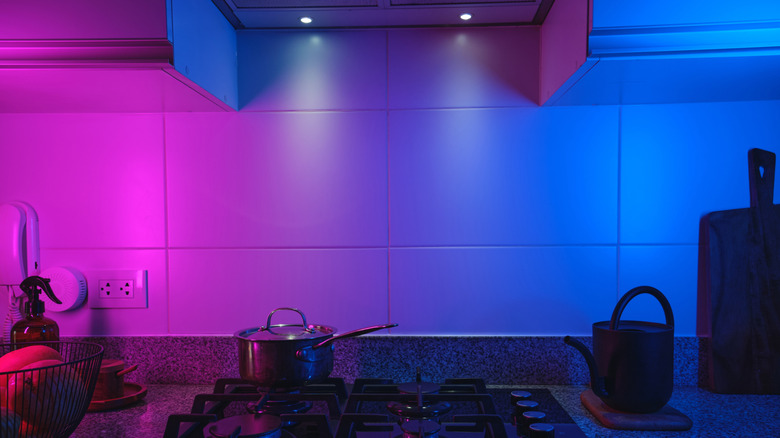
Are neon light fixtures a cute home accent or seriously outdated? Depending on how you use them, retro décor like neon lights can be overwhelming in a kitchen, making the interior design feel gimmicky. Using them as an accent rather than your main source of lighting — a vintage neon lamp, a neon sign, or playful under-cabinet lighting — is a good approach. Limit neon illumination to a single spot, such as a countertop corner, a kitchen table, or a feature wall.
The size and shape of the lighting you choose will determine the price, with large and complex designs costing more. Expect a custom neon sign up to 2 feet wide to cost anywhere between $200 and $500. Go larger, say, between 3 and 5 feet, and the price jumps — about $600 to $1,300. Of course, prices vary widely across areas, brands, and manufacturers. For a more affordable alternative, there are faux-neon signs on the market, like this Folkive Let's Eat LED Neon Sign for about $36.
Outside of getting creative with style and size, the real fun of neon lighting lies in the wide variety of colors it comes in. Pink, yellow, orange, and blue are all popular hues. Orange can be a good choice for warm kitchens, especially if you want that retro feel, while yellows and blues create a cooler effect. If your kitchen is primarily black or white, you can choose basically any color of neon lighting you want, but warmer hues work best in kitchens with lots of wood detailing.