

How To Identify Hull Pottery, The Stunning Brand That Adds A Nice Vintage Touch
If you love collecting vintage decor for your home, you'll know that the secret to using vintage ceramics as decor is to mix and match pieces that look beautiful together. You'll undoubtedly have come across Hull pottery while you've been out thrifting for more collectibles. The Hull company started producing its unique pottery pieces way back in 1905, starting with dinnerware and other useful items such as bowls and jugs. However, around the 1920s, the company ventured into producing art pottery with a range of more colorful glazes. For 50 years, right up to the mid '80s, Hull pottery continued to produce new pottery items and ranges, which means there are likely to be lots of different pieces that you could potentially add to your collection. All you have to learn is how to identify this stunning line of pottery correctly by looking for some distinctive markings on the different pieces.
This can often be a bit tricky because there are many different trademarks, logos, and numbers that could potentially identify these vintage pieces, although most items are usually well-marked. It seems that the company chose to use different markings for the many varied ranges or lines that it created over its 80 years of production. From simple numbers within a wreath to beautiful cursive scripts, it helps to know exactly what to look for when identifying branded Hull pottery.
The different trademarks and logos used by Hull Pottery
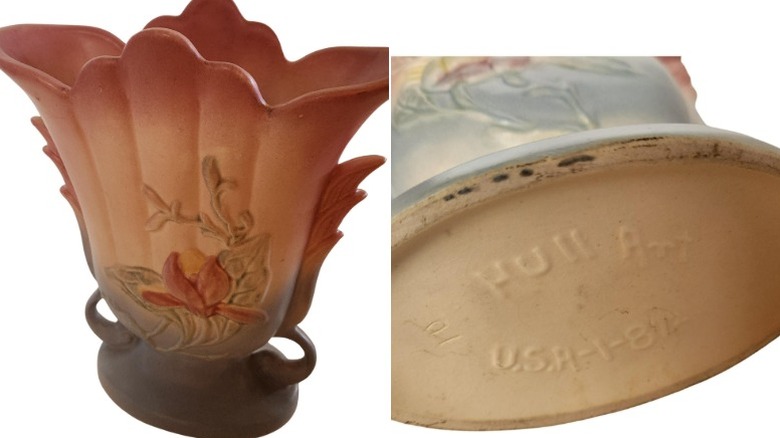
The earliest pieces of pottery produced by Hull around 1910 would have a wreath with a number on the base, along with the Hull name. You would find this marking on the bottom of jars and jugs. If you're looking at older kitchenware, you might see the letter "H" within a circle or a diamond. From around the 1930s onwards, trademarks may have included "U.S.A." or simply "USA" along with the Hull name. Some pieces may even have the words "Hull Made."
The popular Little Red Riding Hood Line is normally quite easy to identify because pieces should have this marked on the base along with the words "Hull Ware," and sometimes even the patent number. On the other hand, pieces in the Gingerbread range may have a simple smiling face logo along with the words "hull gingerbread man u.s.a." in a cursive font.
Of course, Hull pottery can also be identified by its glazes and interesting color combinations. Its brown pottery or oven-proof line features a deep brown glossy glaze, while many of the art pottery pieces can be distinguished by their color combinations of muted pinks, greens, blues, yellows, and creams. While Hull pottery is not one of the most valuable brands of vintage porcelain, there are some slightly rarer items that you might want to keep an eye out for, like the Little Red Riding Hood cookie jar, which is one example of an expensive vintage cookie jar that's worth looking out for when thrifting.