

The Rare & Valuable Pottery Artist Whose Work Every Collector Wants To Get Their Hands On
We may receive a commission on purchases made from links.
The first step on the path to becoming a collector is often the acquisition of a single piece of art. Then the bug bites, and people want more of the same style or a particular artist to add to their collection. Value isn't always measured in dollars — some collectibles are rare, but others simply make the collector happy. In the world of pottery, names like Rookwood and materials like earthenware are among the vintage pottery brands collectors look for, but the rare and now valuable pottery created by the remarkable George Ohr at his studio in Mississippi has gained popularity. The story of his pottery and his outlandish behavior only add to his art's mystique.
Potter George Ohr dubbed himself the "Mad Potter of Biloxi." Born in 1857, Ohr was a master of self-promotion, turning his studio into a tourist attraction with signs that extolled his greatness. The eccentric art potter sported an 18-inch mustache that he tied behind his ears and spent decades demonstrating to his fellow Biloxians that he was at least a little bit "off." In 1910 he retired, crated up 7,000 pots, put them in storage, and told his family they couldn't sell them for 50 years. He never created another piece.
Ohr's delicate pottery was unlike what others were producing. Asymmetric vases appear crushed or folded in on themselves, pitchers have multiple serpentine arms, and pots sport ruffled edges. They're all fired with kaleidoscopic colors that set his pottery apart from that of his contemporaries.
The unusual history of George Ohr's pottery
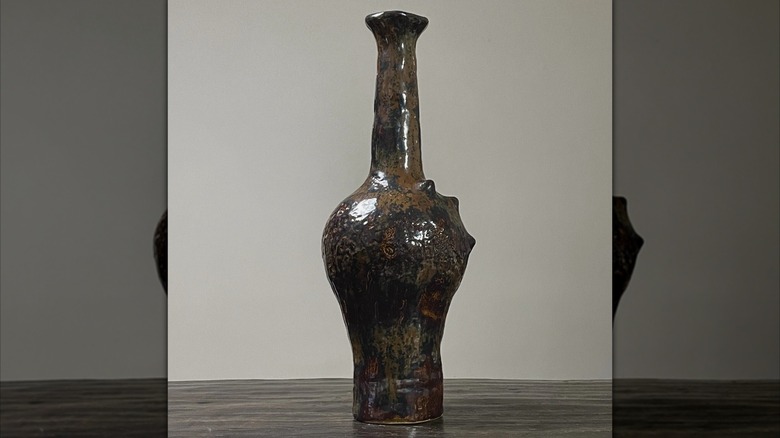
After years of negotiations, Ohr's son sold the pots that had been stored in boxes in the back of his auto repair shop for 50 years. The buyer moved them to New Jersey, and little by little, Ohr was reintroduced to the world. Artists like the painter Andy Warhol recognized them as works of art, and in 2014, a Frank Gehry-designed museum in Biloxi opened a permanent display of Ohr's work. Since then, the works' quirky beauty, rarity, and desirability to collectors like Steven Spielberg have driven up the prices. When Ohr was asked what his pottery was worth, he'd answer that the pieces were "worth their weight in gold" (per Smithsonian magazine). Today, authentic pieces sell for a few thousand dollars to hundreds of thousands at auction.
If you're a collector, the value of a George Ohr piece depends on its condition, its rarity, the glaze, and the provenance. If you think you've spotted authentic vintage pottery at a thrift store or estate sale, be aware that there are knockoffs for sale, so it helps to know how to identify an authentic Ohr. Provenance, or the record of who has owned the piece, with an Ohr might be a little tricky because so much of it was in storage. If the seller doesn't have the record of ownership, look for "G. E. OHR, BILOXI, MISS" or his signature on the bottom. Ohr also created some pieces in collaboration at the New Orleans Art Pottery, which are marked "N.O. Art Pottery Co."