

Purple Hydrangeas Have A Beautiful Secret Meaning When Planted In Your Garden
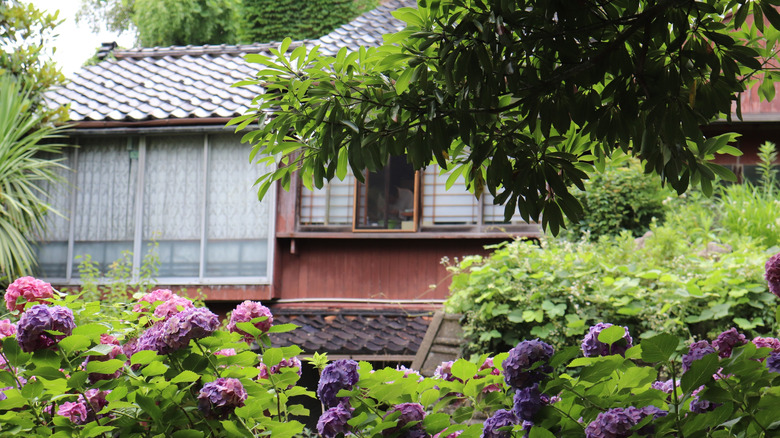
Hydrangeas (Hydrangea macrophylla) were first cultivated in Japan, and they're native to parts of Asia and the Americas. Nowadays, gardeners enjoy them on nearly all corners of the planet, and they're considered to be one of the prettiest flowers in the world. With this plant's wide distribution, it's natural that different cultures have come up with their own symbolism for this plant. Among the gorgeous hydrangea varieties, purple versions are associated with a handful of concepts in Japanese culture. If you live in USDA Hardiness Zones 5 through 11, tuck one into your garden this year to imbue it with a sense of wisdom, nobility, and understanding. Maybe these invisible aspects of purple hydrangeas will rub off on you, too.
Purple hydrangeas are often associated with regal themes across cultures, including in Japan. However, there are other nuances, as well. If you're inspired to plant purple hydrangeas for your next outdoor project, they can spread signs of abundance, gratitude, or a deep understanding of others as they wave their purple heads in the breeze.
Still, there are more layers of meaning with purple hydrangeas. A Japanese folktale tells of an emperor apologizing to a neglected lover with the gift of a hydrangea. This legend has linked the flower in general to apology, and purple ones in particular suggest understanding, endurance, creativity, and tranquility.
Bring purple hydrangeas to your garden
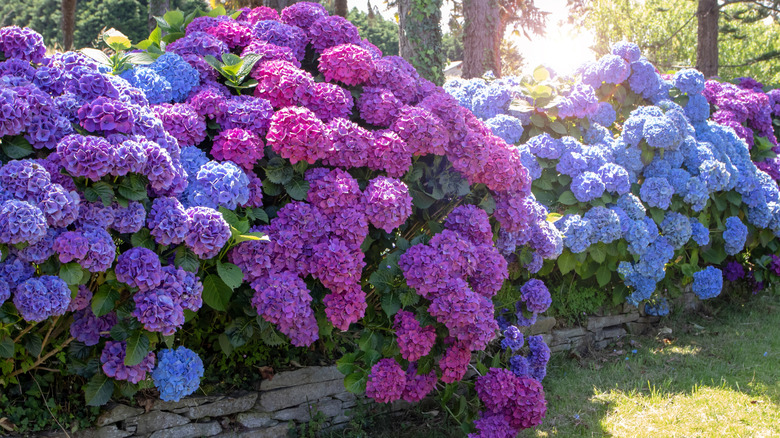
From rich plum to pale lavender or amethyst tones, hydrangeas are available in a range of purple shades. Steep your flower beds in a bit of Japanese symbolism with light-toned purple hydrangeas like 'Everlasting Revolution', 'Endless Summer Twist n Shout', or 'Penny Mac'. Indulge in darker shades with 'Deep Purple', 'Merritt's Supreme', and the slightly magenta 'Wee Bit Grumpy'. If variety is the spice of your life and garden, there are variegated hydrangeas like 'Cityline Mars' with its white-rimmed, orchid-colored petals or 'Rock 'n Roll' whose white buds open into a soft periwinkle.
You may plant one of these types of hydrangea, known for deep purple flowers, but in your garden, it takes on more of a pink or blue hue than what you'd hoped for. The shift in bloom color often reflects the pH level of your soil. If its blooms are more on the pink side, that's a sign that your soil is alkaline, whereas blue shows you have acidic soil. A good pH balance should help encourage purple blooms.
In this way, your newly-planted hydrangea is a sort of "canary in the coal mine," though pH levels can be adjusted over time. However, start with an official pH test to be certain of your levels. If your blooms are too pink, try one of the many ways to make your soil more acidic. To coax some pink into your too-blue hydrangeas, add the right amount of lime to your beds according to your soil's buffer pH (your soil's residual acidity) and your desired pH levels.