

The Ancient Method That Turns Your Walled Garden Into A Functional Work Of Art
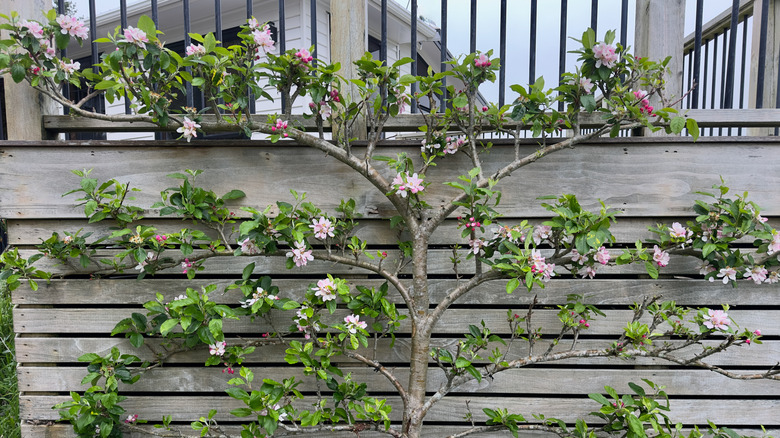
Growing your own fruit trees may seem like a distant dream if you have a small yard, but it might be more possible than you think. However, thanks to an ancient growing technique, known as espalier, you may be able to fit even commonly large fruit trees and shrubs in your garden.
Espalier is a specific way to grow woody plants in thin, but elaborate designs. Generally, this is done for one of two reasons: to fit larger plants into small spaces or to create a barrier. In simple terms, it's essentially a shrub or tree of some sort that is trained to grow in a specific way, usually as flat as possible. To help keep this shape, the plants are grown between support posts, or along a fence, wall, or trellis. It's a method that has been around at least since the ancient Romans. Over the centuries, across different cultures, the process stayed a popular design, despite the work that goes into it.
This is largely thanks to all the perks of the method. For one, it helps you plant trees that might traditionally be too big, especially in narrow yards. Additionally, it helps to protect against frost damage and allows trees and shrubs to grow where they might not otherwise. It's also easier to keep an eye on your plant and cut off problems early.
The kinds of trees you want to consider to espalier
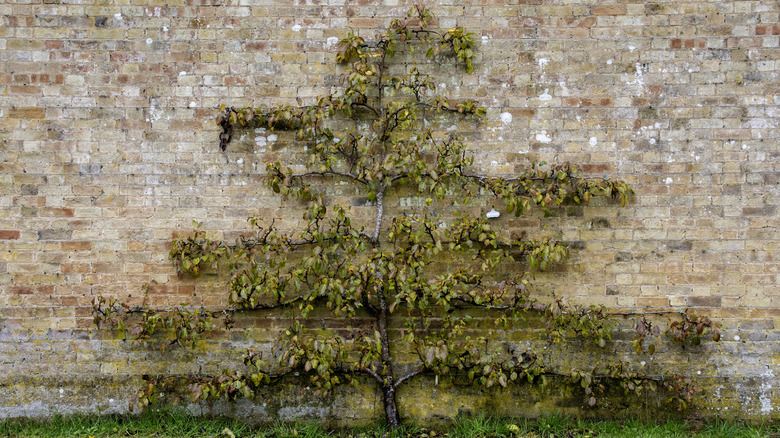
There are plenty of fruit trees that are perfect to espalier, including pears, apples, and lemons. Any kind with long, somewhat bendable branches is a contender. Faster-growing varieties are better, but not a necessity. Generally, apples, pears, citrus fruits, and dwarf trees are considered the easiest. For example, Asian pears make for a low-maintenance pear tree variety that espaliers well and produces a ton of fruit.
Meanwhile, options like peaches and persimmons are a lot harder, as there is a bit of a balance between keeping it trimmed and reducing your fruit yield. For the more experienced folks, it's even possible to graft on a mix of trees, and have every branch produce something different. If you are using a fruit tree, there are perks as well. Since espalier involves a flat design, the entire plant gets sunlight, allowing the tree to dedicate most of its growth towards fruit production.
However, you don't have to limit yourself to this kind of plant. Almost any sort of shrub or tree can be used. While they won't produce food, it still allows you to add more greenery than you might otherwise fit in your yard, and can add a sense of privacy. Some other examples of plants you can try out with this method include firethorn (Pyracantha spp.), camellia (Camellia spp.), iron wood (Ostrya virginiana), and coast silktassel (Garrya elliptica).
Different types of espalier
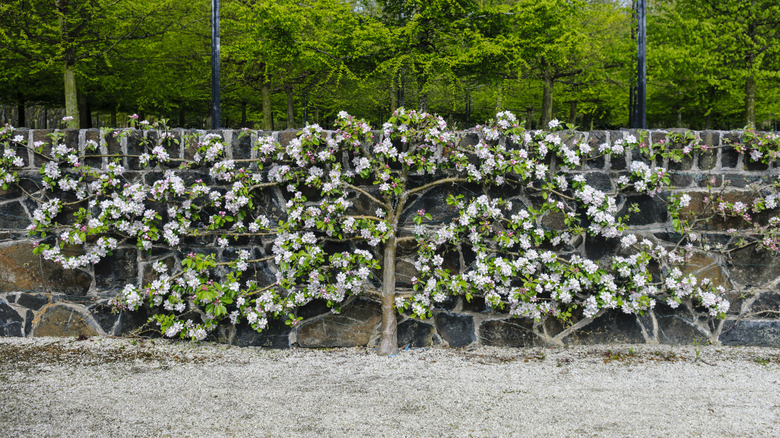
One of the beauties of espaliered fruit trees is that they're easy to make beautiful and to adjust to your garden or yard. Some of the most common designs are the horizontal cordon (a series of horizontal rows of branches), candelabra (90-degree angles to allow for a partially horizontal and partially vertical design), and the Belgian fence (multiple trees interwoven together). However, there are dozens of different designs to choose from, and you can play around as much as you want.
To get your plant to grow into the right shape, most people install guide wires in the directions and spots they want the plant to grow. Then, to train the branches, they use zip-ties or ribbons to hold them to the guide wires. If you want a little more help and guidance, you could also get the same effects by taking advantage of a trellis idea to further maximize your outdoor space. You want to start with a young plant that hasn't developed a lot of branching yet, as it's easier to train. You'll remove any unwanted branches, and place the other ones in the right positions. As the tree grows, you will continue pruning and shaping as needed during late summer. Simple shapes can establish themselves in just three or so years, but complex designs will take more time.