

The Type Of Hydrangea To Prune In The Spring For Bigger, Stronger Blooms
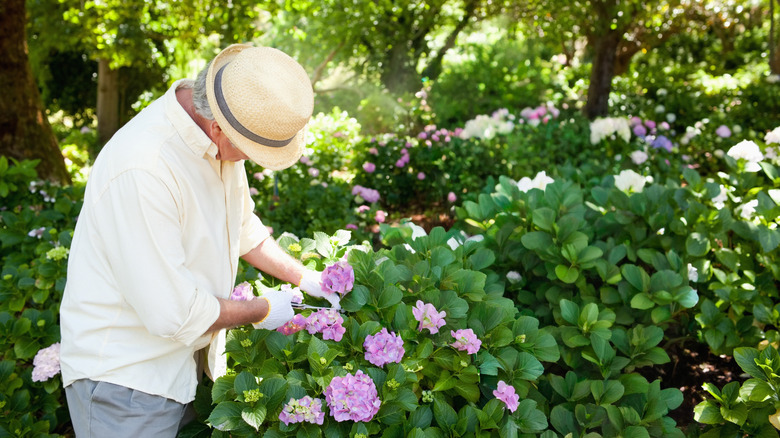
A gorgeous hydrangea in full bloom can certainly take your breath away, but to get to that point with your own plants, you do have to know how to prune them correctly. While there are numerous types of hydrangeas that will thrive in your full-sun garden, not all varieties should be pruned at the same time of year — and for good reason. Different species produce their stunning blooms on either old or new wood. There are two types of hydrangeas that can be pruned in the spring to encourage strong blooms that will delight you with their size: panicle hydrangeas (Hydrangea paniculata) and smooth hydrangeas (Hydrangea arborescens).
Some hydrangea species and cultivars produce their flowering buds in fall. These plants need to be pruned immediately after they've finished blooming in summer. If you wait, you risk inadvertently cutting off all of the developing flower buds. The result is a lack of flowers the following season. However, as mentioned, panicle and smooth hydrangeas produce flower buds on new wood — the stems that grow in the current season. Pruning in early spring encourages these plants to grow plenty of new stems and results in lots of lovely blooms come summer and fall, depending on the species or cultivar. Spring pruning isn't the only reason to favor panicle and smooth hydrangeas over others. They're the perfect hydrangeas for beginner gardeners because they're so easy to grow.
How to prune hydrangeas that bloom on new wood in spring
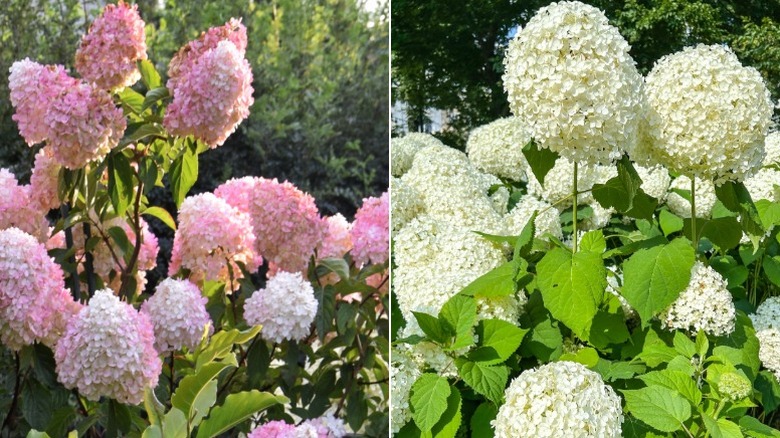
There are a number of delightful and therefore popular panicle hydrangeas, including those in the 'Limelight' series. Their conical-shaped blooms are undeniably stunning, and you'll get plenty of big bunches if you prune your panicles in early spring, just before the leaves start to develop. Pruning helps maintain shrub shape and promotes new growth. Using sharp, sterilized shears, cut the stems back to about ¼ inch above a swelling bud. Make your cuts at a downward, outward angle, facing away from the bud. Among the panicles, there is one versatile hydrangea variety you can grow tall or keep compact in the garden: Hydrangea paniculata 'Quick Fire.' It requires less pruning than its counterparts.
Smooth hydrangeas, such as the cultivar 'Annabelle,' can be cut back quite hard — even right down to the ground — in spring. This usually results in really large blooms, so much so that the stems may not be strong enough to hold them aloft. If you find smaller flower clusters and a large shrub acceptable, you can choose to prune lightly or even forego pruning altogether. You'll still need to remove dead and diseased branches. If you choose a hard prune for your smooth hydrangea to encourage large blooms, cut each stem back to the lowest visible bud. However, bear in mind that constant cutting back will weaken new growth, so consider doing it every second year instead of annually.