

Mike Holmes' Money-Saving Tip For A Kitchen Remodel

Kitchen remodels can already be quite time-consuming and expensive. You would definitely not want to add any more costs or delays than required. If you ask Mike Holmes, the legend of home renovations, one way you can save on costs is by simply not rushing. While a kitchen reno can be exciting at times, buying kitchen appliances before the cabinets are even installed (or measured) can be a huge mistake. In fact, Mike includes the practice as one of the many kitchen upgrades that are a total waste of cash.
However, Mike Holmes categorically warns against the idea of pre-ordering a bunch of appliances and hoping they fit the new kitchen design and cabinetry. "The general rule is to install the kitchen cabinets before you order your appliances, as you want to ensure your measurements are correct and that everything is going to fit," Mike writes on Make It Right.
Kitchen appliances account for nearly 20% of a typical kitchen remodel (per Remodelista). This is especially the case if you're focusing on a complete revamp and not just replacing the same design. In fact, kitchen remodeling is a great time for you to get rid of old appliances and buy new ones. The tip makes total sense, since you might find yourself stuck with too big or too small appliances. For instance, your brand new refrigerator may refuse to fit at the edge of the work triangle if it does not have enough clearance room for ventilation.
Pre-bought appliances may not fit new kitchen cabinets
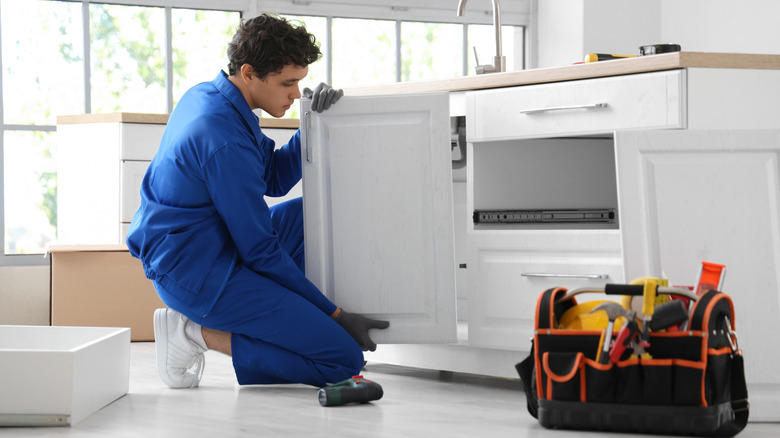
While the age-old adage, "Measure twice, cut once", primarily applies to carpentry and construction, the core principle stays the same for buying new appliances as well. In fact, when you focus on measuring the space in your kitchen and installing the cabinets first, you also get breathing room to pick the right designs and layouts. Only after you have the exact measurement ready should you begin to think about ordering appliances. When you know exactly how much space you have, you are less likely to place a wrong order.
For instance, for an appliance like the dishwasher (usually placed under the counter), the available height often varies from top to bottom. Similarly, the width required to fit the dishwasher can also vary from side to side. Apart from these considerations, you also need to take the room for plumbing essentials into account. Furthermore, for appliances like an oven or refrigerator, apart from measuring the height and width, you also need to consider the depth of the space. In general, when it comes to kitchen appliances with doors, you should be extra careful, since they require more room for functionality.
Having some extra wiggle room around electrical appliances is also a good practice for them to stay ventilated. With such intricate details to design and fit, you're essentially working in guess mode if you're ordering appliances beforehand. This can cause returns, replacements, and more delays.
Pre-bought appliances may not be compatible with cabinet material (or design)
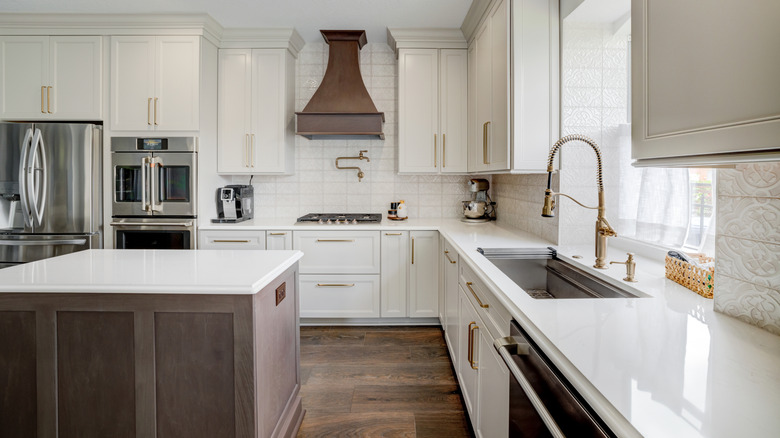
Kitchen material often dictates the kind of appliances you should buy in terms of design as well. For instance, if you're a fan of classic wood cabinet combinations, you might have to let go of that stainless steel refrigerator you just bought, since the two designs will be a total mismatch.
When you have your cabinets already in place, or at least their accurate measurements and designs ready on paper, you can buy appliances that complement your design rather than seeming to be an intrusion upon the space. While you can always return unwanted items, there is usually some cost of replacement that you might have to bear for the entire process.
Furthermore, ordering appliances too early can also create headaches with storage. While your kitchen is being remodeled, you're probably making do with a make-shift kitchen (if you're not a fan of eating out every day for weeks!). Having an extra set of kitchen inventory to store would not just be a problem to solve but could also leave the appliances open to possible damage during that time, which, again, leads to more expenses.