

3 Simple Thrifted Decor Setups To Hide Unsightly Outlets
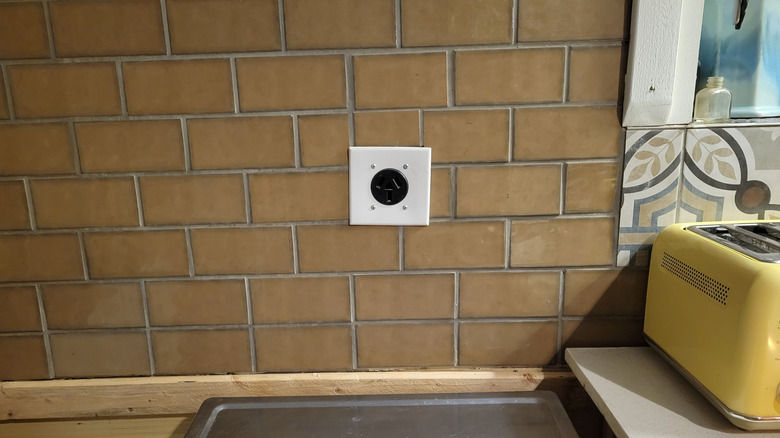
The least surprising thing anyone is going to find in your home is an electric outlet, and that goes for kitchen countertop outlets as well. In fact, countertop receptacles are required by electrical code in most jurisdictions. But people seem self-conscious about them anyway, and I can sympathize more than most. I designed our kitchen without them, blatantly flouting local regulations, and got away with it. They were later retrofitted, resulting in outlets that look out of place. Though not necessarily more out-of-place than the unexpected clutter that comes with some hidden outlets.
They sit awkwardly in the backsplash tile, too deep for a simple cover plate and too shallow for the half-inch box extenders. They are also awkwardly placed because wiring access was limited to the tile edges. This is all the result of our indecision about the final design and layout of the kitchen.
That indecision haunted us in other places, as well. One of the countertop outlets contains a switch that controls a receptacle that used to be on top of some cabinets we no longer have. (I mounted the switch to the wall when removing the cabinets.) That electrical box needed to be disguised. And then there's the 220v receptacle that serviced a wall oven we sold a couple of years ago when we bought into the vintage stove movement. Now that big, round outlet is constantly glaring at us with its judgmental accusations of indecision. We know, outlet, we know.
Hiding kitchen countertop outlets
Common strategies for hiding a kitchen countertop outlet work, but have their drawbacks. Kitchen gadgets are probably already cluttering your countertop, making it difficult to justify adding another item. Simply leaning a cutting board against the backsplash may invite questions about whether it is meant to be decorative or functional. You could lean something useless there, but that only leads to conversations about why your high school diploma is always getting in the way of the outlet, or why a particular olive oil cruet is always empty.
One creative approach is to use a decorative object that draws the eye, making the outlet less noticeable. I have seen, for example, a little arched door built over an outlet. It looked like nothing so much as a mouse door right there on the kitchen counter. Inside? An ordinary receptacle. Alas, not everyone has cooperative mice. The best disguise, then, is an object that looks at home in your kitchen, but which no one will be tempted to actually use, like a low-carb cookbook or a bread machine.
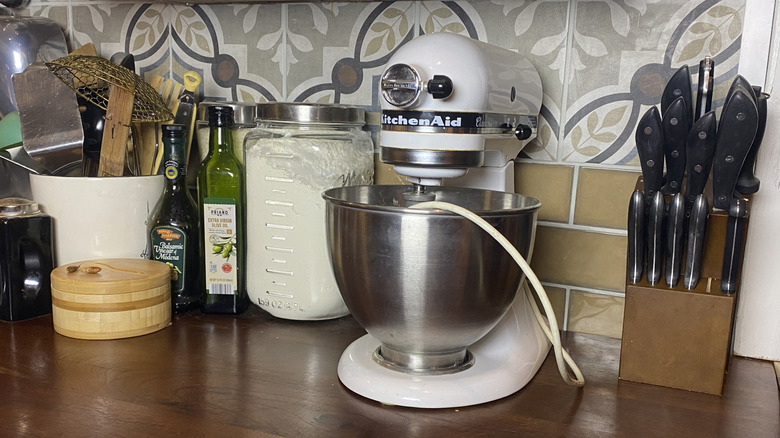
A thrifted knife block can provide substantial coverage for a standard outlet. There's not really any chance of it attracting much attention, generic as it is. Knife blocks also tend to be, well, blocky, which ensures good coverage for situations like mine, where a two-gang outlet is the target.
Hiding peculiarly placed outlets
Covering unusually placed outlets can be more challenging than disguising countertop ones, since an odd place for an outlet also turns out to often be an odd place for a framed print of an unfamiliar landscape or a "lady fashion scarf," as one recent purchase was labeled (my kids use it for magic tricks). These out-of-place receptacles often live higher on the wall than their kin, and were perhaps once used where there was a desk or a wall-mounted television.
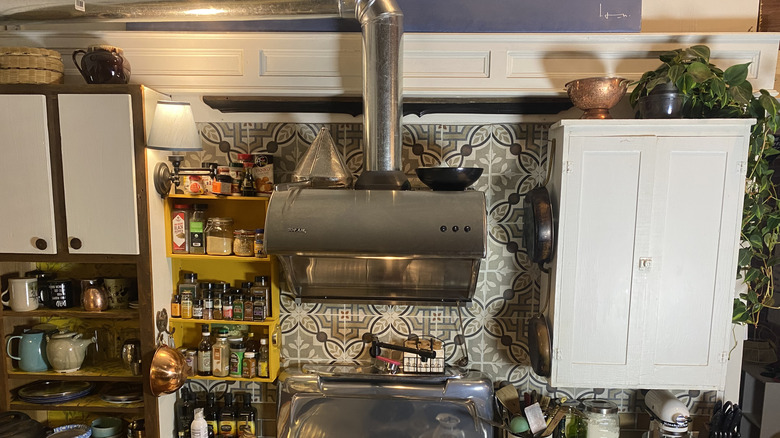
The white piece at the top of this wall, running behind the vent hood exhaust, is what I'm supposing was a cornice in a previous life, above a frilly curtain and decked out in hunter green, cranberry, and ducks. We picked it and a smaller sibling up for a couple of bucks. It outlived three or four plans for using it, until it finally ended up on a kitchen wall that was already somewhat maximalist. While it adds visual interest, it also conceals an outlet positioned high on the wall, which is operated by a switch we just hid with a knife block, and is currently powering the lamp on the left.
Of course, not all thrift-store finds used to cover oddball outlets need to be architectural, but they do often need to be either attached to the wall or comparatively large to cover the distance to the floor. Thrift stores offer affordable frames, and a gallery wall can effectively disguise an outlet. It just might be a little challenging to squeeze into some kitchens.
Hiding wall outlets that are eyesores
My kitchen is blessed with a third irredeemably ugly outlet, the very one shown at the top of this article. I feel like it needs some explanation, and I'll tell you what I can. When we built the house, this little expanse of tiled wall originally held a Dacor double oven. It was much despised for reasons that aren't relevant here, but what is relevant is that we finally got rid of it. But removing a 50-amp receptacle entirely would require electrical modifications and code compliance.
Unfortunately, the outlet or a replacement cover plate would maintain this one's position — about four feet up the wall. I have no recollection of what possessed me to install the outlet here. Possibly it was the naive confidence that there was no way we'd ever tire of the quirks of a Dacor double oven and ultimately replace it with a vintage Chambers stove that looks and cooks a hundred times better and avoids most of the downsides of electric stoves.
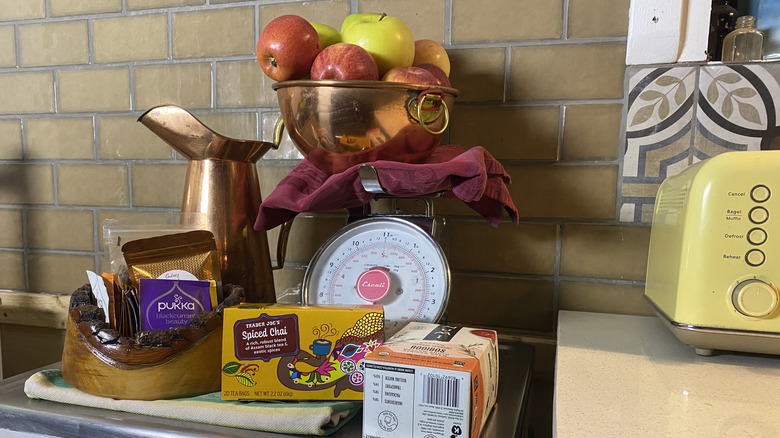
Since there's a small metal cabinet with a stainless top where the Dacor cabinet used to be, we just made it a little tea-and-snacks station. We gave a thrifted copper bowl of apples some loft by resting it atop a vintage scale, also thrifted, and then kind of spread some tea things around the front. Odds aren't good this setup will last forever (what will take the place of apples in early spring?), but whatever resides in the copper bowl will be more attractive than a 50-amp oven receptacle.