

Can Fridge Odors Be Eliminated With This Wine Cork Idea? Our Writer Gave It A Pop

To grasp why a refrigerator-freshening hack would catch my eye — particularly the claim that placing wine corks in your refrigerator can absorb odors — it helps to understand the kinds of things that are in my family's refrigerator at any given time. At the moment, we have the following items, among many more, crowding the shelves of our vintage fridge: three varieties of kimchi; two varieties of sauerkraut; half of an onion; half of another onion; seven kinds of cheese; two jars of garlic, totaling more garlic that anyone has ever seen in one place; and the leftovers from maybe four meals. So there are many possible reasons for potentially unpleasant fridge smells.
It's also not uncommon for us to have hard-boiled eggs, broccoli, and occasionally defrosting meat in there, as well. Perhaps you see where I'm going with this. Occasionally, the combination gets stirred up, and things get a bit pungent in there. And that's after I banned saving any of that delicious pho from Costco that smells 100% like cat urine.
To address this problem, some inventive internet denizens have come up with the idea that cork absorbs such odors. Others have adapted this hack so that the corks become little more than essential oil diffusers designed to hide, or at least dilute, smells like kimchi with more pleasant aromas like vanilla. I figured it was worth a try. Or, at least, something very like it was worth a try, since (as far as I know) there's no such thing as vanilla essential oil.
Designing an unscientific science experiment

I have a glass of wine every few years, whether I need one or not. Fortunately, at some point in my less moderate past, I saved a bunch of corks of varying size and quality. (Yes, it turns out that there's such a thing as quality cork. Who knew?)
I wanted to test both recommendations I found ... whole corks, au naturel, and cork slices in a little bowl. I originally had big plans involving sheets of cork and other forms of overkill, but I dialed it back to these two. I cut the rounds by hand, using a utility knife and the power of positive thinking to avoid severing a digit. The rounds were scented with around five drops of orange or vanilla extract, dispensed from a pipette. The corks and rounds went into small glasses without lids, which themselves went on the middle shelf of my fridge. These methods replicate two of the most common ways commercial air fresheners deal with odors: masking the smells and adsorbing odor molecules with certain porous materials. Smell is particulate, and adsorbers fill up, so one of my sources said to replace the corks after three days. I figured they'd start to work in half that time, so I checked for smell reduction at the one-, two-, and three-day marks.
There is a lot of subjectivity here, and many uncontrolled factors. How often would the refrigerator be opened? I have four kids, and I have seen them stand in front of an open fridge looking for a snack four minutes after a huge meal. Complications to ignore, I decided.
Some fishy results from a corker of an experiment

There were some bumps in the road along the way, as there always are. First and most distressing was that the refrigerator didn't smell bad. In fact, it only very occasionally does. Perhaps it's just confirmation bias from a vintage appliance aficionado, but I always kind of assumed that something in an old refrigerator tamped down odors. This was easily resolved by moving some kimchi into Mason jars with specialized tops designed to vent fermenting foods. Whatever magic old fridges have to suppress odors, they don't have that much magic.
I also had trouble keeping the corks in one place, and in fact, a few cork slices disappeared along the way. Teenagers will eat anything, I suppose. I keep waiting for someone to ask me if it was homemade vanilla mulch or store-bought.
When the first rounds turned up almost nothing interesting, I upped the ante by putting both the whole corks and the scented cork slices in there at the same time. Oh, and I attempted one other thing, of which my wife was not fond: I placed an open container of fish sauce in the fridge until it was noticed (pretty much immediately), whereupon it was promptly and permanently removed.
Keeping my excitement over the results corked up
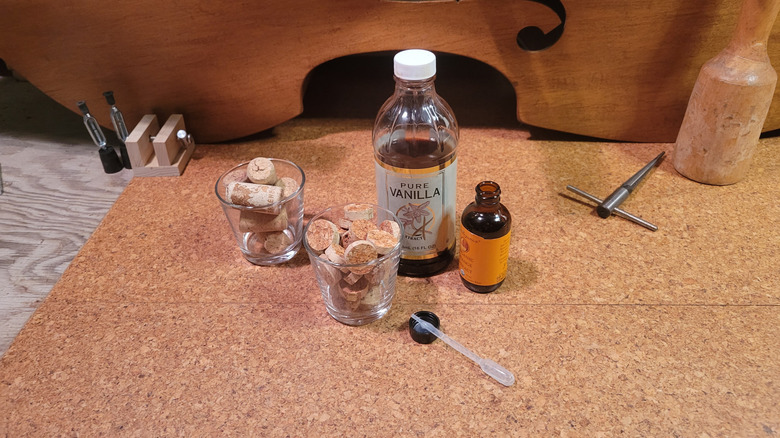
Regarding the initial experiment, in lieu of any kind of measurement device, I can only offer my impressions and compare them with the impressions of others. I asked my wife and one of my kids, and there's little doubt that my impressions influenced the child, at least. In any event, there was very little disagreement. After one day, very little had changed except that the vanilla and orange extract scents seemed to have weakened and disappeared quickly. Nothing noticeable had changed in the overall smell of the fridge, which remained very slightly pungent from the ferment.
Neither did the second phase seem to have any noticeable impact. Perhaps the olfactory exercise is too subtle and demanding for a man of my age. Whatever the case, I couldn't tell that the corks made any difference whatsoever at any point, other than perhaps becoming slightly smellier themselves. That is, no doubt, evidence that they were soaking up odor, and cork is widely known to absorb odor to some extent. Maybe what was called for was a lot more cork, even an entire DIY accent made from old wine corks. But it didn't seem to improve anything for me, except that I have fewer corks to keep shuffling around from workshop to workout room and back again, without ever making either smell better, in the hope that I'd one day make simple cork fire starters with them.