

The Small, Cute Collectible Worth A Lot Of Money You Don't Want To Miss At The Thrift Store
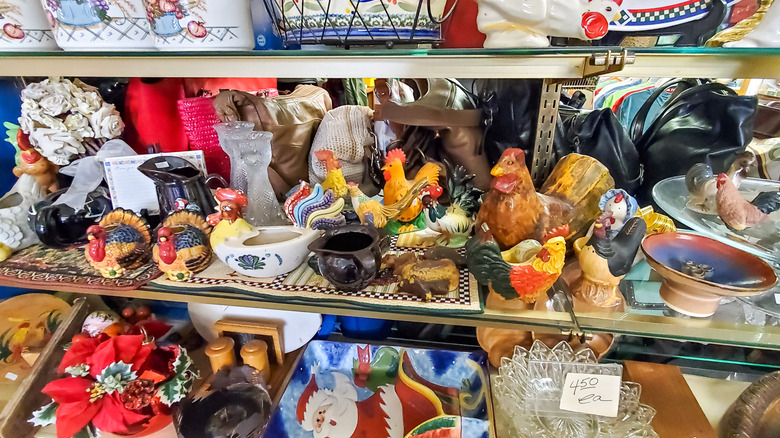
A day of thrifting can lead to some quite bizarre finds. From strange portraits of angry-looking Victorian gentlemen to thimbles depicting towns you have never heard of, the home decor section of a thrift store holds some questionable stuff. But, there are some small collectible figurines that you may disregard as another weird find when they actually might be worth a fair amount of money. The thrift store find? Hummel figurines. Some vintage lovers call them creepy, others call them cute. But however you feel about them, you may want to buy one at the thrift store.
First produced in 1935 by the German porcelain manufacturer Goebel, Hummel figurines were inspired by the sketches of the nun Maria Innocentia Hummel. The porcelain, rosy-cheeked children were introduced at the Trade Fair in Leipzig that year and quickly became beloved across Germany. Although the company stopped creating the figurines during the Second World War, they began to produce them again in 1946, with their reach becoming global.
Their popularity rose as the decades passed, and Hummel figurines can be worth a fair bit of money. Although most of them are valued at around $50 or less, older and rarer pieces can be worth thousands of dollars. If you think you have found a Hummel figurine, you can estimate its worth and authenticate your latest thrifting find by looking for Hummel marks and determining when the piece was created.
What influences the worth of a Hummel figurine?
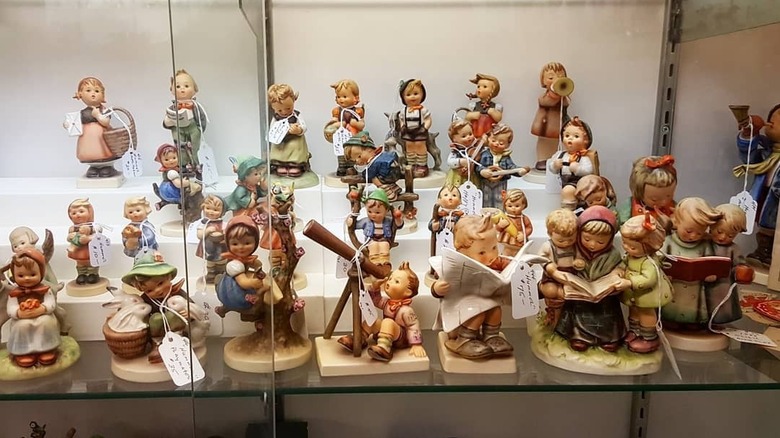
As Goebel produced Hummel figurines from 1935 to 2008, there are a lot of them on the market, and certain ones are more valuable than others. There are quite a few things that influence the worth of a Hummel figurine, from the condition to the era. Generally, the older the figurine, the more valuable it is, with those that were produced in the 1930s being worth the most. Pieces that have the TMK-1, TMK-2, and TMK-3 trademarks are the first Hummels ever produced, and this means that they are usually the most valuable. Furthermore, figurines that are still in their original boxes and are not damaged will be worth more than those that have chips or pieces missing.
However, it is not just the age and condition of these valuable vintage trinkets that impact their worth. Hummel pieces that depict multiple characters are generally more valuable than those that just have one character, with group figurines, such as Adventure Bound, sometimes being worth $6,000 to $9,000. The most sought-after Hummel figurines include Apple Tree Boy and Apple Tree Girl, which are often sold as a set, and International figurines, which depict solo characters dressed in the traditional clothes of different countries, such as Serbia and Hungary.
How to identify a Hummel
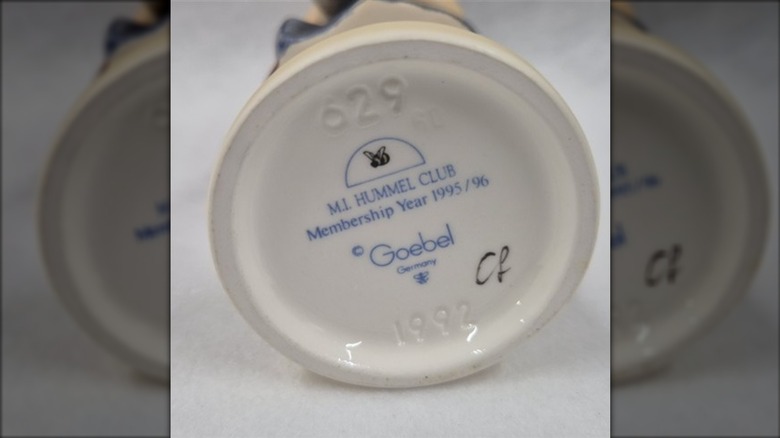
As Hummel figurines are incredibly popular across the globe, pieces that are inspired by their appearance have been created. This means that you need to work out if your thrift store find is authentic and actually a Hummel creation. Thankfully, there are marks and signatures on genuine Hummel figurines that help you authenticate them and work out the era. Hummel figurines will usually have a signature on the base that says "M.I. Hummel," along with a mold number. They will also have a trademark stamp, which has changed over the years.
The first Hummel trademark stamp (TMK-1) depicts a crown, with either the word Goebel or the letters WG underneath. The second Hummel stamp (TMK-2) depicts a V with a bee inside, and the third (TMK-3) shows a more stylized bee within the V, with its wings being symmetrical.
Later trademark stamps are simpler and to the point, depicting the words Goebel W.Germany or Goebel Germany (depending on whether they were made before or after 1990). In 2000, the bee was added back into the stamp. If you spot these stamps on your thrift store find, you may well be holding a valuable Hummel that you can either bring home to add a vintage touch to your space or sell for some cash.