

The Perfect Berried-Vine To Grow Near A Birdbath
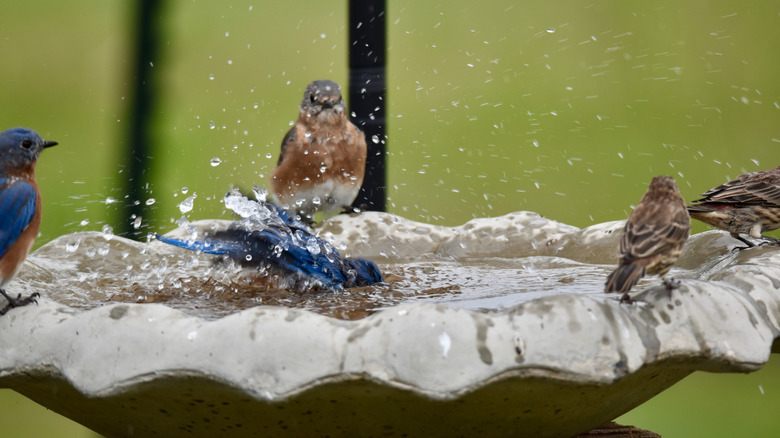
There's something mesmerizing about watching the different birds that visit a garden birdbath. Some birds are very polite drinkers, dipping their heads up and down as they imbibe the cool liquid. Others will just jump right into the water, flapping their wings vigorously as they take full advantage of the feature you've so kindly provided. Why not add even more amenities for your feathered friends to enjoy? One simple trick to attract more birds to your birdbath is growing a berry-filled vine nearby, like Virginia creeper (Parthenocissus quinquefolia). It makes for a perfect addition to your makeshift backyard bird sanctuary. Just be prepared to do some plant maintenance, such as trimming back the vine's rampant growth, from time to time.
As you may already know if you're a passionate backyard birder, our feathered friends need ready access to three basic resources to thrive: food, water, and shelter. Providing fresh, clean water in a birdbath is a good start when trying to attract more birds to your yard — with strong emphasis on the fresh and clean part. However, a bath with food and shelter nearby will entice even more avian species. Your birdbath provides the water, but a berry-covered vine like Virginia creeper provides both food and shelter — it can grow 50 feet tall with a 10-foot spread. If you're lucky, your visitors will stick around for longer than a quick dip. Before any of that can happen, you need to make sure you situate your new vine correctly and care for it properly so it thrives.
Why Virginia creeper is loved by bathing backyard birds
Virginia creeper is native to the U.S. and grows happily in USDA Hardiness Zones 3 through 10. You can grow it as a beautiful groundcover that will have birds flocking to your yard, but it is much easier to maintain if you provide a structure for it to climb over. It has tendrils with sucker-like disks that it uses to cling onto and clamber over all sorts of things — from unpainted fences and stone walls to other shrubs and trees. If you've situated your birdbath next to a fence, for example, a Virginia creeper will cover the fence in no time. Another ideal option is to locate your birdbath close to or underneath a metal arbor, then plant this vigorous vine nearby so it will climb the structure.
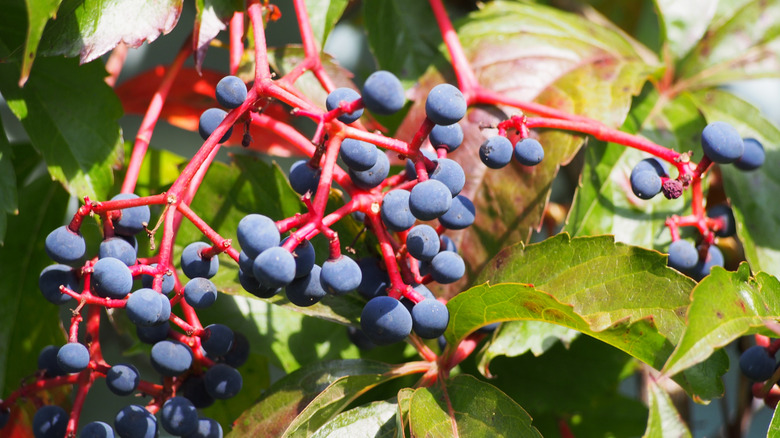
In late spring to early summer, the vine will produce flowers that are fairly inconspicuous but loved by pollinators such as bees. These are followed by a profusion of fleshy berries, which start out green and turn dark blue as they ripen. They stay on the plant into winter, providing a much-needed source of food for songbirds in cold weather. Over 35 species eat the berries — from thrushes, woodpeckers, and warblers to vireos and mockingbirds. What's more, an bundance of foliage in the warmer months provides shelter and nesting sites, particularly if your Virginia creeper is climbing a tall structure. A word of caution: The berries contain oxalic acid, making them toxic to mammals, including humans, if ingested. The vine also produces an irritating sap. Wear gloves when you're pruning this aggressive vine in October to keep it from taking over.