

The Unique Great Plains Bird You Can Attract Without A Feeder

We may receive a commission on purchases made from links.
If you're an avid birdwatcher, you may have already equipped your yard with baths and feeders to attract birds to your garden. Depending on where in the U.S. you live, you're likely to regularly catch glimpses of cardinals, chickadees, and blue jays. Another fun avian species to spot in the backyard is the scissor-tailed flycatcher, but you won't draw them in with feeders. Instead, you need to turn your yard into a haven for birds that prefer to eat insects. You can, for example, grow plants that are bug magnets. Before you start frantically remodeling your outdoor space, you need to dig into the habits and preferred habitat of these beautiful winged visitors. They also happen to be the state bird of Oklahoma.
Scissor-tailed flycatchers are eye-catching and easy to recognize, though you may confuse juveniles for western kingbirds. These sleek birds have a white or pale gray head, chest, and neck, dark-colored wings, and pink and orange on their sides, flanks, and under their wings. The species also has a small patch of red on each shoulder. However, the most distinguishing characteristic of the scissor-tailed flycatcher is its long, black-and-white forked tail. These Great Plains birds are frequently spotted in south-central U.S. However, they're sometimes also seen in the southeast and southwest of the country, in the Rocky Mountains, and in California and Florida. Occasionally they travel as far north as southern Canada. Apart from admiring their form, you'll enjoy watching the male's aerial courtship displays or marveling at the large fall pre-migration flocks.
Attract scissor-tailed flycatchers to your yard by encouraging insect diversity
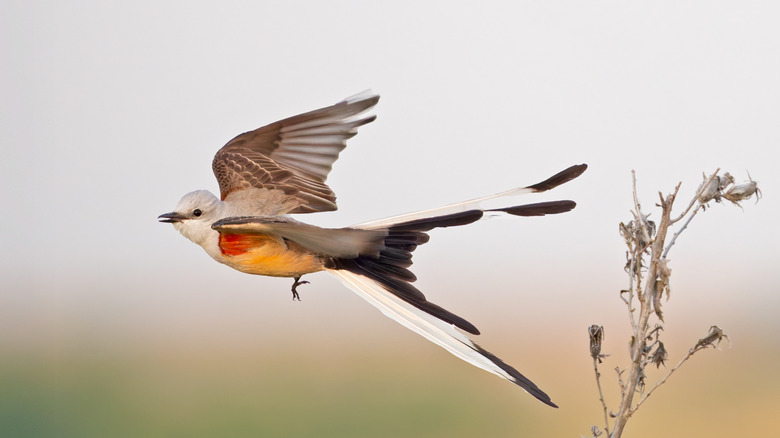
Whether you live in the Great Plains region or elsewhere, to draw scissor-tailed flycatchers to your yard without relying on feeders, you'll need to provide an abundance of natural food sources. In fact, most gardeners love having flycatchers around because they snack on many of the insects we consider common agricultural pests, including grasshoppers, crickets, and beetles. If you're lucky, they'll protect your plants with their snacking. To a lesser degree, scissor-tailed flycatchers also feed on caterpillars, moths, bees, wasps, and spiders.
Native plants are perfect for bringing birds to your yard because they attract all sorts of insects, especially if the plants and bugs in question are endemic to your specific area. For example, if you don't often see grasshoppers — a staple in the flycatcher diet — jumping about your yard, you can create habitat for them by planting lots of native grasses and sedges. In addition to their proclivity for munching on insects, scissor-tailed flycatchers also eat small fruit and berries, especially in winter when other food sources are scarce. Cultivate fruit-bearing North American native trees, such as common hackberry (Celtis occidentalis), red mulberry (Morus rubra), and prickly ash (Zanthoxylum fagara), to create a flycatcher-friendly backyard.
Grow tall shrubs and trees that scissor-tailed flycatchers like to nest in
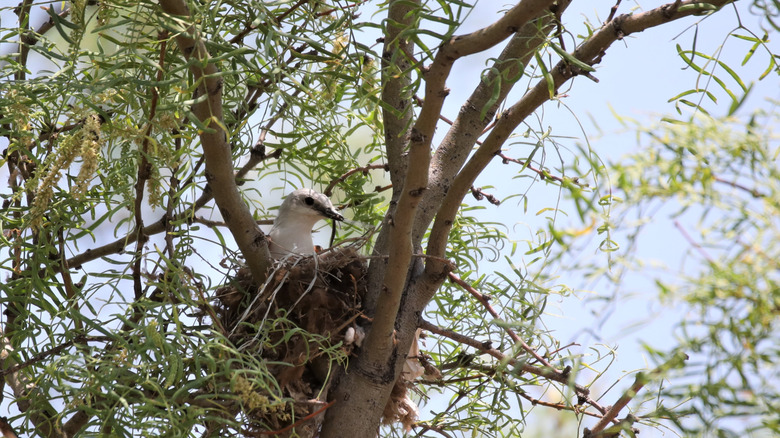
Scissor-tailed flycatchers prefer semi-open or open habitats for hunting insects. Take inspiration from the types of landscapes they're most adapted to — grassland, prairie, savanna, pasture, and scrubland — when creating your garden layout. The easiest way to achieve this is simply to let some of your backyard grow wild and brushy. These birds catch their prey in midair and by swooping to the ground from branches or posts. Give them lots of spots to perch on while hunting — woody, branching vegetation is preferred over artificial structures, but a combination of both can also work.
If you want to encourage generations of scissor-tailed flycatchers to visit your backyard, plant shrubs or trees that grow between 7 and 30 feet tall for nesting sites. These pretty birds prefer elms (Ulmus spp.) and oaks (Quercus spp.) for nesting, as well as pecans (Carya illinoinensis), magnolias (Magnolia grandiflora), and yaupon holly (Ilex vomitoria). Finally, there are some other small actions you can take that will help protect both scissor-tailed flycatchers and the wider ecology of your backyard. Forego using pesticides whenever possible, keep cats indoors, and apply Collidescape Spiderweb Clear BirdTape or a similar product to your windows to prevent collisions.