

Your Old Soda Cans Are Begging To Be Turned Into A Whimsical Lamp Shade

We may receive a commission on purchases made from links.
You've probably seen it before, even if you don't know its name. Embossed tin, or "hojalata", is a 400-year-old Mexican craft that's instantly recognizable. Hojalata pieces show off textural details made by pressing into the metal. Artisans typically make these pieces from tin, but this art form is also an unexpected way to repurpose empty soda or beer cans. Crafty Instagrammer @threegothdaughters was inspired to snip these recyclables into detailed woodland creatures and tuck them into a delicate wire-sided lampshade. Beverage cans' aluminum or tinplate sides are cuttable with scissors and malleable enough to embellish with a ballpoint pen or embossing stylus. The creator shared the evolution of this project across several videos and admits it's still a work in progress. In their evolving lampshade video series, @threegothdaughters gives a plain lampshade a makeover with rows of loopy, twisted gold wire to hold a growing collection of hojalata animals and trees.
You can recreate this DIY with at least five cans and a broken or boring lampshade in need of a stylish and personalized makeover. To recreate the shade's framing, you'll also use several spools of gold jewelry wire, wire cutters, and a utility knife. For the metal silhouettes, set aside one can per cutout along with a pair of scissors, masking or painter's tape, a thick towel, and a ballpoint pen or a specially-made embossing tool. If you're good at sketching, add a pad of paper to your supplies to make stencils. If not, swap it for tracing paper and digital or print images of animals and trees.
How to create hojalata shapes
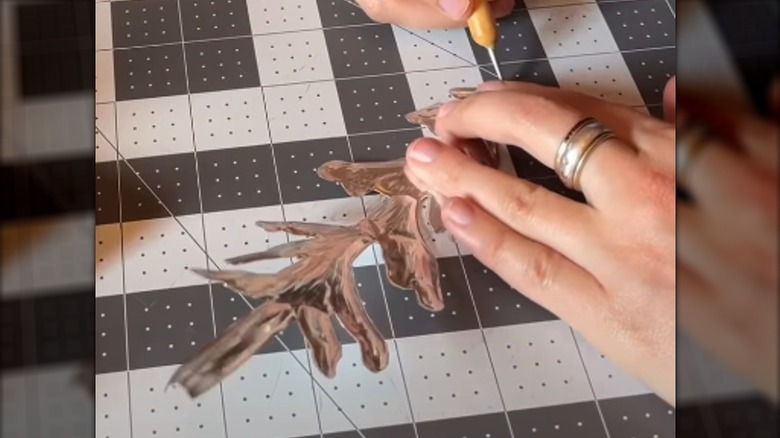
You'll need to collect a few images of animals and trees; you can trace them from magazines or books, or right from your screen for online images. The template images need to be the same size or smaller than the wall of a can. Trace the templates onto paper, but don't cut them out.
The raw edges of cut cans are extremely sharp, so protect your hands at all times. DEX-FIT Cut-Resistant Gloves are thin and flexible enough to wear while using tools. Poke the utility knife blade through the can at the bottom and top edges of the can, just below and above the spots where it narrows toward the mouth and base. Poke your scissors through these guide holes, and snip off the base and the lid. Cut the can vertically to create a sheet.
Lay your towel on a work surface, and tape the metal piece to the material in place. Set the template paper on top of the metal, and trace the edges with a pen or embossing stylus. Cut out the shapes with scissors. On the label-side of the metal pieces, add detailing to the metal cutouts with your pen or stylus, like eyes and fur, or bark and leaves. Keep the cutout on the towel as you detail it to give the features dimension. If you want a smooth surface, run a cotton swab over the shape so that its body curves away from its edges for a relief effect. Create at least five cutouts, depending on the size of your shade.
Finishing your hojalata lampshade
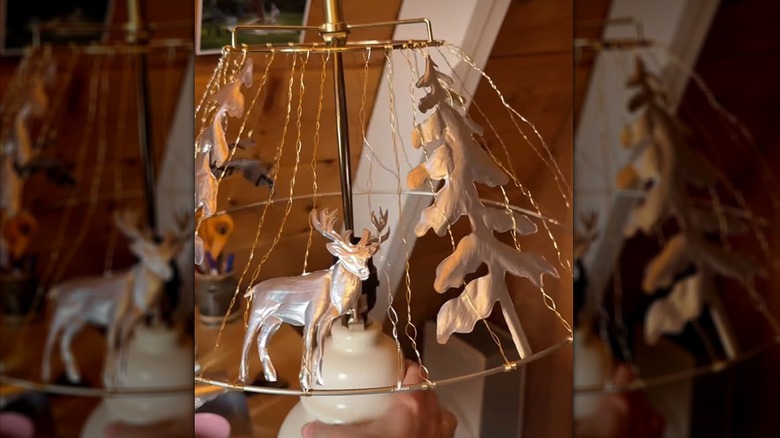
Keep your gloves on and use a utility knife to cut away the upper and lower framing rings from the lampshade. Trim off as much cloth and rigid material as possible. Attach the upper ring to a lamp for support. Cut pieces of wire that will double up to hold the two rings together. Make each piece a bit more than twice as long as you want the shade's sides to be, and prepare enough space to space them about 1 inch apart along the top ring. Bend a wire over the top ring, and twist the two halves together loosely, giving the combined wires a sort of organic look. Repeat this at the opposite point on the ring, then two more times at the midpoints between the first two wires on both sides of the ring.
To add your hojalata pieces to the mix, you'll do little more than tuck them into the wire loops. Gently bend a wire open and send a bit of the hojalata piece's edge (like a tree branch, an animal tail, or a deer antler) through the hole. Secure each cutout at a few other points where it touches wires and where it also has the right shape to fit into a hole. Before firing up your lamp, outfit it with a cool-burning LED bulb to ensure it's not a fire hazard or a burn risk, since the metals in the shade may get dangerously hot with an incandescent bulb.