

The $1,000 Anthropologie Wall Art You Can DIY For Way Less
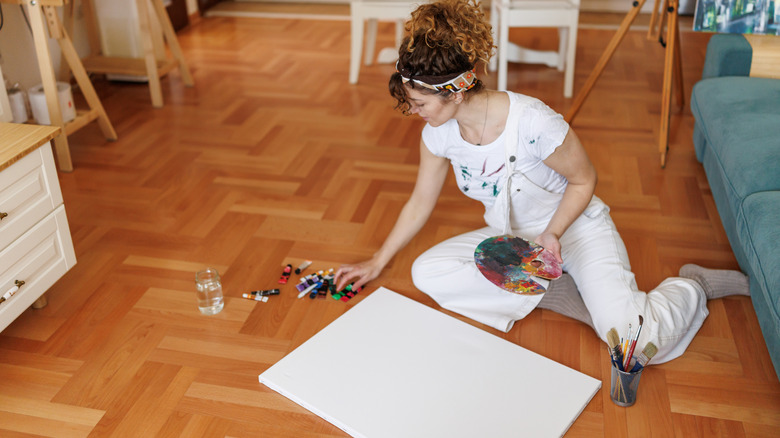
Raise your hand if you're a crafter who often says "I could totally make that," when spying an overpriced item in a store. Chances are pretty good that you've only acted on one or two of those moments of inspiration, no matter your experience level. But Anthropologie's astronomically priced Color Palette Abstract Wall Art is so easy to recreate that you'll almost hope that no one will part with $1,000 for a ready-made version. Not only does a DIY version save you hundreds, it's low-skill enough for novices to pull off with confidence.
All you need is some joint compound or spackle, a putty knife, a disposable plastic knife, small bottles of craft paint in 12 complementary colors, a paintbrush, a measuring tape, a pencil, an oversized canvas, and a frame in a matching size. Aim for small bottles of acrylic craft paint to keep the cost down. Before investing in a canvas and frame, search thrift stores for a large, framed wall hanging. You can repurpose old canvas wall art by resurfacing it for a fraction of the cost of a fresh canvas and new frame. Also find a circular template that's a good scale for the size of your frame.
The joint compound or spackle will give you a white textural background. Each of the circles will have another layer of spackle to give it more dimension before you paint. As for paint colors, a full-on rainbow spectrum is always nice, but keeping to a cool or warm palette (like the Anthropologie originals) will also look good.
Preparing your pattern and canvas
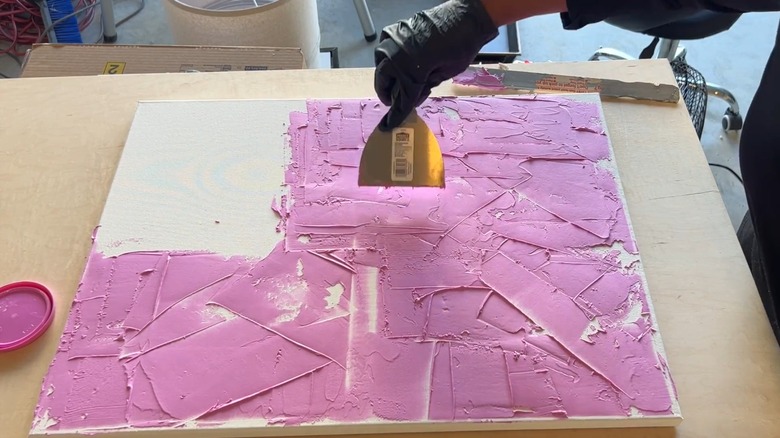
Before launching into the project, do note that the Anthro wall hanging doesn't have the textured background that our inspo dupe does. If you only want to use the spackle or joint compound to give the circles some texture, opt to paint the canvas background white, cream, or a more vibrant solid color (use acrylic paint). What's the difference between joint compound and spackle? Joint compound has a reputation for shrinking and cracking as it dries, whereas spackle doesn't. Cool tip: Both of these products are available with formulas that go on pink but tell you they're fully dry by turning white.
Make a plan for both the size and the layout of your circles. You can mock up a layout on your computer or outline the design by simply making measurements and pencil markings right on the canvas. If you do the latter, make note of the spacing between each circle, each row, and the margin around the pattern on something other than the canvas itself before your next steps.
If you're repurposing already-framed wall art, cover the frame with painter's tape before this next step. Scoop up some spackle or joint compound with the putty knife, and smear a thin layer onto your canvas. You can smooth it on in vertical or horizontal stripes, with haphazard strokes, or another joyful approach. Imperfection is best here. However, if you don't like how the material lies, you should be able to smooth it with the knife and have another go if you work quickly. Let everything dry fully before painting.
Paint, frame, and show off your faux-Anthro art
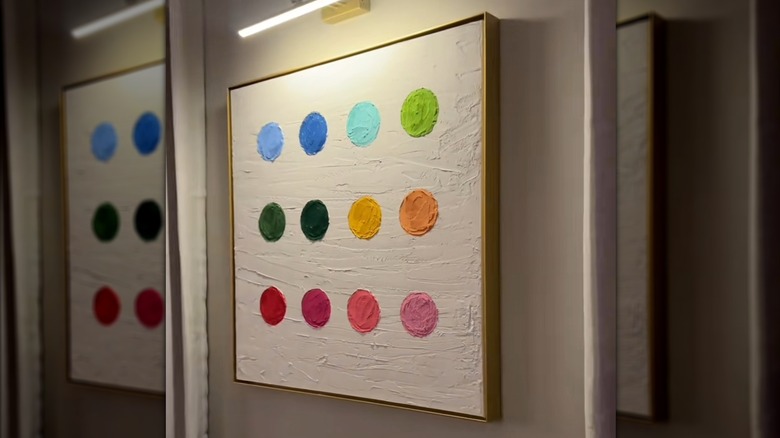
After your spackle or joint compound has transformed from pink to white (if you bought that kind), measure and mark on the canvas where you'll make each of the 12 circles. Trace your template right onto the canvas with pencil. Within each circle, add another layer of texture by spreading more spackle/joint compound over its surface with the plastic knife. You can smear it in a circular pattern or in lines, and take advantage of the serrations on the knife to give them extra detailing. Let this layer dry fully before painting each circle a different color; it will probably take at least two coats of paint per circle.
For the Anthropologie product, each circle is painted a different color, either in warm gradients of red or cool ones ranging from blue to green. The order you paint the circles is entirely up to you. You might want the circles to progress to a darker or lighter shade from one to the next, but scattering the colors at random is more Anthropologie's take. Using monochrome shades of cream to tan to brown, white to gray to black, or another range of hues is another appealing route to take. Finally, frame your artwork, and hang it up to enjoy. One of the major cons of buying home decor at Anthropologie are their exorbitant prices, so tell all admirers how much you saved and how easy it was to copy their costly abstract wall art.