

The Bedroom Light Choice That Is Ruining Your Sense Of Calm

Picture this: You're in your bedroom trying to wind down from a stressful day. When you flip your light switch, however, you're flooded with direct overhead lights that may affect your well-being and mood, according to a study in the journal Neuroscience Letters. Relying on this kind of lighting to illuminate your bedroom is a blunder that a lot of people unknowingly commit. If your objective is a calm and soothing space, there are some simple ways to rectify this mistake with your bedroom lighting.
Whether you get easily overstimulated or not, bright overhead bedroom lighting is a mistake worth avoiding. Unlike softer ambient lighting that can help your eyes, mind, and body relax, intensely bright direct lighting can produce unsettling feelings, making it more difficult to relax or fall asleep. The solution is to do away with the harsh overhead lighting and embrace softer, warmer, and more diffused options. To have a little more control over how bright your overhead fixture is, consider swapping out bright white bulbs for soft white ones, which give off a warmer tone, and installing a dimmer switch (a smart lighting tip that Nate Berkus recommends to keep your home Zen). If you want to save money, you can learn how to install a dimmer switch in your home without calling an electrician. Or, opting for warmer accent lighting throughout the room instead of relying on one center light is another smart way to make your room well-lit and calming at the same time.
How to create calming illumination in your room
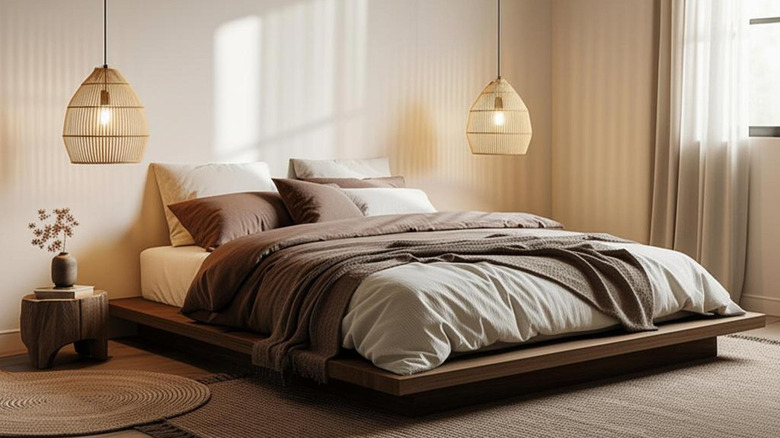
When looking for softer bedroom lighting, you'll want to familiarize yourself with Kelvin, a unit of color temperature. The Kelvin temperature will tell you how warm or cool the light is: a lower Kelvin temperature will result in a warmer light — which is ideal for relaxing and sleep — while a higher number will be cooler and more activating. Bulbs that are in home settings usually range from 2,700 to 6,500 Kelvin, but if you're aiming for relaxation-friendly bulbs, select 2,700 to 3,000 Kelvin, which are soothing, soft, and warm. Since overly bright lights can be jarring in an environment that you want to be calm, it's also worth paying attention to the lumens, which indicate the brightness of the light. For a small or medium-sized bedroom, select bulbs with a cumulative output of 1,000 to 2,000 lumens, or 10 to 20 lumens per square foot. It bears noting that very large bedrooms could benefit from more lumens.
Interior decorators often also recommend accent lighting ideas that make homes feel more luxurious and relaxing — especially in the bedroom. These lights can include table lamps, floor lamps, recessed lighting, or wall-mounted sconces, which can create soft layered lighting rather than the floodlight effect of overhead lights. You could, for example, purchase an IKEA LAUTERS floor lamp to place in a dark corner of the room. Pairing it with a bedside lamp, like the dimmable IKEA TÄRNABY table lamp, will help ensure the ultimate soothing vibe as you relax. By embracing these lighting tricks and principles, you'll be sure to pull off bedroom illumination that is calming and functional.