

Give These Perennials A Hard Prune In March For Bountiful Blooms In Summer
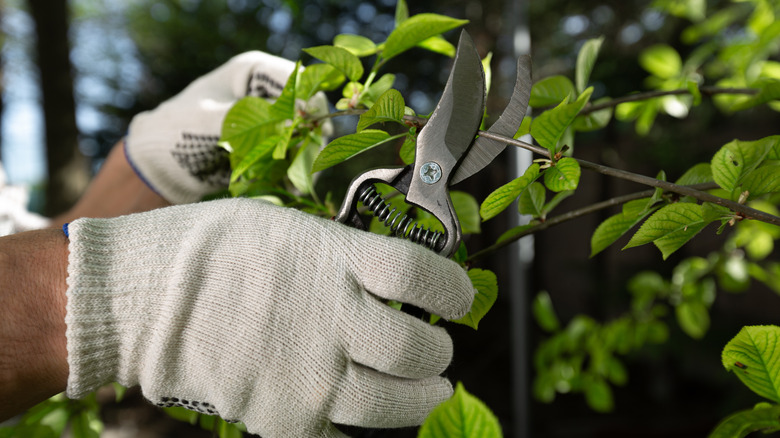
A garden full of perennials is a welcome sight to see when spring comes around again in March. This is the time of year when many will start to notice the first new growth after a long winter of bare plants and snow-covered ground. Even if it doesn't snow where you live, most gardeners still look forward to all the signs of life at this time of the year. Spring is also the time to get a few pruning tasks done, especially if you have a wide variety of perennials. While there are some perennials you want to prune in summer for more showstopping blooms, one cluster of plants in particular will really benefit from a hard prune in March and reward you with a bounty of summer blooms, and that's group 3 clematis, also referred to as group C clematis.
These are the group of late-flowering clematis varieties that only start to bloom in summer and carry on into the fall. They will always bloom on the growth that has occurred just this season, commonly referred to as new growth. It's important to prune these in March so that you'll encourage the plants to send up lots of new growth from the base that will result in many more blooms. Species in this group include woodbine (Clematis virginiana), bush clematis (Clematis recta), Texas clematis (Clematis texensis), and Italian clematis (Clematis viticella). There are also plenty of cultivars and hybrids that have been bred from these group 3 species. If you're not sure which group you have, take note when your plants flower, as that should help.
Prune group 3 clematis for blooms on new growth
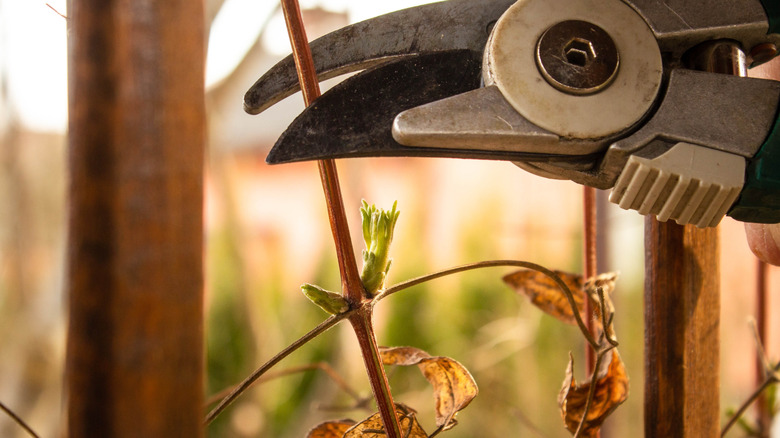
As a fast-climbing plants that adds vibrant color to ugly fences and other structures, there's nothing very complicated about pruning group 3 clematis. The most important thing is to make sure you're doing it as soon as you start to see new buds forming on the stems or vines in March, and cut them back quite hard. The first thing to do is remove any dead stems. You'll know that they're dead because they'll have absolutely no leaf buds or growth swellings on them. Start at the tip of each stem and work your way down. If you see no new buds at all or your clematis is severely overgrown and lanky, you can cut these stems right down to the base of the plant. Don't worry if you accidentally remove a live stem or two, as the plant will send up new ones.
Once you've removed the old, dead growth, work your way down the remaining live stems and cut each one down to a pair of new buds that are around 1 to 3 feet from the base. Bear in mind that those buds will produce new stems, and these will then grow flowers, so if you want to enjoy those blooms at eye level, cutting the stems lower should achieve that. If you fail to cut these back in March each year, you'll end up with plants that only flower at the ends and have bare stems lower down, so don't be afraid to cut these back severely each and every year. This will also ensure that there will be plenty of flowers to keep hummingbirds coming back to your yard.