

The Smart Upgrade You Need For More Eco-Friendly Sliding Glass Doors
When you are building a house or looking at purchasing one, having sliding glass doors that lead out to a patio is a popular design feature. They allow natural light to penetrate the house, and they can provide some ventilation when they're paired with a sliding screen.
However, one of the downsides of sliding glass doors is that loose or low-quality panels could allow climate-controlled air to escape. Air leaks can cause an increase in your energy bills. Some types of untreated glass also allow infrared waves to pass through them, which means heat may travel from outdoors to indoors on a hot day, or vice versa on a cold day.
To make the doors more eco-friendly and energy efficient, consider replacing cheaper panes with low-E glass. Also called low-emissivity glass, this product contains a transparent coating that reflects heat. If the sun is shining on the panes in the doors, the coating will reflect heat from the sunlight back outdoors, keeping your home cooler in the summer. During winter, the coating reflects heat originating from inside your home back into the house, rather than allowing it to escape outdoors. Although replacing the panels in your sliding doors with low-E glass can cost $300 to $1,200 per panel with labor, according to Home Guide, it can be cheaper than replacing the entire door, which may cost $600 to $5,500.
Why low-E glass saves money on your energy bills

If you have standard two-panel sliding doors that measure 82-by-96 inches, you have more than 50 square feet of glass. A four-panel configuration could be twice as wide and create more than 100 square feet of glass surface. Considering the most common window size is 60-by-36 inches, creating about 15 square feet of glass, you have a far greater potential loss of energy through the large doors.
When you want to make sure you have an energy-efficient, all-glass door that won't cause energy costs to spike, low-E coating is the choice most professionals recommend. The transparent metal oxide coating used with low E is placed inside the glass, rather than on the surface, so you don't have to worry about seeing scratches on it.
Using low-E products is one of the ways to reduce your energy costs at home. An average home may suffer an energy loss of up to 70% through windows and doors with the vast majority of that loss related to the glass. When installing low-E glass, you'll pay a 10% to 15% premium compared to regular glass that doesn't have the metal oxide coating. You might be able to recoup the cost of installing low-E glass in your sliding panel doors in five to eight years from energy cost savings. You also receive the benefit of having a more comfortable home by limiting temperature fluctuations.
Challenges to install low-E glass in existing sliding doors
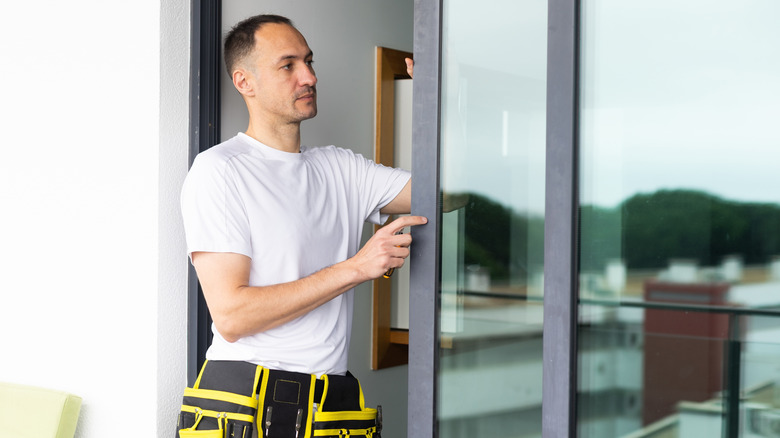
You can replace regular glass with a panel that has a low-E coating to improve your home's energy efficiency without replacing the entire frame and door. However, it is a difficult replacement to do as a DIY job, which is why many people hire professionals to do the work. These glass panels are heavy and large, making them awkward to handle. Professionals will take exact measurements of your existing sliding doors to ensure they order the right size of low-E glass.
To replace the panel, start by removing the door from the sliding track. Some doors can be lifted upward from the track, which allows the professional to pull the bottom of the door frame away from the track. Others may have adjustment screws that first need removal or loosening inside the track.
Lay the door flat on the ground or on sawhorses for support. Most door frames are connected at the four corners, and the professionals would start by removing the screws or clips in the corners. These pieces hold the glass inside the frame. The glass may also have caulk or glazing beads that keep it tight inside the frame, and these may need removal with a putty knife or utility knife. After removing the old glass panel, professionals put in the new panel with the help of another person. They will then put the frame back together, add glazing beads or caulk, and insert the door in the track once again.