

The Valuable Clock Brand You'll Want To Keep An Eye Out For At The Thrift Store
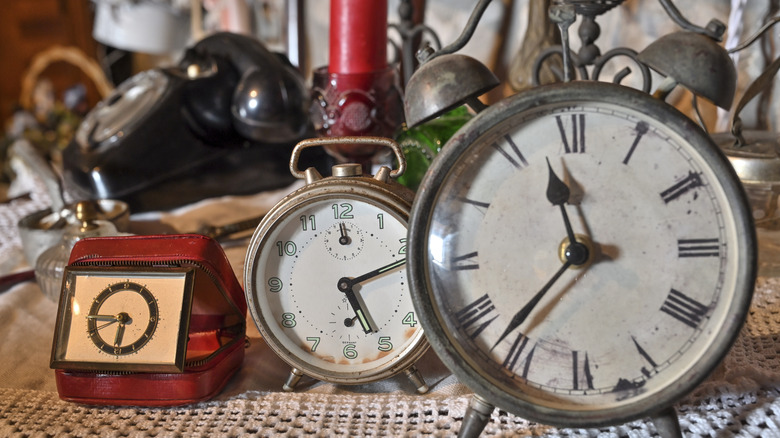
There's nothing like a great deal at a thrift store, but even at a steal, it can be hard to justify buying a clock. Most people find it easier to check their phones, computers, or exercise trackers on their wrists for the time, and alarm clocks are one thing you can declutter from your nightstand for a more polished bedroom. But among those unique and trendy vintage clocks on the shelf, there may be one brand that's worth more than just its looks and timekeeping capabilities. Buyers who find Seth Thomas clocks at their local vintage shops may be able to double their investment on this collectible — and maybe even more.
Founded in 1813 and named for the owner, the Seth Thomas Company produced regulator, spring-driven, mantle, and calendar clocks, among many other types, in Plymouth Hollow, Connecticut, later renamed Thomaston. Thomas' business started using wood gears in its products, but by the 1840s, the company began using brass parts. During that same time, the clockmaker employed over 40 people in his factory and reached an annual production of 10,000 clocks. Thomas died in 1859, but his son and grandson continued his work, eventually pivoting to manufacturing pocket watches and always trying to improve on their designs.
The Thomas family continued company ownership until 1930 when it merged with the Western Clock Company of Illinois. In 1955, two hurricanes caused massive damage to the region, and Seth Thomas never resumed its former production capacity. The business went through two more ownership changes before it closed its Connecticut factory in 1983 and moved production to Georgia. In 2001, production closed entirely. Today, the brand is still revered for its classic designs and high-quality craftsmanship, which is why it remains a great find for investors and thrifters looking to decorate around a clock.
What to look for when you find a Seth Thomas clock
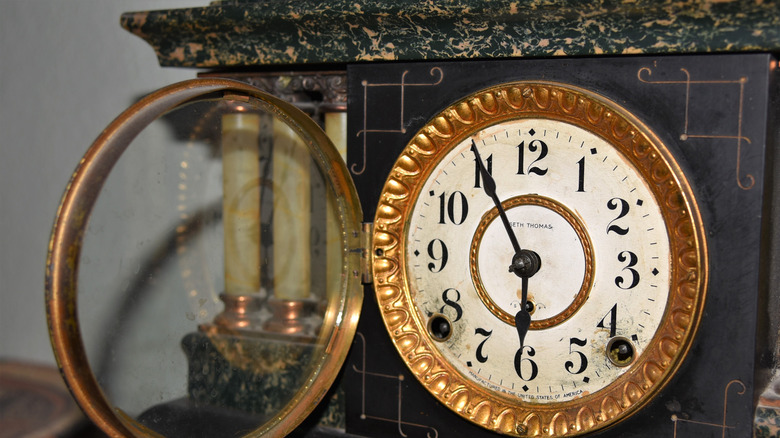
With such a storied history, it's no wonder collectors pay good money for a Seth Thomas clock. These pieces can go for anywhere between $100 and $10,000 and beyond for the larger regulator clocks. Like any antique, the product's condition, age, style, size, and materials will help determine how valuable it is. Fixing up one of these clocks may also cut into your profits if you do find one. Parts to get these pieces working again can go for several hundred dollars, and you may need to pay a professional restorationist to do the work.
You can get some idea of the worth of your Seth Thomas find by inspecting the clock and looking for some key signs. There may be a paper label with a model number or manufacturing date somewhere in the case, on the back of the clock, or on the clock face itself. Movements, the parts and gears that make the clock work, had date codes that read "A-09" in early 20th-century pieces. This likely stands for January 1909. For other model numbers, you may need to consult old catalogues.
Knowing a little bit of company history can also help you understand your find while you're at the store. The manufacturer used wooden gear movements from 1813 to 1842, and it wasn't until after 1850 that brass movements became standard. Adamantine, a veneer that was meant to look like marble, was popular with Thomas clocks from 1880 to 1910. A Thomas clock with a synthetic finish means it was likely produced in the 20th century.