

Don't Toss Your Empty Laundry Detergent! Turn It Into Clever Hanging Storage
We may receive a commission on purchases made from links.
As you add detergent to the washing machine for your next load, give the container a second look. If it's made of plastic, it's probably thick, durable, and in a color that's not unappealing. A container with this much potential is begging for more use. Save a trio of similar-sized plastic detergent containers for an easy project that will give you sturdy vertical storage that nearly everyone could use. Cut into handy pocket forms, linked together one above the other, and equipped with a built-in hanger, this simple project will have you rethinking the future of your plastic recyclables from now on.
In addition to three clean, empty bottles, you'll need a utility knife, a label peeler, a permanent marker, a straight edge, a pack of zip ties, and potentially a soldering iron. Keep yourself safe during the cutting detail with a pair of flexible protective gloves like these Schwer A4 AIR-SKIN Cut Resistant Work Gloves, too. You may want alternative materials based on the supplies you have. If you've already ditched the liquid for eco-friendly laundry sheets or another plastic-free alternative, take inventory of other sources of plastic bottles, from bulk foods or yard and garden products. Also, the soldering iron is for making holes in the containers; if you don't have one, a nail heated in a candle flame (held with pliers, of course) will work just as well. Lastly, the containers rely on plastic zip-ties to hold them together. These are apt to be the weakest link in the project, so you could swap them out for wire.
Prep the bottles to become wall pockets
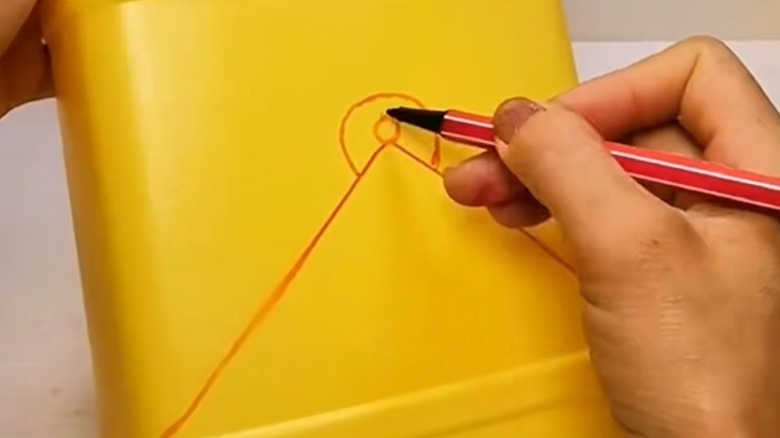
To get the labels off the bottles, grab the label peeler, cut-resistant gloves, and a steamer or a blow dryer: The heat they produce is a foolproof way to remove sticky labels. Focus the heat on the labels a bit at a time, working the peeler under them until you've removed the labels. For the first bottle, you'll be cutting one of its sides into a hanger, while the other side will become a pocket. Use the straight edge and marker to make a horizontal line all the way around the bottle, about 4 inches up from the base. On one wide side of the bottle, outline a triangle pointing upward from the horizontal line; this will be the base for the hanger. At the peak of the triangle, draw a 2-inch circle that overlaps the point, and cut along the lines with the utility knife.
Create the two lower pockets similarly. Draw a horizontal line around three sides of the bottles at the same height you did for the first bottle. The remaining side will be part of the storage rack's backing. Customize this back piece for what you plan on storing in the pocket; its height will dictate how far above and below each other the pockets sit. At this point, you can add a bit of flair to your plastic pockets if you want. The cut edges on the front of each pocket can go from utilitarian to cute with a scalloped or wavy edging. The heated nail or soldering iron can also come in handy to make decorative holes, eyelet-style, along the edges.
Connecting and fine tuning the upcycled plastic rack
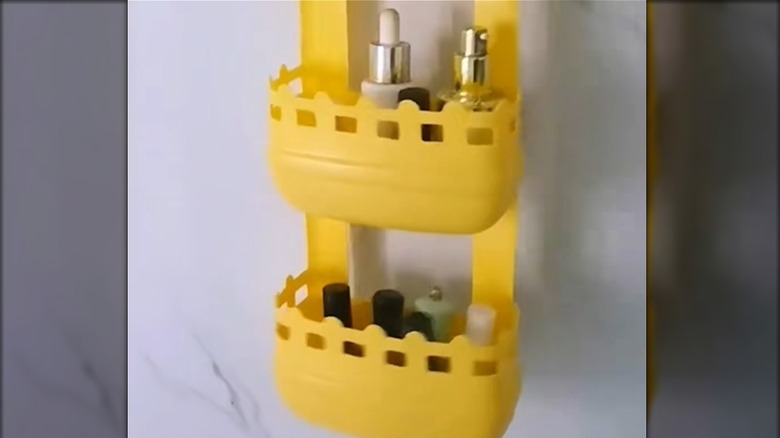
To connect the pockets to each other, you'll be melting pairs of holes through their backs for zip ties. But first, if the raw edges of the plastic are jagged, you can smooth them by running a hot iron over the cut edges. Flip the hanger pocket over, and near each corner of the pocket area, mark two points that are 1 inch apart. Poke a hot nail or soldering iron through these four points. Also make a hole through the rounded point at the top of the backing that's large enough to slide over a hook. If you aren't satisfied with the color of the bottles, now's the time to treat them to a coat of paint. A plastic-friendly spray paint is a must. Give the paint the best chance of sticking by sanding the surfaces first.
Lay another pocket piece flat, set the hanger pocket on top of it so that the melted holes sit over the upper corners of the other pocket's backing. Use the four melted holes in the hanger pocket as a guide to mark spots on the other pocket, and poke holes through those marks. Line up the holes on the hanger pocket and the other one, and connect the two pockets with wire or zip ties through the holes. Like you did for the hanger pocket, melt two holes at the bottom corner of the pocket area, and make matching holes at the top corners of the backing on the last pocket, and connect them with zip ties or wire. Hang your sustainable home storage solution wherever you need it.