

Attract Birds To Your Coastal Garden With A Fruit-Bearing Shrub That Provides Privacy

There's a good selection of flowering plants that thrive near the coast for those who live and garden in Florida — or in USDA Hardiness Zones 10 and above. In particular, you might want to consider growing this attractive native shrub with blooms that turn into edible fruit. Not only is this evergreen species salt-tolerant, but you can also prune it into a stunning privacy hedge. It doesn't grow very quickly, nor does it grow slowly, making it easy to maintain. We're talking about the cocoplum (Chrysobalanus icaco). Bonus: If you love birds, they flock to this shrub's sweet, plentiful fruit. The dense foliage also provides excellent coverage for perching and nesting.
Cocoplum is an interesting native species because it has naturally developed two distinct ecotypes — coastal ('Horizontal') and inland ('Red Tip' or 'Green Tip'). The inland subtype grows into a tall shrub or small tree, but it's not salt-tolerant and should be avoided in areas immediately adjacent to the ocean. Those gardening near the ocean need to select the coastal variety for their bird-attracting privacy screen. It will reach a height of 6 feet, which is the minimum for a privacy hedge.
No matter the variety, the leaves of this low-maintenance fruit-bearing tree that's perfect for coastal landscapes are round and leathery, and the plant produces small white or green flowers in winter and spring. The edible plum-like fruit is white, blush pink, or purple when ripe and is commonly used in jam. There's even an oil-rich seed inside that can be cooked or eaten raw. The fruit won't ripen off the plant, so only harvest those that come away easily when you pull on the stem. Whatever you don't get to in time will no doubt be snapped up by fruit-eating birds, such as catbirds, waxwings, and bluebirds.
How to grow cocoplum in your coastal garden for privacy
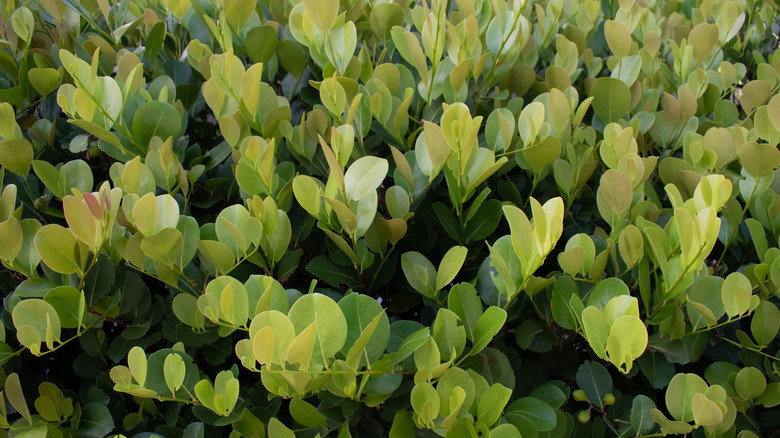
As mentioned, when shopping for cocoplum saplings, select the coastal cultivar — the low, spreading, salt-tolerant 'Horizontal' — for your beach-front garden. With a little care, the plant will grow into a dense hedge that won't get too tall, making it easy for a home gardener to manage. Choose a sunny spot, although light shade is acceptable, too. If you space your plants about 3 to 4 feet apart, you can expect them to fill in the gaps in around two years. Despite their intolerance to salt, inland cultivars 'Red Tip' and 'Green Tip' may be worth considering if you need a taller hedge and your garden doesn't get a lot of salt spray.
Cocoplum is not cold-tolerant and won't survive temperatures below 32 degrees Fahrenheit. Make good use of your time during the warmest months of the year — March to September — to get your new shrubs established as quickly as possible. Add top soil, organic peat humus, or composted cow manure to the planting hole for a boost of nutrition. Water them consistently, at least once a week during dry spells, to encourage the plants to develop hardy root systems. Once your plants have grown to an acceptable height for your privacy hedge, prune them up to three times a year to maintain their shape. Additional fertilization is not necessary. To complement your new cocoplum hedge, plant Turkish sage beneath its boughs. It's a gorgeous, salt-tolerant ground cover that handles heat and still looks lush.