

How To Choose The Best Curtains For Your Home Office
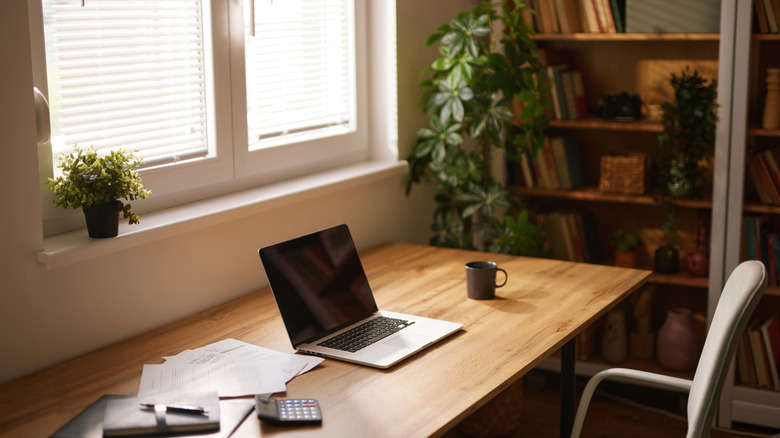
A home office needs essential equipment and comfortable furniture, but it's also important to decorate the space in a way that makes it both appealing and productive. If your home office has windows, this includes shopping around for window treatment options that will make the space complete. To help you pick the best curtains for your home office, Lori Miller, President of LGC Interiors, exclusively spoke with House Digest to provide suggestions and pointers for dressing up your office windows.
Miller points out that a home office can be outfitted with curtains in a broad range of styles and fabrics and encourages homeowners to seek out options that bring them joy. "Style is always dependent on personal taste, type of home, window size and placement, need for privacy and light filtering needs," she said. Where your home office is located in the home, how many windows it has, and the type of work you do in your office — including where your computer is placed — will be the primary factors that determine the best style of curtains for your situation.
Blackout and light-filtering curtains will reduce glare and provide privacy for your home office
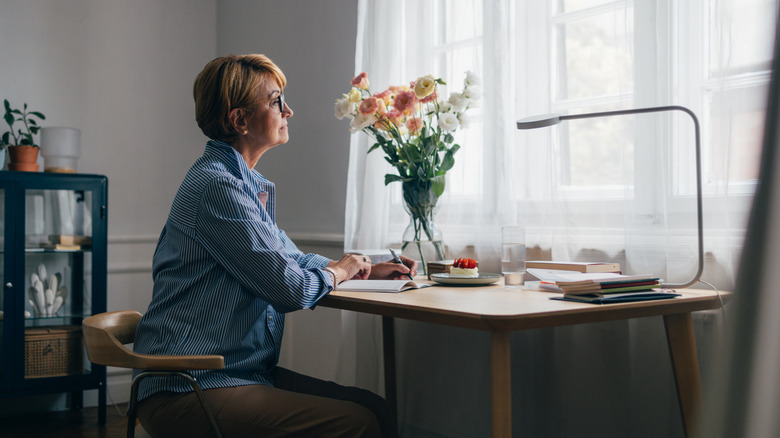
A computer is pretty much a given in any home office, and because you want your screen to be easy to read and glare-free, Miller told House Digest in her exclusive interview that "blackout and light filtering options should always be considered." Light-filtering curtains are effective at reducing glare while still allowing for natural light, while blackout curtains can reduce natural light almost completely, which eliminates any glare. The former option won't completely block the window, but the latter option will give you complete privacy.
While the density of your curtains matters, it's also important to consider how the fabric lays and how it will look both open and closed. "If you are going to choose to design with a drape, simply hang a long drape and use a decorative tie back," Miller shared. Drapes deliver a bold, dramatic look and offer the flexibility to easily open and close as needed. With the drapes tied back, you can let in natural light as desired and then block light when needed by pulling the curtains closed. While this is fairly simple advice that's easy to achieve, it's also important to consider placement to get the best possible look. "[T]he biggest mistake is a poorly hung drape. [W]hether its too low and sits on the window frame or too long and puddles on the floor or, even worse, the drape is too skimpy and does not look full," she said. Measure your windows before buying drapes and take Miller's suggestion to use a professional installer to hang drapery for the best results.