

Forget The Fence: Plant A Tropical, Fast-Growing Perennial For Stunning Privacy
If you've been wanting to screen off your neighbor's house or hide an unsightly view that's ruining the aesthetics of your backyard, you may be on the lookout for a trendy alternative to a boring wooden fence. Alternatively, you might want to forget the fence altogether and choose a gorgeous, fast-growing perennial instead. If you happen to live in a southern state or in a warm coastal region — anywhere in USDA hardiness zones 8 through 10 — you could opt for a lovely tropical species known as yellow oleander (Cascabela thevetia).
Yellow oleander is a relatively fast-growing evergreen shrub that comes from South America, Mexico, and the West Indies. It's closely related to Nerium oleander, which can grow at a rate of 1 to 2 feet per year. This species can reach a height of up to 8 feet and a spread of around 5 feet under cultivation, although it grows much larger in its native habitat. You can easily plant a row of these as a stunning privacy hedge, and in summer and fall, it will delight you with large yellow flowers among the slender but waxy leaves. The flowers are followed by green fruits that act as seed pods, which turn black as they ripen. Just be aware that all parts of this shrub are highly toxic to humans and animals, and contact with the sap can cause dermatitis.
How to grow yellow oleander as a stunning tropical privacy screen
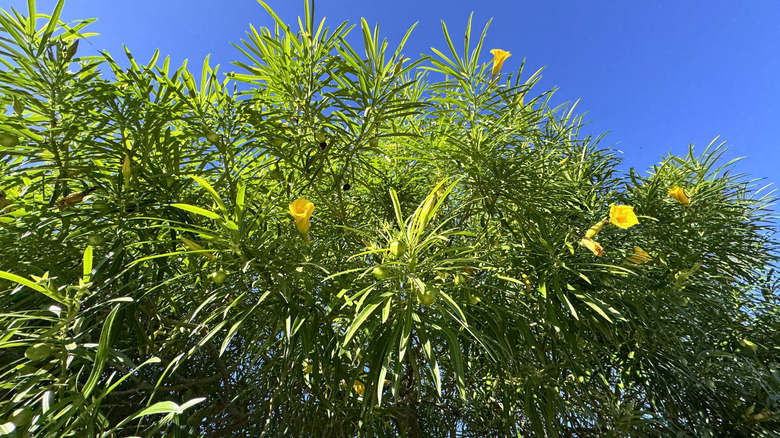
Yellow oleander is one of those poisonous plants that look beautiful in gardens. As long as you know that you must keep any children or pets away from this plant, it can provide an outstanding screen in lieu of a fence. It does particularly well when planted against a wall because it loves the warmth, and you can easily use it to hide an unsightly shed or other structures. Just check with your local extension office first, because, while it's not currently classified as an invasive species, it does carry a high invasion risk.
If it's fine for you to grow yellow oleander in your garden, know that it does best in sandy soil and should be grown in full sun or partial shade. You might want to deadhead the spent blooms to prevent the fruits from forming, as these aren't particularly attractive. Just remember to wear gloves when working with this species. If you want to control the shape and growth of your yellow oleander, you can prune it after it's finished flowering in late summer or fall. Finally, although yellow oleander is a tropical plant, it's also quite drought tolerant, so avoid one of the mistakes everyone makes when growing oleander, and wait for the soil to dry out between waterings.