

Don't Toss Dead Spider Plant Leaves — Turn Them Into An Eco-Friendly DIY Project Solution
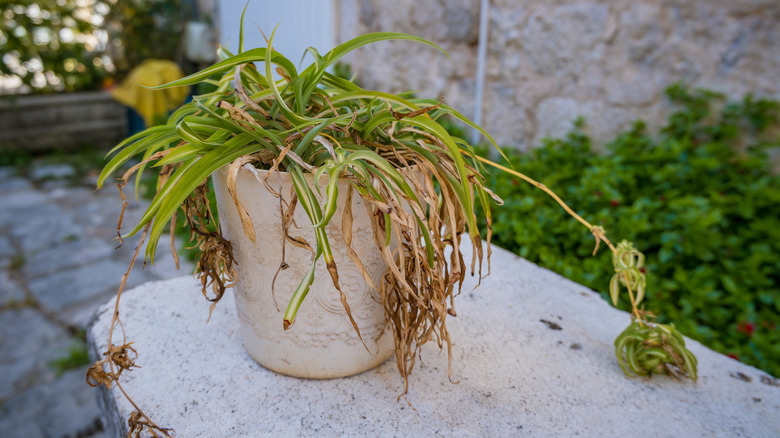
Have you ever found yourself in need of some cord or thin rope when you're engrossed in a DIY project, but just can't find any in your craft supply stash? If you happen to have a spider plant in your plant collection, you're in luck. By mastering a special technique to make cordage from dead spider plant leaves, you can create your own eco-friendly solution.
Cordage is just a fancy term for rope or twine, and people have been using plant fibers for this purpose for thousands of years. Using those dead spider plant leaves will work quite well for this, but you should bear in mind that the cordage you end up with might not be as strong as if you were using a more fibrous type of plant, like flax or yucca. However, the lovely pieces of cord you create can be used in DIY projects as decorative trim or to turn empty cans into cute boho decor. Alternatively, you could use these pieces of cord as handy plant ties when you want to tie plants to a trellis. Either way, you're going to need a few dead spider plant leaves, a spray bottle filled with water, some scissors, and a towel.
How to turn dead spider plant leaves into rope
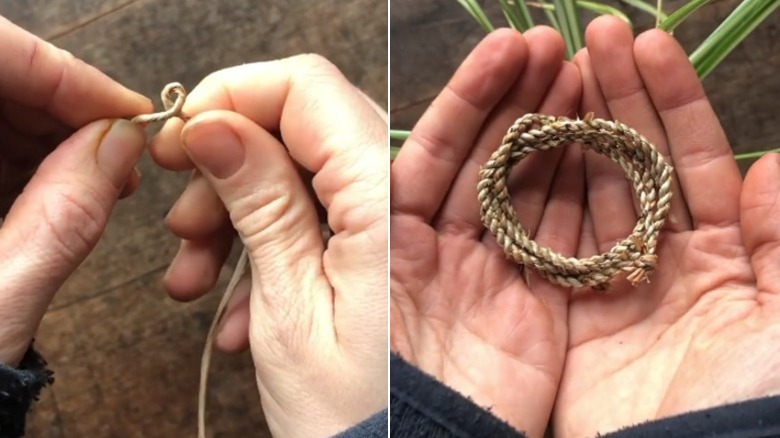
As demonstrated by foragedfibres on Instagram, the first thing you want to do is take your scissors or snips and remove all the dead leaves from your plant, right at the base. Next, you'll have to condition them so they won't be too dry or brittle. Lay them out on a towel and spray them well with water. Fold them into the towel and let them sit for around 15 minutes until they're flexible enough to bend and twist without breaking. At that stage, they're ready for cording.
Take one of the leaves and hold it roughly in the center. Start twisting one side in a clockwise direction; you should notice that it starts to twist at the halfway mark to resemble a thin coil of rope. Once this happens, hold the leaf sideways so that you have a top and a bottom piece. Continue twisting the top piece in a clockwise direction, but, after a few turns, flip the two pieces counterclockwise so that the bottom piece now becomes the top. Continue twisting and flipping until you're almost at the end of the top piece.
If you want to lengthen the piece that you have, just grab another leaf, lay it on top of the short piece, and twist both together. This is referred to as splicing, and you can do this as often as you want to make your rope as long as you need — or until you've run out of spider plant leaves. Once you get the hang of the twisting, rope making is actually quite a neat skill to have. You could even forage for other materials to use and create your own stunning hanging planters to liven up your home.