

What To Do If You Find Moth Holes In Your Clothes
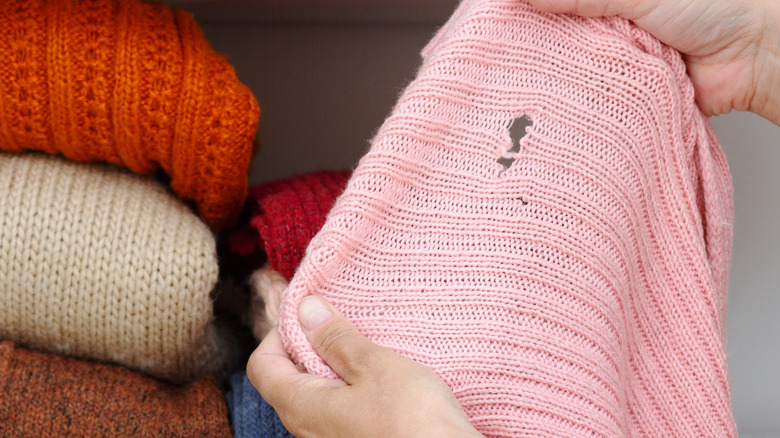
Picture this: You open your neatly organized closet one day to grab your favorite sweater, when you see the damage. It's not a bad dream — it's the surefire sign of moths, and your go-to cardigan is full of moth holes. Finding moth holes in your favorite sweater can be incredibly frustrating, but acting quickly is the best way to save the rest of your wardrobe. Since clothes moths are often after the protein found in natural fibers, your approach needs to be part cleaning and part containment.
Don't panic, and definitely don't toss the whole wardrobe. Instead, take a strategic approach if you notice telltale signs moths have gotten to your belongings. While the holes themselves are the most obvious symptom, they are actually the work of moth larvae, not the adult moths you might see fluttering around. By understanding their life cycle and your fabrics' vulnerabilities, you can reclaim your closet without losing your mind — or your favorite knits. You'll need to focus on inspecting the entire wardrobe, clearing the infestation, and cleaning the area to ensure your home remains moth-free for good.
Step-by-step approach if you find moth holes
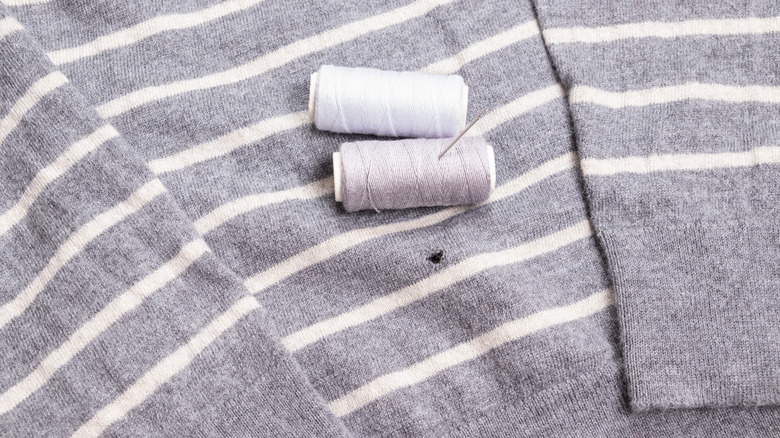
Clothes moths are absolutely one type of bug you don't want living in your home — they are destructive and notoriously difficult to eradicate. First, focus on quarantining and inspecting your entire collection. Start by isolating the affected items and immediately moving the damaged clothes into sealed plastic bags to prevent larvae from spreading to other areas. Check seams, cuffs, and under collars of all natural fiber garments. Keep an eye out for "webbing" (silky tubes), tiny white cocoons, or "frass" (sandy debris that looks like dust but is actually moth excrement). Any undamaged clothing should still be treated as a potential host and separated from the damaged ones.
Next, eliminate the infestation. If the fabric can stand it, wash items in water that's at least 120 degrees Fahrenheit and dry them on high heat. For delicate items that can't handle heat, seal them in a Ziploc bag and place them in a freezer for at least 72 hours. If you have heavier items, dry cleaning is your best bet, but be sure to speak with the dry cleaning company first to understand their policies.
You'll need to deep-clean the space where you found the holey clothes, since putting clean clothes in a dirty closet is an invitation for a second round of damage. Use a crevice tool on your vacuum to get into the corners of shelves, floorboards, and carpet edges. It's also important to clear any lint — moths feed on hair, skin cells, and lint, so removing every bit of dust is essential. Wipe down surfaces with a mixture of vinegar and water to scrub shelves and hanging rods. Once everything has been cleaned and thoroughly sanitized, you can start repairing and mothproofing your clothing.