

What To Do If You Find A Bee's Nest In Your Walls
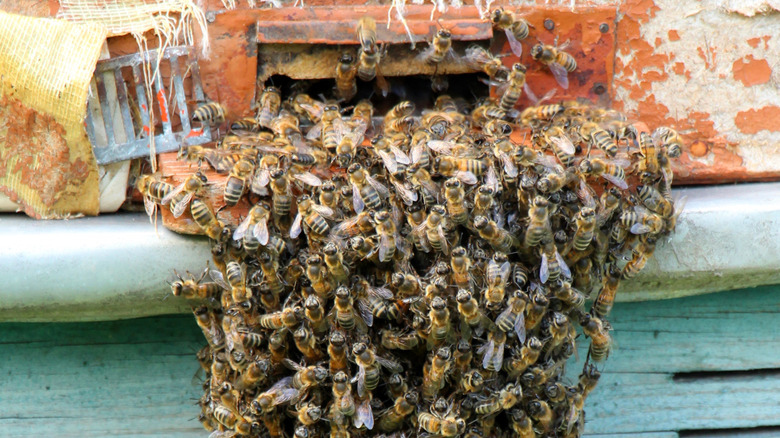
Unless it's exposed during remodeling or by accident, many of us never think about the anatomy of a wall or how it's just a skeletal structure filled with insulation and wrapped with drywall. The truth is, while walls might seem solid, they are built more like a hollow sandwich.
To an insect, once they wiggle past the outer layer, your wall becomes a wonderful, heated, dry space to set up shop. In particular, to a honey bee, the inside cavity is roughly the size and shape of a hollow tree trunk, just like a natural nesting site, and if a scout bee finds an entry hole, you could end up with a bee's nest inside your wall. Although many homeowners plant fruit trees, flowers, and vegetable crops, hoping to bring more bees into the yard and garden, when bees start to see the inside of your walls as a home, that's a different situation and requires removal.
Of course, if you hear buzzing in the walls, you may not be able to tell if the problem is a honey bee or a wasp. For a quick identification, honey bees have fuzzy bodies and are a golden-brown color. They are less aggressive than wasps, which are hairless and have narrow waists. But either way, if this type of pest is nesting in your walls, don't try to get rid of it without a professional.
Why professional treatment is required when honey bees get in your walls
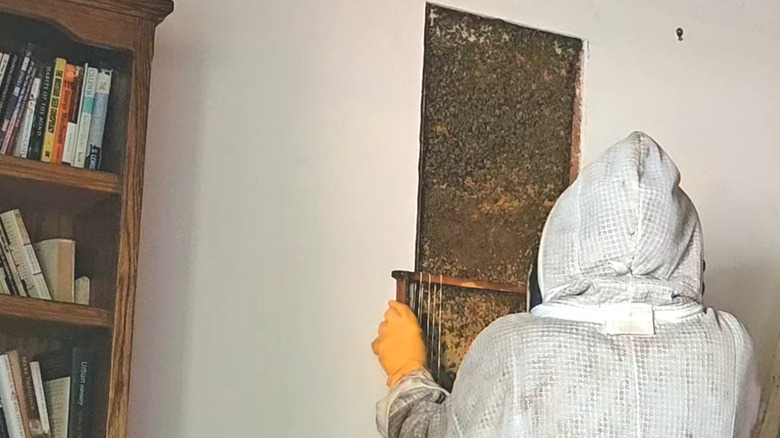
While pest control is a common DIY for many homeowners, tackling a bee's nest on your own can have disastrous consequences, both for you and the bees. An established bee colony isn't just a few bees. A single hive can house anywhere from 20,000 to 80,000 bees. If they've been there for a while, they may have produced a significant amount of honey. In a worst-case scenario, you could end up with honey pouring out of your walls or a living room filled with bees if they chew their way to the inside.
After you call a professional, it's best not to do anything. Don't seal the entry from the outside because the trapped bees will just find another way out, which could be the inside of your house. Professional beekeepers with knowledge and experience about removal methods may be able to rescue the bees and rehome them. Since removal methods vary depending on the location and how long they've been there, beekeepers may use a variety of techniques, including vacuuming or trapping them to remove them with as little disturbance to your house or the colony as possible.
Removal is the right call for most homeowners, but there's another reason you might find a beehive in the walls, especially in older homes: keeping bees in walls is a historical tradition, and some modern indoor beehive installations even have observation ports so you can see the colony.